A decade after Guess Inc. made its first public commitment to sustainability, the topic is filtered across the company’s portfolio of brands, supply chain, products, operations and culture.
The company’s latest FY2024-2025 ESG report dives into how the brand is streamlining its sustainability strategy called Action Guess to sharpen its targets and amplify impact in priority areas.
“We recognized that some of the existing targets were too vague or difficult to interpret, limiting their effectiveness. As a result, we refined them to ensure greater clarity and relevance across the entire business, aligning each goal more clearly with the broader short- and mid-term objectives of the Action Guess strategy,” the company stated.
Related Stories
Materials and fibers are key areas. The company said it strengthened its Eco Materials and Product Guidelines to reflect global best practices and recommendations from organizations such as Textile Exchange and the UNFCCC. By 2030, the company wants 75 percent of its global apparel materials to be environmentally preferred and 90 percent of products to be Guess Eco—the label given to a collection made with less water, fewer chemicals and sustainably sourced fabrics.
In FY2025, 25 percent of the company’s products were made with environmentally preferred materials and over two-thirds of the material used renewable fibers like cotton, Tencel and leather.
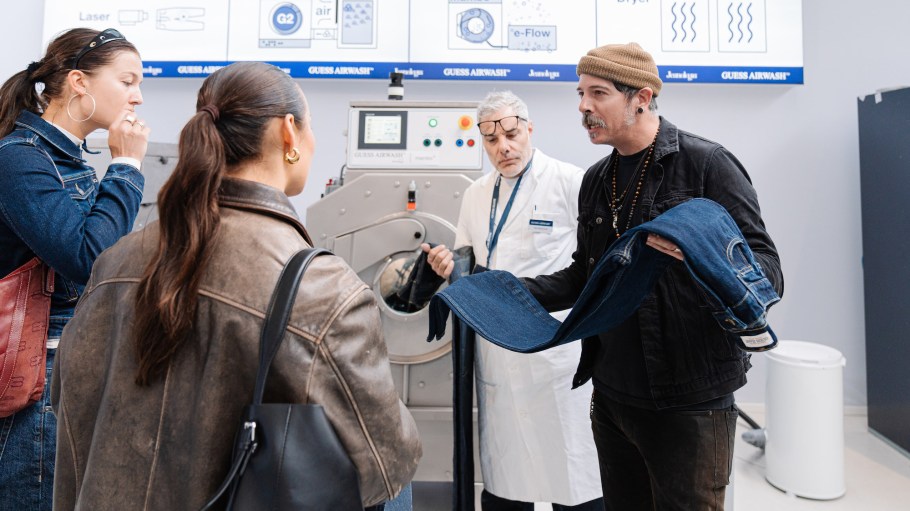
Guess Jeans, which launched during the FY2024-2025 period, is setting the example by building sustainable alternatives into its foundation. The Gen Z-focused brand uses only recycled or organic materials. It is also tackling the denim industry’s water and energy consumption issues with Guess Airwash, a washing method developed with Jeanologia that replaces conventional stone-washing methods with nano-bubbles and ozone.
Reducing Scope 3 GHG emissions across the supply chain remains challenging. Guess reported that the increase in Scope 3 is emissions in FY2025—up 14 percent from 2024 but down 6 percent from the 2019 baseline—is primarily due to higher production volumes relative to 2024. The company’s goal is to reduce Scope 3 GHG emissions by 30 percent (compared to 2019) by 2030.
Guess expanded its supplier training program, which covers compliance issues and education on emerging challenges including Guess Eco product requirements and certifications, GHG emissions reduction strategies and wages and benefits compliance. The company reached about 800 suppliers through six sessions in FY2024-2025.
Third-party partners are critical to Guess’ efforts for circularity. In 2024, Guess launched Guess Again, a program powered by SuperCircle, a tech-driven reverse logistics platform, that allows U.S. customers to recycle pre-owned clothing from any brand. Available online, customers can request a shipping label through the Guess website to send in unwanted garments and earn Guess credits for future purchases.
In house, the company’s color and product compliance team ran a pilot with external testing laboratories to ensure fabric and sample scraps after testing have been directed to recycling partners.
Through textile recycling, reuse partnerships and the customer takeback scheme called Resourced, Guess Inc. said it diverted 26,536 kg of apparel, accessories, footwear, and jewelry from landfills in FY2025.
Data is playing a large role in the company’s ESG outlook.
Guess revisited its material impacts in FY2025 through its Double Materiality Policy, which evaluates the ESG factors of business and the company’s wider impact on society and the environment. The assessment identified 14 material topics spanning climate action, labor rights, responsible sourcing and more to create a roadmap to prioritize key sustainability issues.
Additionally, Guess conducted a quantitative impact study using sales and other data to identify environmental and social hotspots within its product portfolio.
This included a biodiversity and water risk assessment to assess and prioritize areas of highest impact, and identify key hotspots where risks to biodiversity are most significant. The findings will form the foundation for a biodiversity strategy that aligns with the Science Based Targets for Nature (SBTN) framework.
The company said this approach “ensures a data-driven understanding of our value chain impacts, complemented by national and industry-level risk data for our key regions.”