Guess outlines the responsible material sourcing strategy and chemical and wastewater management in its newly released ESG Report for fiscal 2022-2023.
The Los Angeles-based company reports that 28 percent of its apparel mainline products are now made with environmentally preferred materials.
“Each material brings its own considerations, with cotton production requiring high water use; polyester being manufactured with non-renewable petroleum products, and high carbon footprint; and manmade cellulosics carrying risks of deforestation. To increase our ability to innovate in climate positive fashion, it’s imperative we increase our sourcing of environmentally preferred materials,” Guess stated.
Related Stories
Used to make everything from logo tees to jeans, cotton accounts for 57 percent of the company’s global materials in 2023. Guess aims to source 80 percent regenerative, recycled, or organic cotton for all of its apparel brands by 2030. Synthetic fibers like polyester, nylon and spandex account for 30 percent of materials. Plans are in place to replace virgin polyester with a recycled version as it uses less energy and aligns with circular design. Manmade cellulosic fibers like viscose, modal and lyocell account for 10 percent. Guess says it sources these fibers from producers that have pledged to manufacture viscose more sustainably, including Lenzing and Birla.
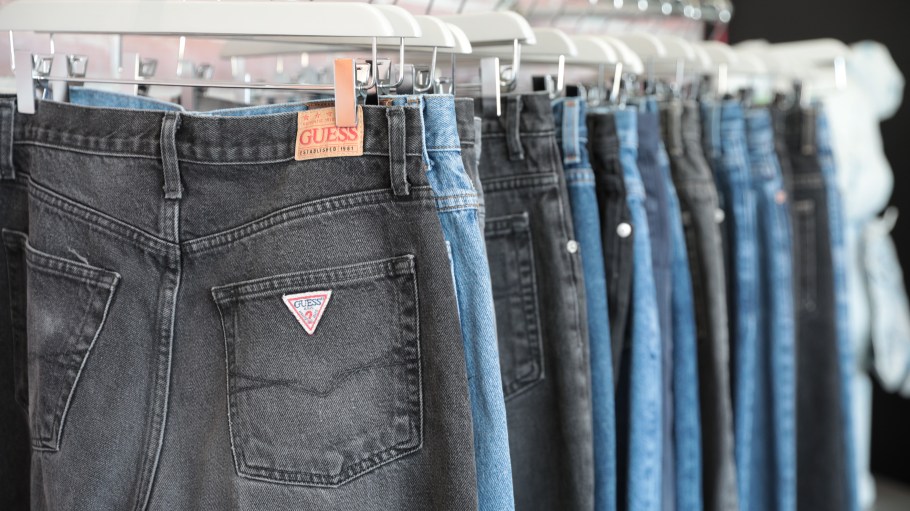
These responsible fibers are core to Guess Eco, a collection of garments made with at least 20 percent environmentally preferred materials and additionally sustainable production methods. For example, Guess uses Indigo Flow dyeing process for its denim, which allows the company to reduce water use and produce minimal waste. Guess is working toward making 75 percent of its denim apparel under Guess Eco standards by 2030.
The Guess Eco product line will add handbags and footwear made with recycled polyester or recycled polyurethane in 2024.
The company provides guidance on limiting the use of certain substances in apparel, accessories, footwear, and jewelry. Suppliers are required to follow Guess Apparel Performance and Guess Accessories Performance Manuals as well as a category-specific List of Restricted Substances and Materials (LRSM), which has been developed in accordance with the strictest standards found in any of the countries where it operates.
Additionally, Guess has started to track the vendors which are compliant with the Zero Discharge of Hazardous Chemicals (ZDHC) program for safer chemical use. The company’s goal is to become a signatory of ZDHC and adopt ZDHC MRSL by 2026 and for its supply chain to be ZDHC approved by 2030.
A priority is to improve water management throughout the life cycle of its denim. This is laid out in Guess’ Denim Water and Chemicals Management Policy which applies to all denim suppliers and their facilities. The policy addresses each phase of the denim life cycle to prioritize water savings and water quality. It also emphasizes the importance of water education with employees, denim suppliers and customers.
Wiser Wash, a provider of pumice stone-free processing, is one of the suppliers that is helping eliminate water. “Wiser Wash is a new technique that gives gorgeous bleaching results without harming human health or the planet,” Guess states in the report. “Thanks to the ozone gas generated from oxygen, Wiser Wash provides abrasions and bright contrasts with reduced pollution. The technology behind Wiser Wash gives revolutionary results using up to 80 percent less water.”
Other suppliers are using e-flow technology to reduce water and chemicals in the finishing phase.
Guess is working toward a circular strategy that builds on its existing success stories. The company’s goal is to develop a strategy and policy supported by a circular design playbook for product designers by 2025. The plan is to apply the playbook to at least one capsule collection per season by 2030. The Ellen MacArthur Foundation’s Jeans Redesign program provides that blueprint for denim. Guess joined the program in 2020 and continues to offer a portion of denim offerings that meet the circular requirements.
The company promotes circularity to consumers through its Resourced takeback program across stores. The program diverted 101,515 kg of apparel, accessories, footwear, and jewelry from landfills in fiscal year 2023. By 2025, Guess aims to introduce or increase repair, resale and upcycling initiatives.
With 1,608 stores across over 100 countries, Guess said its potential impact to reduce fashion’s environmental footprint has weighed heavily on the company’s sourcing and manufacturing strategies since it introduced its first sustainability plan in 2016.
Each annual report expands its coverage, setting an example for others to follow. In 2022, Guess was a finalist at Reuters’ Responsible Business Awards for the Reporting and Transparency Award. The company also named a Supplier Engagement Leader by the CDP. Guess was recognized among the top 8 percent for supplier engagement on climate change, focusing on its role in addressing their environmental impact and driving the transition to a net-zero sustainable economy across the supply chain.
“For well over a decade, Guess has embedded environmental, social and governance priorities into all aspects of our business—and we couldn’t be prouder of the progress we have made as a result,” said Carlos Alberini, Guess CEO and company director. “Looking ahead, we continue to anticipate a more heavily regulated environment for ESG practices, with an increased focus on transparency, integrity and accuracy in reporting ESG data.”