Kids grow fast. Denim doesn’t. That mismatch turns a wardrobe staple into a short-term rental for parents: stiff jeans kids won’t wear, waistbands that don’t fit lanky bodies and knees that blow out—subjecting families to the revolving door of replacements every time a child shoots up an inch.
GILi Guise founder Lauren Falesnik believes she built a workaround, beginning with boys’ jeans.
“The boy area is a hard market to shop in,” Falesnik told SJ Denim, arguing that while boutiques often over-index on girls’ product, boys’ offerings tend to default to basics with less fit or design consideration.
Related Stories
Industry data reflects that imbalance. Girls’ apparel frequently makes up the majority of kids’ clothing SKUs at major retailers, according to Woven Insights, while boys’ assortments skew toward T-shirts and pants with fewer stylistic or fit variations. After infancy, Falesnik said, the friction becomes more visible.
“That’s why GILi Guise starts at 12 months; that’s when you start dressing your kids really cute, because kids are starting to walk,” she said.
The brand launched in August 2024 as a family-run, women-owned label. Its name pulls from the household roster—Greg, Indy, Lauren and Irelyn—GILi. A third child is on the way, she noted, alluding to a future collection tie-in. The aesthetic is clean and Midwest-seasonal, emphasizing neutrals, sweats and denim basics rather than character graphics or rapid trend cycles.
The central objective is denim-specific: to create jeans that children will wear comfortably and that parents will not need to replace frequently.

Falesnik said the idea came together during a weekend “dance rave party” with her kids, as she watched her son opt for sweatpants on repeat. “I was like, gosh, I want him to wear something cute,” she said. She wanted denim soft enough that “he won’t fight me on it,” flexible enough for “run and tumble,” and durable enough to handle wash cycles and re-wear. The real breaking point, she said, was fit—specifically the waistband.
“Boys can be very tall and lanky,” Falesnik said. “When they go through growth spurts, it’s hard to keep up with that waistband to actually have it fit.”
She tried belts. That failed, too—functionally. “He couldn’t get the belts off,” she said, describing potty training and bathroom sprint logistics. And she didn’t want the solution she kept seeing in kids’ denim: obvious elastic backs that create bulk and read as “kids pants,” not jeans.
So, she designed her own solution.
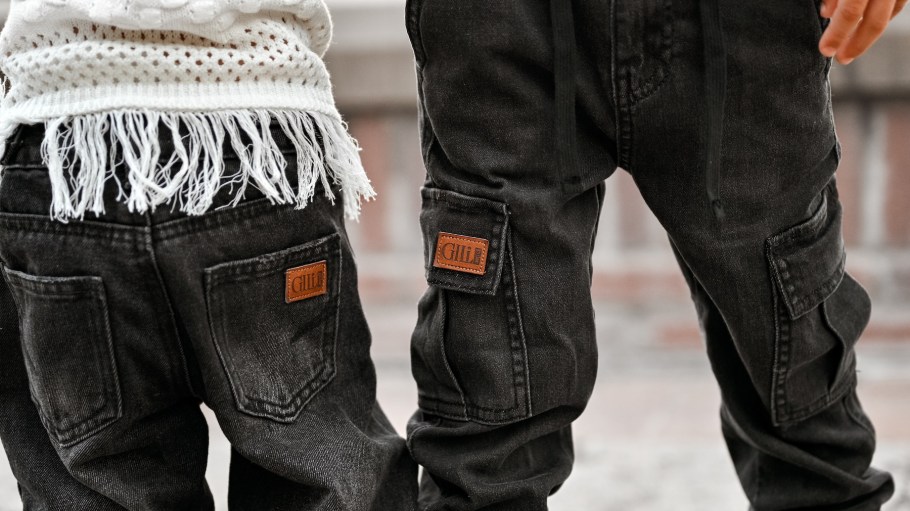
GILi Guise’s hero product, the “Grow With Me” jean, features an adjustable internal waistband with elastic tabs and buttons that can be tightened or loosened incrementally. The jeans arrive cuffed, allowing parents to release length over time. “On the inside, we have elastic built in where you can actually move the button over back and forth to adjust,” she explained. “It uncuffs as they grow as well.” The concept later expanded into “Denim Flex,” which retains the adjustable waistband but does not rely on cuff extension.
Falesnik characterizes the fabric as authentic denim with sufficient stretch to achieve what she calls a “jegging vibe,” while retaining the integrity of traditional denim. “It is truly a denim pant,” she said. “It just happens to be really flexible for the kiddos.”
She said her son wore a pair for “an entire school year” before the first hole and estimated the Grow With Me jeans can stretch “a size, size and a half on average,” depending on the child. Returns, she added, have been minimal since launch. “Since we’ve launched our denim, we’ve had two returns,” she said, noting one was an exchange for sizing and that, to her recollection, the returns occurred on Denim Flex—not Grow With Me.
For now, those durability and returns claims are founder-reported and early-stage. Kidswear doesn’t lend itself to easy benchmarking without third-party testing or real scale, and return rates tend to shift once growth accelerates. A formal wear-and-wash study, Falesnik said, is still on the horizon.
“Something on our to-do list is actually to do a study with kids,” she said, “to ask how often are they wearing these pants, how often are you washing them, what’s their activity level, and just try to gather that data.”
What she does emphasize is pre-treatment. “Everything that we sell… the fabrics have been pre-washed,” she said. “So you don’t have to worry about shrinking.”
Regarding sourcing, Falesnik stated that the product is designed in the United States and manufactured overseas. “We’re in China right now,” she said, noting it took time to find a reliable factory partner. She declined to disclose the manufacturer’s name but emphasized the importance of certifications and testing. “Everything’s CPC certified,” she said, referencing the Children’s Product Certificate required for certain children’s products under U.S. regulations.
Despite ongoing cost volatility affecting emerging brands, Falesnik stated that GILi Guise has chosen not to increase prices, even as input costs rise.
“We didn’t feel like a parent had to take that burden. So we just kind of ate that cost,” she said. She positioned the brand for a “middle of the road family” willing to pay for durability—less “cheap jeans that rip after one wear,” more investment basics with a longer runway.
Absorbing higher costs can build early trust, particularly among price-sensitive families, but it narrows margin flexibility if future expenses spike. For now, price stability is part of the brand’s pitch.
Distribution mirrors that measured approach. GILi Guise sells direct via Shopify and offers a 30-day return window, according to its FAQ. Falesnik also described a Shopify-enabled drop-ship arrangement in which retailers can list GILi Guise products on their own sites while the brand fulfills orders, taking a smaller cut in exchange for trade margin and exposure. “It’s more exposure to get people connected with your brand,” she said. “I’ll give a small percentage if they want to market and help sell our stuff.”
The company works with a small network of boutiques—Falesnik cited seven—and uses the wholesale marketplace Faire as a discovery channel.
The San Francisco-based platform connects independent brands with retailers and counts apparel as its largest category. Fashion demand on Faire surged during the pandemic as trade shows paused and buying moved online. In 2022, the company reached a $12.59 billion valuation following a Series G extension round, and in 2023, it partnered with Shopify as a recommended wholesale marketplace provider.
On Faire, GILi Guise is tagged as women- and Latino-owned and explicitly marked as not selling on Amazon—a distinction Falesnik is quick to stand behind. “We don’t ever want to be on Amazon,” she said. “I want to keep our brand a little bit more exclusive.”
The tags are self-selected—Faire notes brands are responsible for complying with applicable laws tied to those claims—but the positioning accentuates her broader point: control matters.
Beyond wholesale, the brand recently joined Manymoons, a resale platform focused on children’s apparel. Falesnik frames it less as a sustainability halo and more as operational common sense. “It’s more like overstock,” she said. “When you’re ready to move on from certain collections, you can send it to them, and they house everything and market and sell it for you.”
Falesnik is clear about what she won’t pursue. She said she has no interest in Amazon and remains wary of large-scale retail expansion. “I would never go into a big-box retailer that just throws it in and hopes it sticks,” she said.
For now, the proposition is simple: a founder without formal design training identified a fit-and-function failure in kids’ denim, engineered around it and is attempting to scale without abandoning her pricing or distribution philosophy.
Whether adjustable waist construction meaningfully reduces waste in kidswear—and whether durability and return claims hold as sales expand—will depend on data the brand has yet to publish.
But the premise is simple enough. Parents don’t need more kids’ jeans. They need fewer jeans that work.