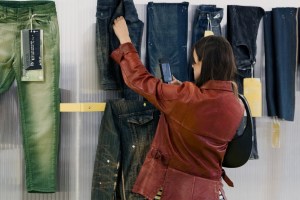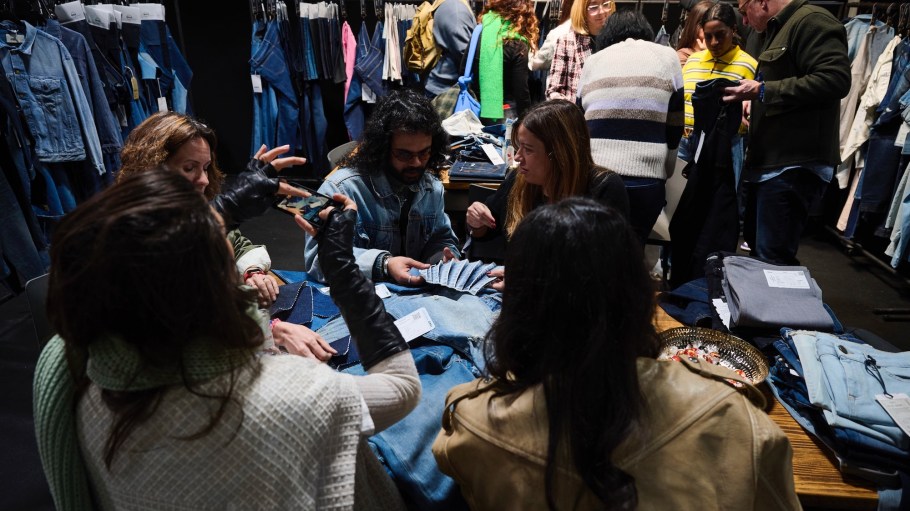
Bluezone wrapped up last week, offering designers and brands a final chance to view denim mills’ Spring/Summer 2026 collections.
The consolidated format brought Bluezone and Keyhouse—the show’s central hub for innovation and startups—together under one lively roof, underscoring a key message echoed throughout the event: selling fabrics alone is no longer enough.
Instead, the 70 denim mill exhibitors and 30 technology exhibitors, including dye innovators like Synovance and Sonovia, showcased solutions designed to make denim production more efficient, sustainable, and aligned with the demands of today’s market.
Related Stories
“Denim is not a simple fabric nowadays. It’s not enough to make a fabric to be successful,” said Mirela Slowik, Isko category leader.
Isko is adding value to textile is through MultiTouch, a yarn and finishing technology that allows brands to achieve several unique effects including 3D, permanent creases and silicone-free embossing with a single fabric. A chemical-free heat process gives the fabric permanent structure. Rigid styles are available now but stretch and shirting weights are coming next season.

The Turkish “solution provider” also bowed Isko Iconic, a range of fabrics with colorless coating that enhances surfaces with oily, waxy, resin looks, and Isko Comfort2, a comfort stretch concept with low shrinkage, meaning the consumer doesn’t have to wash the jeans to get the stretch back. While many stretch fabrics can look flat, these have a textured appearance for more commercial appeal.
In general, companies are finding ways to simplify denim manufacturing.
Denimai Textiles showcased rigid and stretch fabrics that are not necessary to wash and will not shrink after home laundries. The Turkish garment manufacturer, which designs and develops fabrics with its clients, is seeing interest in 100 percent organic cotton products, especially articles with a soft touch.
Denimai added a new layer to the animal print denim trend by introducing a special application that gives the fabric an extra-soft, fur-like hand feel. Other concepts call for laser finishing to be applied to fabrics versus final garments.
Kipaş Denim presented Contra Denim, a solution to make black jeans more compatible with laundries and laser finishing. The fabric was developed with chemical company Archroma. Contra Denim utilizes Archroma’s Denim Halo approach to denim production, which incorporates Dirsol RD, a resource-saving pretreatment, and dyeing processes to produce fabrics that are easy to wash and laser.
The Turkish mill is also applying the technology to indigo denim and achieving the sale positive results.
Kipaş is leaning into the post-pandemic trend for comfy and functional fashion with Soft Smart, a line of specially woven fabrics with all day comfort. Lyocell, viscose and modal elevate the fabrics and give them a premium look.
Softness was a common theme across collections.
Turkish mill Realteks showed a sustainable finish that enhances the softness and lightweight feel of fabrics. The result is 100 percent cotton fabrics that have the touch of a Tencel blend. The mill is also seeing interest in Refined Raw, a collection of fabrics that do not require any washes.
Lahore, Pakistan-based Naveena Denim Limited (NDL) showed several variations of Aero Soft. The featherlight 9.5 oz.-10.7 oz. fabrics have volume but their hallow yarns add lightness and a soft hand feel without compromising strength.
Other novelties from NDL include gray, blue and khaki fabrics with a mélange look, mimicking the appearance of linen without the linen price, and a range of fabrics with subtle herringbones.
Isko is looking ahead by pitching a new line of soft and cozy corduroy. Available in rigid and stretch constructions, the fabrics are a continuation of the mill’s effort to branch out beyond non-denim wovens.
Though the show’s mostly German audience tends to gravitate to stretch denim, mills tempted with fresh concepts.
Sharabati presented Dream of Nile, a line of denim made with certified Egyptian cotton—a premium long staple fiber that Dr. Dilek Erik, Sharabati Denim’s global marketing manager, noted is known for being soft and flexible. Additionally, the mill showed Loomers, a range of selvedge denim, and a brand-new Gabardine collection spanning everyday fabrics to luxury fabrics.
Prints and colors are a focal point for the Turkish mill as well. Sharbati works with an Italian design company to develop exclusive designs that can be applied to both the denim and gabardine ranges. Over 300 prints can be found in the mill’s library, which is accessible through its new app.
Fabrics made with linen are proving to be popular for Orta. The noble fiber adds a unique shine and color to fabrics, including one made with French linen that uses no chemicals or water, resulting in fabrics with a brown tint. A PFD version also shows off the fiber’s natural color.
Chambray dyed with indigo foam is another elevated option from the Turkish mill, which split its seasonal collection into three travel-inspired stories. In St. Tropez, Orta leans into ocean-like indigo shades, sandy colored denim and single and double stripes. The use of Lycra’s Coolmax adds a touch of shine to refreshing fabrics.
In Kyoto, a touch of Tencel adds comfort and lightness to 13-plus oz. fabrics with green casts. In New York City, Orta offers versatile fabrics that can go day to night, including cotton fabrics with natural stretch, flowing fabrics made with Tencel and denim made with bio-based Lycra. Orta is the first mill in Turkey to offer fabric with the sustainable alternative.
Local production
“Made in the EU” was a hot topic at the show as many European brands look for ways to reduce their carbon footprint.
Italy’s Candiani Denim and Berto and Spain’s Tejidos Royo highlighted how they’re some of the last mills in Europe to produce denim.
“I think that makes us something very different,” said Simon Giuliani, Candiani’s marketing director, about the mill’s 85 years of experience. “We’re fully vertical mill, which means that it allows us to improve the process and to innovate and take every step of the process.”
Giuliani emphasized that Candiani operates differently from most mills, as it doesn’t wait for demand to drive production. Instead, the company anticipates the market’s needs, staying ahead of trends and continuously pushing boundaries.
Candiani has been a pioneer in the industry, hosting the first open mill day in 2018 to offer a transparent look into its operations—well before transparency became a standard expectation. In 2020, the mill introduced Coreva, a plant-based, biodegradable stretch denim, and the following year became the first to earn certification for the Regenagri Chain of Custody standard.
“We always have to anticipate the market… this requires a lot of experience and know how to operate and produce,” Giuliani said.
For Berto Industria Tessile, adapting to the market’s shifting demands has been key to its survival over its 138-year history. Despite a retracted market, the family-owned mill in Bovolenta, Italy, remains focused on its core strengths: premium fabrics and indigo dyeing.
“We are not big as we were 10 years ago, and this was difficult. A lot of people in the surrounding area worked for Berto, so it was difficult to scale down our dimension, but we had to follow the market,” said Francesca Polato, Berto’s marketing and communications manager. “Now we are a small company, but we produce really high-quality fabrics.”
Berto has introduced several innovative fabrics, such as soft-touch and shiny denims made with silk, as well as Lenzing’s Modal and EcoVero viscose. The mill is also expanding its circular fabric collection, offering ring-spun fabrics made with 60 percent recycled cotton and 40 percent organic cotton and the reverse. “The result is clean, perfect fabrics, just like the standard ones,” Polato said.
Being a smaller company gives Berto the flexibility to quickly meet clients’ requests, while ensuring top-notch quality control throughout the production process. Polato shared that the mill is also preparing to release its first sustainability report to further showcase its commitment to sustainability. “If you don’t measure and control your sustainability efforts, you can’t be sure you’re doing it right,” she said.
Tejidos Royo sees opportunities with fabrics made with Spanish cotton as companies look for ways to minimize their carbon footprint, cut costs and create engaging stories for the end consumer. The mill is also seeing a strong interest in linen denim. Among the mill’s seasonal highlights is a cotton, Lycra and 22 percent linen blend, which a rep said is garnering a lot of attention from clients despite it being costly.
Denim accounts for approximately 40 percent of Royo’s business. The remaining comes from garment dyed, which the mill is enhancing with special coatings to make softer, more durable and retain color longer. A rep said the reality is consumers are buying less nowadays so it pays to make garments that can last. These fabrics, he added, are also popular with uniform brands.
Royotec, the mill’s technical division, flexed its strength with FR denim for workers, protective clothing for motorcyclists and denim for technical sport enthusiasts. The five-year-old business segment also uses Dry Indigo and Dry Colors technologies, which use 97 percent less water in dyeing and 69 percent less energy compared to traditional dyeing methods.