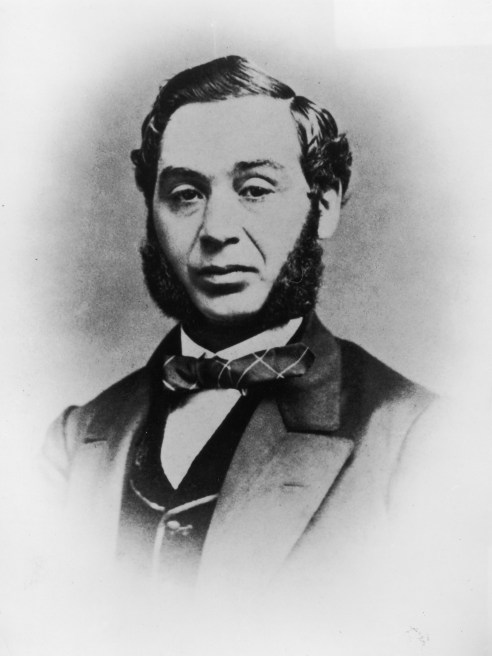
The founder of one of the most quintessentially American brands was, in fact, an immigrant from Franconia, a region in southern Germany.
For denim enthusiasts, the story of Levi Strauss often begins in 1872, when he received a letter from Jacob Davis, a Nevada tailor, describing his innovative method for reinforcing pants with rivets. Their collaboration led to a joint patent with Levi Strauss & Co. for what would become the world’s first blue jean.
But the Levi Strauss Museum, located in the denim pioneer’s birthplace of Buttenheim, Germany, reveals a lesser-known chapter—the years before Strauss founded his wholesale dry goods business in San Francisco.
Related Stories
Here, Dr. Tanja Roppelt, the director of the Levi Strauss Museum Buttenheim, shares with SJ Denim what is known about the Strauss family and their roots in Germany.

Did you know?
Levi Strauss was born on February 26, 1829 as the youngest of seven children of a Jewish peddler in Buttenheim, Franconia. At that time, Buttenheim had approximately 800 inhabitants and a large Jewish community. One in five Buttenheim residents was Jewish.
To this day, Levi’s ancestors are buried in the Jewish cemetery in Buttenheim. Today, Buttenheim has a population of around 2,300 and commemorates its most famous son with the award-winning Geburtshaus Levi Strauss Museum.
Did you know?
Levi Strauss was born as Löb Strauss. His older siblings were named Jakob, Rösla, Jonathan, Lippmann, Maila and Vögela. Probably due to restrictive laws against Jews (for example, Jews were not allowed to belong to guilds, could only in rare cases acquire land, and were not free to choose their place of residence) and the family’s poor economic situation, the older Strauss children decided to emigrate.
Jakob moved to London around 1833 and later joined the family in New York, Rösla travelled to New York in 1837, followed by Jonathan in 1840 and Lippmann in 1841. The rest of the family followed in the summer of 1848 after the death of the father Hirsch Strauss, who had died of lung disease in 1846.
They first settled in a part of Manhattan which was called “Little Germany” in today’s Lower East Side. The brothers had founded a business for dry goods there. Levi learned the merchant’s trade from his brothers.
Did you know?
The emigration was published in the official gazette so that potential creditors could still collect their money before the people set off for the New World. The emigration plans of the Strauss family, Levi’s mother with her three children Löb, Vögela and Mathilde, were published in the “Royal Bavarian Intelligence Gazette” in 1847.
Did you know?
To be allowed to emigrate, numerous applications had to be submitted and the intention to emigrate had to be justified.
The historical documents contain an interesting detail: Mother Rebekka cites as her motivation for emigrating that, due to the death of her husband, there was no one left here in Germany to provide for her livelihood. The older children had emigrated and were living in America, and her youngest son Löb had not learned the trade of a merchant and had no desire to do so. Apparently, he changed his mind in America, as he became one of the most famous businessmen in San Francisco.
Did you know?
After arriving in New York, the family Americanized their names in the early years. This was mostly likely because German “umlauts” are difficult to pronounce in English. Therefore, Jonathan became Jonas, Lippmann became Louis, Maila became Mary, and Vögela became Fanny. Löb Strauss, as is well known, called himself Levi Strauss.
In 1853, Levi finally became an official American citizen, but first he had to renounce his allegiance to the Bavarian king which probably wasn’t difficult for him anymore.