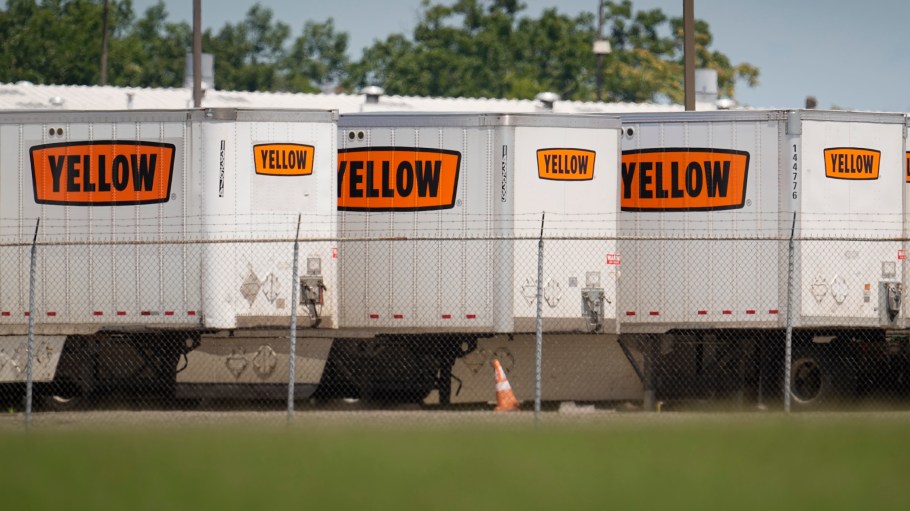
Yellow Corp. failed to provide sufficiently detailed notices to terminated employees when the trucking firm ceased operations in July 2023, a bankruptcy judge said in a memorandum opinion Thursday. But the company could still see reduced damages in a class-action lawsuit that has former workers seeking as much as $244 million in claims.
A lawsuit filed in the wake of the Yellow bankruptcy last August on behalf of more than 25,000 employees had argued that the company failed to provide 60-day layoff notices to employees as required by the federal Worker Adjustment and Retraining Notification (WARN) Act.
Related Stories
A three-day trial surrounding these matters is scheduled to take place starting Jan. 21, 2025.
The less-than-truckload (LTL) carrier has defended its decisions, saying it was unable to provide earlier notice of the company’s shutdown under various exceptions set forth in the WARN Act, such as that it was a “faltering company” and enduring “unforeseeable business circumstances.” Under those exceptions, a 60-day notice period may be shortened.
Under the faltering company defense, Yellow said that it had been in discussions with various parties seeking to refinance existing debt as it became apparent in May 2023 that the company was rapidly running out of cash. The trucking firm believed that sending a WARN notice would “tank those efforts,” the judgment said.
And the “unforeseeable business circumstances” came when Yellow’s cash crunch forced the company to miss a $50 million payment to its pension funds that July—which prompted the Teamsters and its 22,000 Yellow drivers to threaten a strike within 72 hours.
This ultimately led to more customers abandoning Yellow for other carriers in the weeks ahead of the company’s Aug. 6 bankruptcy.
Judge Craig Goldblatt agreed that both of these exceptions were applicable to Yellow’s defense at the time, but that the form of notices given to both union and non-union employees “did not contain enough facts adequately to justify the reduced notice.”
“The notices that the debtors sent were inadequate,” Judge Goldblatt said. “The debtors emphasize that much of the information that should have been included in the notices was communicated separately to the employees and indeed was so widely publicized that it was well known to everyone and anyone. While there is some truth to that…it does not fully excuse the failure to send a compliant notice as the statute requires.”
Yellow also contended that it was a “liquidating fiduciary” and no longer a “business enterprise” by the time it provided its notices. This means that when a company stops conducting business and is merely in the act of liquidating its assets, that it is no longer an employer covered by the WARN Act.
However, Yellow did not become a liquidating fiduciary until after they completed delivery of their last shipment, which was July 30, 2023—the day the company ceased operations.
“That means that the debtors were an employer, not a liquidating fiduciary, when they laid off 3,500 non-union employees on July 28, 2023,” said Goldblatt.
Whether the 22,000 union employees will be impacted by the liquidating fiduciary distinction will be determined at January’s trial. According to the judge, the record does not reveal whether Yellow’s last shipment on July 30 was delivered before or after the union layoffs.
The January trial could also reduce some of the class-action claims against Yellow on the grounds that the liquidating trucking company acted in good faith throughout the issuing of the WARN Act notices.
“The Court is sympathetic to the argument that this ‘good faith’ basis for reducing the statutory damages should apply,” said Goldblatt in the 67-page opinion. “The violations arise out of the fact that the notices the debtors provided were worded improperly. And much of the information that those notices should have contained had been separately communicated by Yellow to its employees and was widely publicized at the time. For those reasons, this seems like an awfully strong case for reducing the damages on the ground that the violation was a purely technical one and that the company had in fact acted in good faith.”
Yellow’s estate is still dealing with the fallout from last year’s bankruptcy and ongoing liquidation process. In December, the company agreed to sell off 12 terminals to former LTL competitors Estes Express Lines and R+L Carriers for a combined $192.5 million.
On top of that, Yellow is still duking it out with 11 of its pension funds over the settlement of roughly $6.5 billion in claims. According to Dec. 12 court filings, a settlement is now unlikely before February at the earliest.
Yellow had been previously found liable for these claims, but has long disputed it owes any money. Goldblatt most recently ruled in favor of the pension funds in November, with arguments related to the funds’ claims set to take place at a Jan. 28 hearing at the Delaware bankruptcy court.