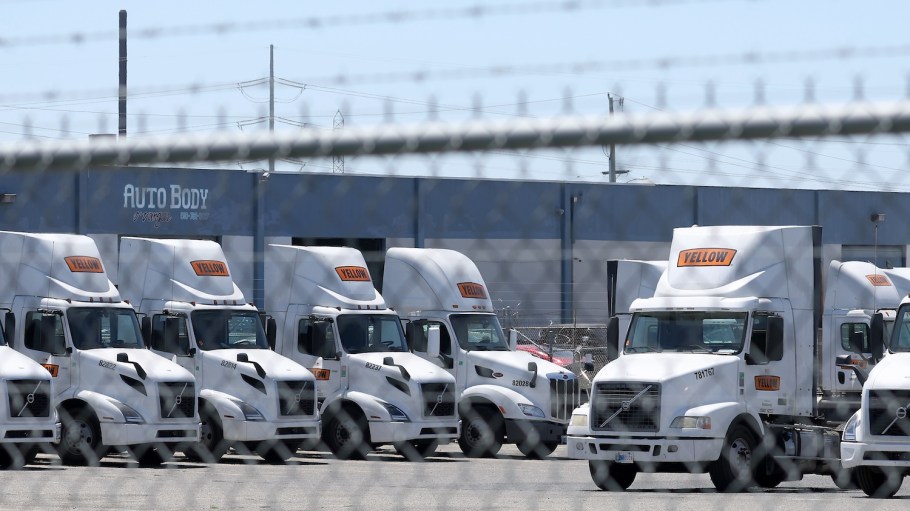
In a big win for former Yellow Corp. workers currently engaged in a class-action lawsuit against the insolvent trucking firm, a Delaware bankruptcy judge said he would recognize the claims tied to the terminations brought by both union and non-union workers alike.
Last August, Yellow dockworker Armando Rivera initially filed suit against Yellow, accusing the company of violating federal law, as well as California and New Jersey state laws, by failing to provide Worker Adjustment and Retraining Notification (WARN) Act notices to employees prior to their mass layoffs.
Related Stories
Yellow’s estate requested the bankruptcy court to throw out the case in March.
In total, 30,000 staff members were left out of a job when Yellow filed for bankruptcy and ceased operations last summer, with 22,000 of them belonging to the Teamsters. But those employees did not receive a 60-day notice as would be required by federal law (or 90-day notice for N.J.-based employees).
During a Thursday hearing, Judge Craig Goldblatt said he would certify claims from 3,200 non-union employees as a class, allowing them to pursue legal action alongside separate claims made on behalf of the Teamsters. Total WARN Act claims against Yellow Corp. have totaled up to $244 million.
The WARN Act typically makes exceptions to its notice period when employers can show that layoffs or worksite closures happen because a company falters or faces unforeseen business circumstances or natural disasters.
Yellow tried to do just that, maintaining in court that its July 30 shutdown was abrupt and that the regulation doesn’t apply, asserting that the former workers’ demands were invalid.
In past filings, Yellow claimed various exemptions due to “unforeseeable business circumstances” as it was “a faltering company.” The less-than-truckload (LTL) carrier company also labeled itself “a liquidating fiduciary,” on the contention that it wasn’t an employer at the time of the layoffs and therefore was not required to provide advance notice.
“Yellow went from picking up over 40,000 shipments daily on July 17 to under 10,000 on July 21, to nearly zero on July 26,” Yellow’s estate said in the March court filing. “Yellow was shocked at the rapidity of its knife-edge transition from an operating business to an entity existing only to liquidate its assets for the benefit of its stakeholders. The company had no time to plan, much less provide WARN notice for, what became mass layoffs on July 28 and July 30, 2023.”
Although Judge Goldblatt recognized the plaintiffs’ class-action claims, this suit is likely to have a long way to go for a settlement takes place.
Goldblatt proposed a timeline that allows for fact discovery through mid-August, with summary judgment motions likely being filed in October. If needed, a trial could occur in December at the earliest. Counsel from all parties involved are expected to agree on a final schedule in the coming days.
Yellow is still locked in a legal battle with its pension fund, Central States Pension Fund (CSPF), over nearly $6 billion, including $4.8 billion in withdrawal liability claims. Goldblatt said in the Thursday hearing that he would rule in favor of Yellow’s discovery motion to request access to internal communications between CSPF and pension insurer Pension Benefit Guaranty Corp. (PBGC).
A hearing for the pension withdrawal claims is scheduled for August.
As the ongoing cases linger, less-than-truckload (LTL) freight and logistics company XPO is beginning to open the facilities it acquired from Yellow in the estate’s auction in December.
Upon acquiring 28 terminals for a combined $870 million, XPO has opened three of those service centers in Goodlettsville, Tenn.; Grand Junction, Colo.; and Nogales, Ariz.
With these three new locations, XPO’s North American network now includes 297 service centers, according to the company.
“Each service center is in a prime position to enhance our nationwide capacity, service excellence and operating efficiency,” said Mario Harik, CEO of XPO in a statement. “With a deeper presence in strategic markets, we are introducing new premium services and expanding our existing offerings, such as our cross-border service with Mexico.”
The new sites are located near major population centers including Nashville and Denver, as well as near the U.S.-Mexico border, where XPO can leverage coast-to-coast linehaul capabilities on interstate highways to reduce shipping times.
Another LTL provider, Saia, recently opened two new terminals, with one in Missoula, Mont. being one of the properties it acquired from Yellow during the auction process. Throughout December, Saia scooped up a total of 28 terminals for a combined $244 million.