Walmart‘s strong fourth quarter may have overshadowed rapid advances generated within the retail giant’s fulfillment and delivery network.
America’s largest retailer lowered last-mile store-to-home delivery costs by about 20 percent over the past year, according to chief financial officer John David Rainey. This marks an increase over the 15 percent cost cut that Walmart touted merely three months ago. Along with the optimized fulfillment costs, Walmart is now offering same-day delivery from roughly 90 percent of its more than 4,600 U.S. stores.
Related Stories
In cutting fulfillment costs and “densifying the last mile,” Walmart has substantially improved in e-commerce profitability within Walmart’s U.S. segment. The company lowered e-commerce losses by more than 40 percent versus last year, Rainey said in the fourth quarter earnings call on Tuesday.
Additionally, store-fulfilled delivery sales were up nearly 50 percent.
“The unit economics of delivering a package to a customer or a member have simply improved, and we expect to see continued improvements there,” said Rainey, who echoed similar sentiments shared by Amazon CEO Andy Jassy on Feb. 1. At the time, Jassy said the cost to get a product from Amazon to a customer was down 45 cents per unit compared to the prior year.
Walmart CEO Doug McMillon said customers are noticing the changes. In the call, he pointed out that during the quarter, the U.S. team delivered a “three-year high” in customer net promoter scores across pickup and delivery from stores, as well as for orders that are shipped directly from the e-commerce fulfillment centers.
On the whole, e-commerce sales in the U.S. increased 17 percent, compared to total sales of 3.4 percent across all channels in the market.
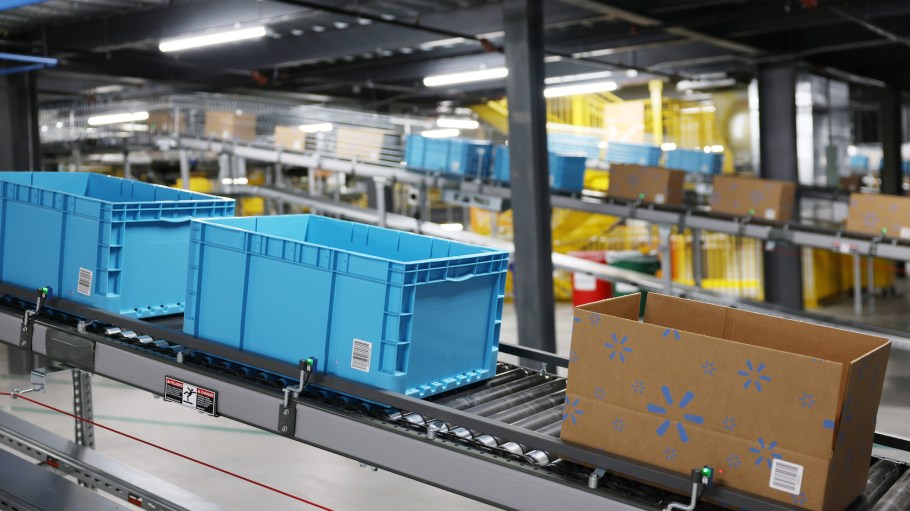
The retailer attributes much of its more efficient fulfillment operation to its phased deployment of automated technologies across warehouses, with Rainey pointing out that the activity will step up in the current and next fiscal years.
“To date we’ve retrofitted 13 regional distribution centers (RDCs) with varying levels of automated storage and retrieval systems,” Rainey said. “This technology gets product to shelves faster and has meaningful benefits to productivity both in our DCs and stores.”
This retrofitting process has stepped up in recent months, with Rainey saying in November that nine RDCs had some level of automation. The project is a long-term play to update all 42 RDCs in Walmart’s U.S. supply chain network.
These warehouses leverage combination of people, robotics and storage systems to increase the speed at which the retailer sends merchandise to stores, ensuring products get onto shelves faster.
“With the progress we’ve made over the past year, we’re on track toward our goal of having approximately 55 percent of our fulfillment center volume and roughly 65 percent of supercenters serviced by automation by the end of FY 2026,” the CFO said.
Roughly 1,500 stores are receiving palletized freight from these DCs, according to Rainey.
“We expect to begin seeing the enterprise financial benefits of upstream automation and cost to fulfill, inventory efficiency, store productivity and wage leverage as we move through FY 2025 with a more pronounced benefit in the second half,” said Rainey.
E-commerce profitability in reach?
The success of the automation efforts is even inducing chatter from Walmart that its e-commerce operation will be profitable.
‘In terms of where we or when we can get to profitability, we have line of sight to e-commerce being breakeven when we include all the various components of this, advertising, fulfillment services, all that together,” Rainey said. “But to be clear, we’re focused on getting to e-commerce profitability even without the subsidization of those additional items. That’s a little further down the road. We have a lot of work to do to get to that point, but we’re really pleased with the progress that we’ve made and the plan that we have going forward.”
McMillon said the automation initiatives were most aggressive so far in the U.S., and he expects the plan to deliver a higher level of inventory accuracy and improved flow over the next few years. In turn, the expects the new deployments to improve markdowns and associate productivity.
Walmart’s fulfillment buildout is gaining favor among third parties as well. The retail giant’s marketplace sellers are getting good use out of Walmart’s proprietary logistics services.
In the U.S., approximately 30 percent of Walmart’s Marketplace sellers use Walmart Fulfillment Services (WFS). Walmart U.S. Marketplace revenue grew 45 percent in the quarter, with more than 35 percent of orders fulfilled by WFS.