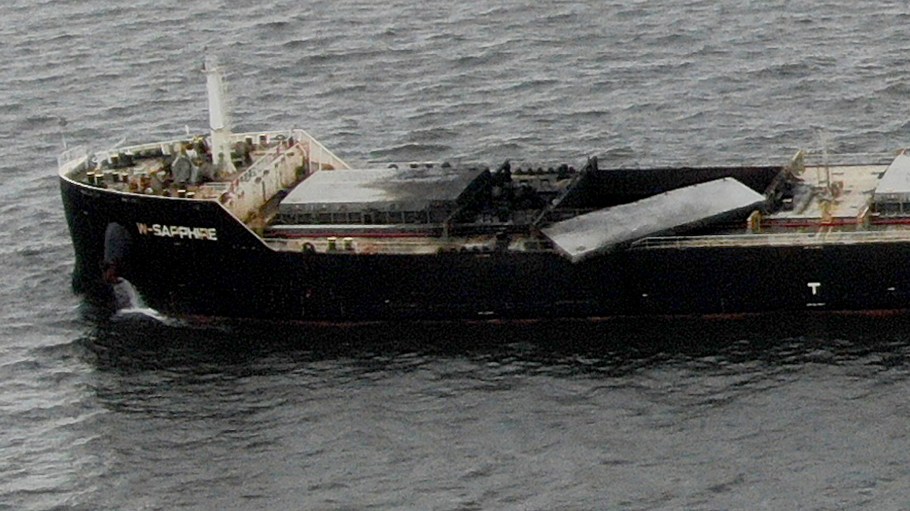
An explosion aboard the bulk carrier W Sapphire Monday evening forced the closure of the Fort McHenry Federal Channel for nearly a full day, preventing ships from traversing in and out of the Port of Baltimore and creating a backlog of vessels before reopening Tuesday afternoon.
No injuries were reported and the cause of the explosion is under investigation, according to the U.S. Coast Guard, which led the response.
According to the Coast Guard, the 751-foot Liberia-flagged vessel was sailing outbound from Baltimore Harbor with 23 crew members and two pilots aboard when the explosion occurred around 6:30 p.m. Eastern Time near Fort Carroll in the Patapsco River. The W Sapphire loaded coal at CSX’s Curtis Bay terminal and was bound for Mauritius.
Related Stories
Ahead of the reopening, which occurred around 3 p.m., AIS signals showed at least 10 large vessels waiting at anchorage south of the harbor in the northern area of the Chesapeake Bay near Annapolis, Md. That group included container ships from Mediterranean Shipping Company (MSC) and CMA CGM, as well as bulkers and two vehicle carriers that are currently unable to proceed into Baltimore. Ships are also anchored at the Dundalk and Sparrows Point terminals in Baltimore.
The Port of Baltimore confirmed the reopening of the channel in a social media post.
“We appreciate the great work of the Coast Guard, tugs, pilots and other port partners to reopen the channel as quickly as possible,” said the Port of Baltimore in a statement. “We also thank our customers for their patience and understanding through this incident.”
Reports state the fire from the explosion has been extinguished and plans for the vessel are being prepared. The W Sapphire remains anchored in the channel.
Prior to the incident, the bulk tanker already was displaying some concerning signs. In February 2025, the vessel was cited for issues with fire safety by the Australians during a Port State inspection, and in May, it received 11 deficiencies during an expanded inspection in Spain.
In the minutes after the explosion, the Coast Guard Sector Maryland-National Capital Region watchstanders received a call from the W Sapphire notifying them of the incident, indicating that it was a coal explosion.
Additionally, boat crews in Coast Guard stations in Annapolis, and Baltimore neighborhood Curtis Bay were involved in the response. The Baltimore Fire Department and Maryland’s Department of Natural Resources Police were also dispatched to the area to assist.
The Coast Guard established a 2,000-yard safety zone around the incident location, spanning from the Francis Scott Key Bridge to the Brewerton Angle Channel.
Crews are awaiting verification to confirm safe conditions before proceeding with further Coast Guard investigations onboard the vessel.
During the explosion, a hatch detached and entered the water. Recovery plans to locate and retrieve the hatch are under development, but its exact location and potential impact on the navigable channel remain unknown.
The U.S. Army Corps of Engineers deployed the vessel Buck, a sonar-equipped survey ship, to the incident site at approximately 7:30 a.m. Tuesday. The Buck is collecting data to identify any obstructions to the safe navigation of traffic entering or exiting the Port of Baltimore via the Fort McHenry Federal Channel.
This data will also help determine the operational plan needed to fully reopen the federal channel, the Coast Guard says.
The explosion is the second incident over the past 18 months that shut down traffic entering and exiting the Port of Baltimore.
Last March, the Francis Scott Key Bridge collapsed into the Patapsco River when a container ship lost power and crashed into one of its support pillars. Six construction workers were killed in the accident, and the McHenry Channel was closed for two months to allow for cleanup of the debris.
The Port of Baltimore shuttered for the stretch, with container shipping giants like MSC, Maersk and Hapag-Lloyd not returning until June once cleanup was completed.
In the time since, that incident has resulted in multiple lawsuits from groups including the Justice Department against the two Singaporean companies who own and operate the MV Dali vessel.
Earlier this month, the Singaporean shipowners were the ones taking legal action, with both companies suing the ship’s manufacturer.