U.S. Customs and Border Protection (CBP) now wants operators of Chinese vessels to pay up ahead of time once new port docking fees go into effect later this month.
The agency said carriers are “strongly encouraged” to pay the U.S. Trade Representative (USTR)-levied fees prior to vessel arrival, stopping short of officially enforcing the early payment. But container shipping companies could still be risking other penalties at CBP’s discretion.
As of Oct. 14, China-built, owned and operated vessels that arrive at U.S. ports without proof of payment will be subject to refusal of loading and unloading services, the CBP says. Additionally, their clearance could be withheld until the proof can be verified.
Related Stories
The CBP recommends vessel operators to pay three days before the ship arrives at a U.S. port.
The agency clarified in the update, “the burden for determining if a vessel owes the fee is on the operator, NOT CBP.”
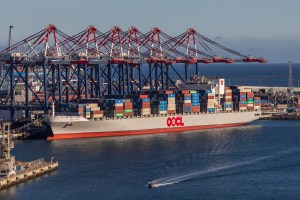
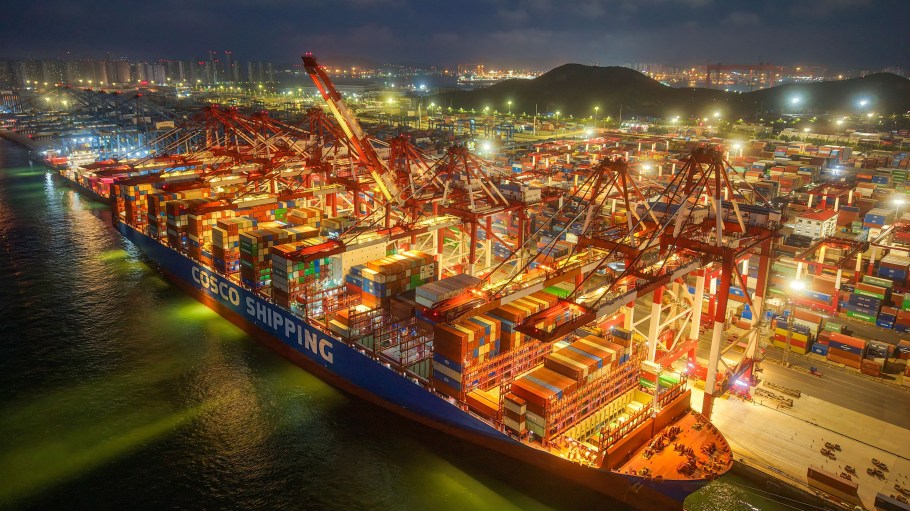
Carriers like Cosco Shipping and Orient Overseas Container Line (OOCL) are the most directly impacted by the policy changes. The USTR office will levy punitive fees of $50 per net ton for vessels owned or operated by a Chinese entity. An additional $30 per net ton will be tacked on each year, starting April 2026, and that will go through 2028.
Most major container lines will incur lighter fees if their Chinese-built ships call at a U.S. port. Those carriers will have to pay the higher of a fee of $18 per net ton, or $120 for each container discharged. That fee will escalate incrementally by $5 per net ton per year until April 2028.
Owners of vessels classified as either a vehicle carrier or roll-on/roll-off vessel will have to pay a fee of $14 per net ton.
Following in the footsteps of rivals like Maersk, Mediterranean Shipping Company (MSC) and CMA CGM, Ocean Network Express (ONE) said Wednesday that it would not pass along port fees to customers in the form of new surcharges.
ONE also said it does not expect changes to service coverage, having already removed 10 Chinese-built ships from routes to the U.S. when it split its Mediterranean Pacific South 2 service into separate offerings.
Payments of fees must be made directly through the Treasury Department’s official Pay.gov website and not at the port of entry. Pay.gov will calculate fees based on fields completed within the Section 301 fee payment form.
The payment form will prompt carriers to complete fields including vessel name, port of arrival, estimated arrival date, official International Maritime Organization identification number, the voyage number and the name of the vessel operator.
Major global ocean carriers and their vessel-sharing alliances have made efforts to adapt to the fee structure since it was announced in April so that there will be minimal impacts on both service and bottom line.
But overall, the industry is still expected to sustain some short-term damage on the fees.
In total, container shipping companies are projected to pay $3.2 billion in U.S. port fees next year, according to data from industry research firm Alphaliner.
Cosco Shipping would be subject to $1.53 billion in fees should their fleet deployment remain unchanged next year, leading all carriers due to its Chinese ownership.
Israel-based ZIM would have to pay the second-most in fees total at $510 million, Alphaliner said. While 25 of its U.S.-bound ships are exempt from the fees, another 26 are subject to the extra costs.
ONE is subject to $363 million in fees, but only 15 out of its 95 total ships calling at U.S. ports are subject to the fines. And its Premier Alliance with Hyundai Merchant Marine (HMM) and Yang Ming could enable it to switch more ships out of the U.S. routes. All 25 of HMM’s U.S.-docking ships are exempt from the fees, while 34 out of 42 Yang Ming vessels grant the same benefit.
Some container shipping companies are looking at other ways to avoid the new USTR charges, or at least cut them down. Seaspan, which is the world’s largest charter owner of container vessels, moved its headquarters from Hong Kong to Singapore effective Oct. 1 and is planning to reflag about 100 vessels to the Singaporean flag.
While the shipping giants adapt to the new paradigm in the U.S., they may soon have to adapt to new maritime regulations imposed by the Chinese as well.
In late September, China signed a decree enabling the country’s government to retaliate against countries that implement discriminatory bans, restrictions or other measures targeting Chinese operators, vessels or crew.
These countermeasures include charging special fees on their vessels when calling at Chinese ports and prohibiting and limiting vessel port access in China.