China is positioning itself to take countermeasures against countries that impose restrictions on its vessels, but U.S. operators are expected to see very little impact from any such moves.
The U.S.-owned or -operated fleet deployed in China is “disproportionately smaller compared to the Chinese operators’ exposure to the U.S.,” said container shipping research firm Linerlytica in a Monday update.
Signed by Premier Li Qiang on Sept. 28, the retaliatory state decree enables China to charge fees on vessels calling at Chinese ports, or prohibit or restrict ships vessels’ port access in the country. Operators of shipping trading platforms would also be subject to fees if they did not submit required information to Chinese transportation authorities.
Related Stories
Additionally, the decree established that a carrier could be banned from doing business with China under “serious” circumstances.
No punitive actions have been taken by China since the signing.
The move comes in response to the looming fees that the U.S. Trade Representative (USTR) is prepping to place on Chinese-built and -operated vessels that dock at U.S. ports.
Based on Linerlytica’s analysis, the total fees payable by Chinese operators in the U.S. could reach $1.15 billion in the first year of implementation. American companies are only expected to pay $180 million if the same fees based on net tonnage are imposed by China.
Of the $1.15 billion, Linerlytica projects state-owned Cosco Shipping to pay $1.02 billion. The firm also said another Chinese ocean carrier, Hede Shipping, is likely to pay $40 million in fees.
The lack of U.S. cargo ships in comparison to Chinese-built and -operated ships is the biggest reason for the expected insignificant impact.
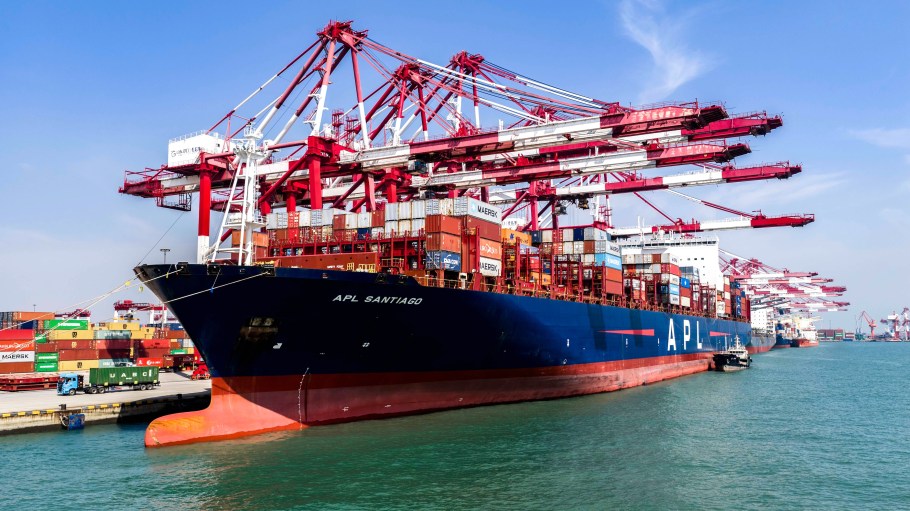
According to Linerlytica, only 24 U.S.-flagged ships visit Chinese ports in total. Eleven come from Matson, the largest U.S.-based ocean carrier, while seven are operated by CMA CGM’s American subsidiary American President Lines (APL). Hapag-Lloyd owns five U.S.-flagged vessels that stop in China, while Gemini alliance partner Maersk has one.
U.S. shipbuilding has lagged substantially compared to China, with the former building fewer than five ships, compared to the latter’s 1,794 in 2022, according to data from BRS Shipbrokers. Even amid the introduction of bipartisan legislation to tackle the topic and President Donald Trump’s announcement of a shipbuilding office in the White House earlier this year, the endeavors have hit various snags.
In a February report, the U.S. Government Accountability Office (GAO) called out the lack of physical space and workers to meet the Navy’s demands for shipbuilding. Later that year, the office said the Department of Transportation hasn’t established the goals required to properly assess the performance of the financial aid programs that are supposed to encourage shipbuilding. Cost control is often cited as a major roadblock to U.S. shipbuilding ambitions.
South Korea, with backing from conglomerates including HD Hyundai Heavy and Hanwha Group, is expected to be a key player in helping bolster American shipbuilding. The country has made a $150 billion pledge to revitalize the industry, with Hanwha announcing in August that it would invest $5 billion into the Philadelphia shipyard it acquired last year.
As the U.S. attempts to play catch-up, Customs and Border Protection (CBP) unveiled that was anticipating those impacted by the USTR fees to pay up at least three business days prior to a vessel’s arrival at an American port.
The top 10 container liners globally are expected to encounter a combined $3.2 billion in USTR gees in 2026.
Cosco Shipping and subsidiary Orient Overseas Container Line (OOCL) have nevertheless committed to maintaining trans-Pacific services into the U.S. Both carriers have a combined 79 vessels that would be impacted by the port fees, according to Linerlytica.
And Hede Shipping is keeping its one service on the route, operating a single ship despite the fees.
The U.S.-levied fees are set to go into effect on Oct. 14, and are punitive charges the office levied against China after a nine-month probe into the country’s logistics, maritime and shipbuilding practices. That investigation determined that China had an “unreasonable” dominance of those industries under Section 301 trade laws on allegations that it uses state subsidies to lessen competition and creates dependencies on the country.