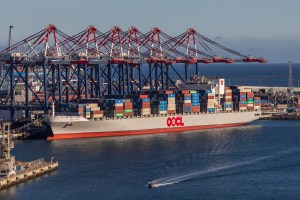
A small container ship transiting eastbound in the Strait of Hormuz was hit by an unknown projectile Wednesday morning, causing a fire in its engine room and forcing its crew to abandon the vessel.
The Malta-flagged Safeen Prestige, a ship owned by Abu Dhabi Ports Group that carries 1,740 20-foot equivalent units (TEUs), was attacked above the hull’s water line at approximately 11:09 local time. No injuries were reported among the 24 crew members rescued by the Omani navy, according to the Oman News Agency.
Related Stories
The projectile’s origin has not been confirmed, but the incident follows a series of drone and missile strikes in the Strait of Hormuz against commercial shipping in the wake of a joint U.S.-Israeli aerial military offensive in Iran that began Saturday.
On Tuesday, a senior adviser of the Iranian Revolutionary Guard Corps declared that Iran “closed” the conduit and that the country’s military would attack ships seeking passage. The declaration and the wider conflict, in which Iranian strikes have directly hit Middle Eastern airports and temporarily stalled operations at seaports like the Port of Jebel Ali and the Port of Salalah, have spooked shipping companies from operating in the region.
The United Kingdom Maritime Trade Operations (UKMTO) first reported the incident, which occurred two nautical miles north of Oman.
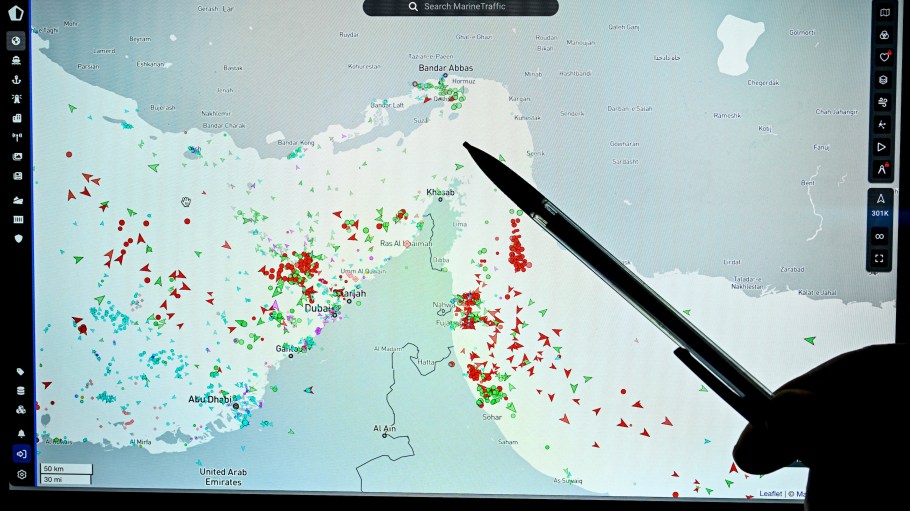
According to MarineTraffic, the Safeen Prestige left the U.A.E.’s Ghantoot Port on Tuesday, and was headed toward Jeddah Islamic Port in Saudi Arabia by Sunday.
On Tuesday, President Donald Trump unveiled that his administration would offer insurance to all ships looking to sail through the Strait of Hormuz, in an effort to replace maritime insurers that are expected to end coverage for vessels in the conflict-ridden area and keep oil tankers flowing.
The president is further incentivizing passage, saying the U.S. Navy would begin escorting tankers through the strategic Strait of Hormuz “as soon as possible” if necessary.
“Depending on the details of the proposal it might help tip the risk/reward ratio and stimulate more shipowners to resume operations in the high-threat area,” said Jakob Larsen, chief safety and security officer of the Baltic and International Maritime Council (BIMCO), in a statement. “Naval escorts would help reduce the threat for the ships being protected. That said, providing protection for all tankers operating in areas currently threatened by Iran is unrealistic as this would require a very high number of warships and other military assets.”
Tanker traffic through the Hormuz strait has plummeted 90 percent since the start of the military operation, according to data from MarineTraffic.
Mediterranean Shipping Company (MSC), the world’s largest ocean carrier, is not taking any chances. After initially saying it was suspending all cargo bookings to and from the Middle East until further notice, MSC has decided to offload all Persian Gulf-bound cargo in alternative ports outside the region.
“All shipments currently en route will be diverted to the next safe port of discharge,” MSC said in a Tuesday advisory. “At that location, cargo will be discharged and placed at customers’ disposal for local delivery and recovery.”
A mandatory surcharge of $800 per container will apply to all affected shipments to cover what the liner calls “deviation costs.” According to data from container tracking solution provider Vizion, MSC currently has 139,500 TEUs of cargo onboard vessels bound for the Gulf.
Maersk and Hapag-Lloyd both clamped down further on Middle Eastern shipments Wednesday, officially ending bookings for several countries including the U.A.E, Iraq, Kuwait, Qatar and Bahrain. Restrictions also are in place for some gateways in Saudi Arabia and Oman, but the ports of Jeddah, King Abdullah and Salalah are still clear for docking.
CMA CGM, which already suspended all Middle Eastern bookings Tuesday, also said it was divert vessels to contingency ports as it implements emergency measures for Gulf-bound shipments.
Shippers can take one of three options: delivery to the diverted port, have onwards transport by road or rail from the diverted port or have a change of destination. The carrier states associated costs, including handling and storage, will be borne by customers.
According to data from Alphaliner, 138 container ships with a combined capacity of nearly 470,000 TEUs were still stranded in the Persian Gulf as of Monday.
MSC and CMA CGM were the most affected carriers, with 15 vessels carrying 109,000 TEUs and 14 ships moving 70,000 TEUs respectively seeking shelter.
According to AIS data reported by freight rate benchmarking platform Xeneta on Wednesday, there are 11 container vessels waiting outside the Strait of Hormuz, and another 20 that are steaming in the immediate vicinity and still listed as bound for Gulf ports.
“Entering the Gulf is highly unlikely at this moment, but in the absence of new directives, vessels default to communicating their last known next port. This aligns well with what we’re seeing in schedules,” said Destine Ozuygur, a senior market analyst at Xeneta in a LinkedIn post on Wednesday. “Voyages that were due to arrive at Gulf ports in the mid-term seem to have a clearer course of action for offloading at alternate ports, but many ships that were enveloped in the immediate aftermath are still waiting for plans to materialize.”
Of the 48 services on the Asia-to-Europe trade among major ocean carriers, 18 call one or more of the 14 countries directly exposed to the widening conflict zone, Ozuygur said. That amounts to 239,000 TEUs of weekly capacity.
As the ports near and around the Persian Gulf demonstrate more risk, congestion is expected to pile up in southeast Asian transshipment hubs in Singapore and Colombo, as well as Malaysia’s Port Klang and Port of Tanjung Pelepas.
“In the longer term, that would likely necessitate regional relays through Indian ports like Mundra and Nhava Sheva, as well as localized distribution through Mombasa, Dar es Salaam and other East Africa ports,” said Ozuygur.
Air cargo backlogs just beginning
The war in Iran has cargo ramifications outside the ocean freight spectrum. Air cargo is expected to experience backlogs as a wide swath of capacity remains grounded due to airport closures in Abu Dhabi, Dubai, Bahrain and Kuwait.
“By the end of the week, and the beginning of next, we will most probably see certain backlogs arising in Southeast Asia and in China for the European and the U.S. marketplace,” said Stefan Paul, CEO of freight forwarder Kuehne + Nagel in a Tuesday earnings call. “There is a mismatch coming that is similar to the Covid times when it comes to supply and demand.”
Data from air cargo market intelligence firm Rotate published Sunday indicated that the Middle East airspace closures and widespread grounding pushed down available global air cargo capacity 18 percent from the week prior.
Forwarders including Kuehne + Nagel are already chartering direct Far East-West flights to compensate for lost capacity, according to Paul.
As of Wednesday, the Freightos Air Index shows Southeast Asia-to-Europe rates up more than 6 eprcent to $3.82 per kg since Friday, while South Asia rates ticked up 3 percent to Europe and 5 percent to the U.S., respectively. Middle East-to-Europe flights increased 8 percent to $1.62 per kg amid the capacity crunch at origin.
China-to-U.S. air cargo rates saw the biggest five-day jump, increasing 15 percent to $6.90 per kg, though some of the trans-Pacific increase may reflect the post-Lunar New Year rebound rather than war disruptions alone.
In the long run, Paul expects the air freight side of the business to benefit from sea-to-air conversions, which were a tool used often when the Red Sea crisis was at its peak throughout 2024.
“As soon as we see a shift from sea to air, there will be further demand coming in into the air freight,” Paul said. “The air freight business will benefit more than the sea freight business from the current crisis situation we see.”