The International Brotherhood of Teamsters gave UPS an ultimatum Tuesday: present a “powerful” tentative agreement for a new contract within one week, or the union would entertain just one final offer from the shipping giant.
On Wednesday, the union turned the heat up after another day of negotiations, pushing UPS to share its “last, best and final offer” no later than Friday.
The current national contract, covering roughly 330,000 UPS employees, expires July 31. The two sides are currently negotiating economic terms including pay and benefits.
Related Stories
Teamsters general president Sean O’Brien insists members will not work beyond the contract’s expiration date without a new contract, with the union saying Wednesday that a strike was “imminent.”
“The largest single-employer strike in American history now appears inevitable,” said O’Brien in a statement. “Executives at UPS, some of whom get tens of millions of dollars a year, do not care about the hundreds of thousands of American workers who make this company run. They don’t care about our members’ families. UPS doesn’t want to pay up. Their actions and insults at the bargaining table have proven they are just another corporation that wants to keep all the money at the top. Working people who bust their asses every single day do not matter, not to UPS.”
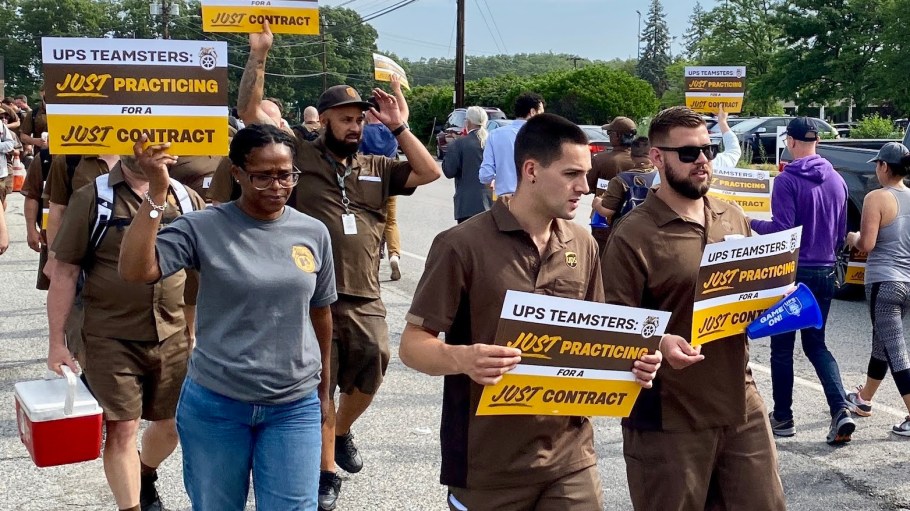
UPS employees coordinated practice picketing sessions Tuesday and Wednesday at numerous distribution hubs across the U.S., including Seattle, Louisville, Ky. and El Paso, Texas. In Louisville, the picketing took place at UPS Worldport, a 5.2 million-square-foot campus that is the largest sorting and logistics facility in the U.S., handling 416,000 packages per hour.
Practice picketing is not a strike, but serves as a training exercise of sorts for employees, and puts added pressure on UPS to come up with more favorable terms ahead of possible labor action.
Teamsters were explicitly instructed ahead of the picketing not to interfere with or disturb working operations for employees on the clock, disparage UPS and or tell the public to boycott the company.
As has been the theme of the negotiations, UPS has put on a happy face in public, saying it welcomed the Teamsters’ urgency to get a ratified contract in place by the Aug. 1.
“Last week, we provided our initial economic proposal. This week we followed with a significantly amended proposal to address key demands from the Teamsters,” UPS said in a statement Wednesday. “Reaching consensus requires time and serious, detailed discussion, but it also requires give-and-take from both sides. We’re working around the clock to reach an agreement that strengthens our industry-leading pay and benefits ahead of the current contract’s expiration on August 1. We remain at the table ready to negotiate.
The fallout from a strike could be far reaching, with UPS accounting for nearly one-fourth (24 percent) of total parcel volume shipped in the U.S. in 2022, according to data from the Pitney Bowes Parcel Shipping Index.
The shipping company’s market share is second only to the U.S. Postal Service, which accounts for 32 percent of all volume shipped in the country. Amazon’s delivery service was responsible for 23 percent of the total, while FedEx shipped 19 percent.
In total, UPS is estimated to have shipped 5.2 billion parcels in 2022, which would amount to 14.2 million packages per day, according to Pitney Bowes. And UPS says it delivers about 6 percent of the nation’s gross domestic product.
Chris Creyts, senior director in Alvarez & Marsal’s consumer and retail group, previously told Sourcing Journal that options for shippers would be limited if a strike occurred, noting that shipping delays would spill over to all carriers struggling to absorb the additional volume.
“UPS still may keep a shell operation functioning but would likely primarily serve critical time sensitive customers (e.g., medical supplies),” Creyts said. “UPS parcel service as we know it would almost certainly grind to a halt until the strike was resolved.”
Creyts expects an agreement to be made relatively quickly to avert more supply chain pain if union workers go on strike.
“The backlash from any interruptions today would be intense—despite most shippers having limited short-term options, this incident will be burned into the minds of their executives over the long term,” he said.
The Teamsters have been busy recently, supporting a strike by 84 former Amazon delivery contractors in California, authorizing a possible strike by employees at truckload freight carrier TForce Freight and agreeing to a new deal for workers at less-than-truckload (LTL) carrier ABF Freight.
The union was recently sued by LTL trucking giant Yellow Corp. on allegations that it has prevented the transportation company from conducting the next phase of its restructuring plan.