UPS will cut headcount even further this year as the courier continues to reconfigure its delivery network and scale down its ties with Amazon.
The company will reduce operational positions by 30,000 in 2026, on top of the more than-expected 48,000 jobs that were cut last year. UPS chief financial officer Brian Dykes said in a Tuesday morning earnings call that the cuts are expected be made through attrition, as well as a second voluntary buyout program offered to full-time drivers.
Related Stories
The 2025 staff culling consisted of 34,000 operational reductions and 14,000 cuts to management positions.
With six months left in its 18-month goal to “glide down” its Amazon volumes by 50 percent—having sifted roughly 1 million packages per day out of its network—UPS is targeting $3 billion in total savings from the reduction.
According to Dykes, the delivery company plans to reduce total operational hours worked by approximately 25 million associated with the Amazon decline.
The cost-cutting measures have been a success for UPS so far, with the company having saved $3.5 billion in 2025 as part of the network reconfiguration, which also included the closure of 93 facilities as part of its nationwide automation push.
Company stock increased 4 percent as of noon Eastern Time.
For the fourth quarter, UPS generated revenues of $24.5 billion, a 3.2 percent decline from the year prior. Net income was $1.8 billion, on an adjusted $2.38 per share. The figures surpassed estimates from analysts polled by FactSet, which called for $24 billion in revenue and adjusted earnings of $2.20 per share.
The company’s forward-looking outlook for 2026 also impressed investors, as UPS guided for revenue of approximately $89.7 billion, ahead of the $88.1 billion projected by analysts and up 1.1 percent from the $88.7 billion in last year’s revenue.
Adjusted operating margin is expected to be approximately 9.6 percent of sales, slightly down from 9.8 percent in 2025. The company is planning capital expenditures of about $3 billion and aims to close another 24 facilities in the first half of the year.
During the peak season, the glide down in Amazon packages made a substantial impact on average domestic daily volumes (ADV), which declined 10.8 percent to 20 million packages.
More than half of the decline is attributed to the Amazon decoupling, alongside deliberate actions to remove less profitable e-commerce volumes for its network, Dykes said.
Ground average daily volume was down 10.6 percent compared to the year prior, while average daily volume via air was down 11.9 percent.
Although these declines contributed to a domestic revenue dip of 3.2 percent in the fourth quarter to $16.8 billion, revenue per piece grew 8.3 percent. This marks the strongest fourth quarter revenue-per-piece growth rate for UPS in four years.
Although cost per piece increased 8.9 percent year-over-year—primarily due to costs associated with the temporary insourcing of its Ground Saver program and additional costs to secure air capacity after grounding its MD-11 air cargo planes—total U.S. domestic expenses declined 3.3 percent.
For 2026, U.S. domestic revenue is expected to be approximately flat year-over-year, with ADV expected to contract mid-single digits due to the Amazon actions.
As for the international segment, revenue increased 2.5 percent to $5 billion driven by a 7.1 percent increase in revenue per piece, which outweighed ADV declines of 4.7 percent to 3.6 million parcels.
UPS forecasts a low-single-digit revenue growth in international year over year for 2026.
“We expect the dynamic environment we experienced in 2025 will continue in 2026, primarily due to the tariff and de minimis policy changes that will continue to drive changes in trade lane mix,” said Dykes in the call.
In the wake of a plane crash at its Worldport air hub in Louisville, Ky. that resulted in a federal investigation into the safety of MD-11s, UPS accelerated the retirement of its fleet of those airplane models in the fourth quarter. The company incurred a $137 million in after-tax charges and $101 million in additional after-tax “transformation” charges as part of the decision.
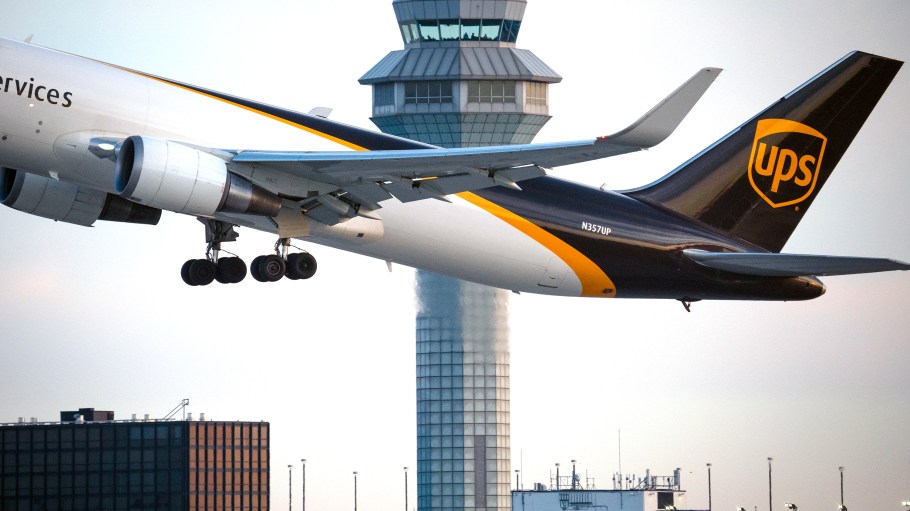
The 26 remaining MD-11s aircraft represented roughly 9 percent of its wider air cargo fleet. Over the next 15 months, UPS expects to replace these jets with 18 new Boeing 767 aircraft, with 15 expected to deliver this year.
With the added expense, UPS will seek to cut more costs elsewhere, with more adjustments set to be made to the company’s domestic warehousing network. The courier says it plans to increase the percentage of U.S. volume processed through automated facilities to 68 percent by the end of the year, up from 66.5 percent at the end of 2025.
“We have 127 buildings that are automated. We are adding another 24 in 2026,” said Carol Tomé, CEO of UPS, in the call. “The cost per piece in these automated buildings is 28 percent less than the cost per piece in our conventional buildings.”