UPS is temporarily closing a package processing facility in Portland, Ore. over the summer as the logistics giant powers ahead with its warehouse automation push.
America’s largest delivery company has sought to flow more package volume into automated warehouses as part of its “Network of the Future” plan, which is aimed at saving $3 billion in costs by 2028.
By the end of that period, UPS expects to implement major automation projects at 63 sites, saying last March that it would triple the number of buildings with automated technologies to 400 across the U.S.
Related Stories
UPS confirmed the Portland facility will close July 1, and expects the building to reopen in 2026 after the enhancements are made.
The company has yet to file a Worker Adjustment and Retraining Notification Act (WARN) notice in Oregon, so the exact number of workers impacted by the closure is unclear.
UPS did not confirm the number impacted. A report from World Socialist Web Site, a publication that covers social inequality and class relations, says the closure would impact roughly 600 employees at the facility.
“Our employees are extremely important to us, and we expect most of them will move to a temporary facility on property, or to other UPS facilities in the area,” a UPS spokesperson said. This temporary closure won’t impact customer service, and we have plans in place to continue servicing the Portland community.”
According to a report from The Oregonian, Teamsters Local 162 has been soliciting union workers at the site to shift to a UPS location in Hillsboro, Ore. in advance of the closure.
Teamsters vice president at-large John Palmer told the publication that some jobs would come back when the warehouse reopens, “but it will be a small percentage, I would say.”
Sourcing Journal reached out to the Teamsters.
In the summer of 2023, the Teamsters reached a five-year deal with UPS that covered 340,000 unionized employees at the courier. But that deal was put in place before the automation-centric “Network of the Future” plan was announced, along with last year’s layoffs of 12,000 employees. Then-chief financial officer Brian Newman said at the time that the company did not expect those jobs to come back.
The Portland warehouse felt this last April, when UPS eliminated its day sorting shifts and laid off 321 employees due to a decline in package volume.
With the current dynamic in place, Palmer told The Oregonian that the Teamsters should have done a better job negotiating contracts that protect workers, and instead should have sought a deal that promised long-term employees training opportunities for jobs where the automated technologies need maintenance.
“Automation is a real thing. There’s only so much we can do to stop progress. But the other side of it is when you have a corporation like UPS that makes billions of dollars in profit every quarter,” Palmer said.
The scenario in Portland is playing out similarly in multiple facilities adapting to the automation updates.
A package processing facility near Denver will partially close on Jan. 15, which will result in the termination of 404 workers. That warehouse is also being retrofitted with automation technologies and is expected to reopen in full in 2026.
Two other warehouses in the Los Angeles and Oklahoma City areas will be temporarily closed on the same date. The Oklahoma City facility will only be partially closed, but 304 employees will be laid off. The shuttering of the Grande Vista hub in Vernon, Calif. will impact 445 jobs.
Through the Grande Vista closure, UPS has said that it would offer the employees temporary transfers to other facilities “within reasonable commuting distance.”
The total automation overhaul across UPS facilities is expected to cost the company $9 billion by the end of 2028. The company already claims it is seeing savings on the back end, seeing cost per piece (CPP) decline 4.1 percent in the third quarter from the year prior.
“We now process 63 percent of the volume in our hubs in some sort of an automated way,” said UPS CEO Carol Tomé in an October earnings call. “That’s up five percentage points from a year ago.”
In that call, chief financial officer Brian Dykes said the network modernization contributed to an 8 percent year-over-year improvement in the number of packages sorted in a single hour of work.
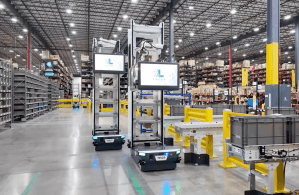
Within its upgraded facilities, UPS is leveraging pick-and-place robotics technologies to help sort small packages, as well as robotics technologies to make unloading trailers less demanding for workers. The company uses autonomous guided vehicles to help workers more safely move shipments and packages through their facilities.
The parcel delivery firm is closing roughly 200 facilities, namely sortation centers, as part of the automation push.