President Donald Trump signed an executive order Monday aimed at enforcing English-language proficiency for commercial motor drivers, including truck drivers.
The EO reinforces an already existing federal law requiring holders of commercial driver’s licenses (CDLs) to be English-proficient. In the order, Trump said the requirement should be a “non-negotiable safety requirement for professional drivers.”
Specifically, 49 CFR section 391.11(b)(2) requires truck drivers to “read and speak the English language sufficiently to converse with the general public, to understand highway traffic signs and signals in the English language, to respond to official inquiries, and to make entries on reports and records.”
Related Stories
Truckers have argued that the lack of enforcement for CDL carriers to speak and read English poses safety risks on the road, especially if a driver doesn’t understand an English sign or cannot communicate with other drivers or law enforcement.
Under Trump’s directive within the EO, “drivers need to provide feedback to their employers and customers and receive related directions in English. This is common sense…this requirement has not been enforced in years, and America’s roadways have become less safe.”
The third section of the EO is expected to drive the changes.
That section directs Transportation Secretary Sean Duffy to rescind an Obama-era 2016 Federal Motor Carrier Safety Administration (FMCSA) memorandum, which removed the requirement to place drivers out of service if they violated English proficiency standards.
That memo also changed the agency’s standard for determining non-compliance with the requirements. With the change, drivers could use interpreters, cue cards or smartphone apps to facilitate communications if they cannot communicate sufficiently with an inspector—and not be cited with a violation.
The Department of Transportation will also review procedures for CDL authenticity verification as a part of the executive order.
Additionally, it’s designed to provide uniform enforcement by federal and state inspectors. Federal officials can set their own law enforcement standards for inspection, despite state officials taking up the lion’s share of driver inspections.
In 2024, federal officials conducted 72,485 inspections—less than 3 percent of 2.9 million total inspections. State inspections accounted for the remaining 2.8 million, per FMCSA data.
The trucking industry is on board with the decision, with its biggest lobbyists having called for the reinforcement of the federal law.
“We thank the Trump administration for responding to our concerns on the uneven application of this existing regulation, and we look forward to working with FMCSA and the law enforcement community on an objective, consistent and effective enforcement standard,” said American Trucking Associations (ATA) senior vice president of regulatory and safety policy Dan Horvath, in a statement.
The ATA had said it had received reports that the English-proficiency requirement is often “misinterpreted and enforcement of this provision is inconsistent,” with the group saying it was likely due to a 2016 enforcement memo issued by FMCSA.
In a letter sent April 10, Chris Spear, president and CEO of the ATA called on the FMCSA to immediately review its directives related to English proficiency enforcement, and ensure the provision should be “enforced consistently during roadside inspections and on-site reviews.”
The Owner-Operator Independent Drivers Association (OOIDA), which represents 150,000 truckers, also celebrated the executive order.
“Basic English skills are essential for reading critical road signs, understanding emergency instructions and interacting with law enforcement. Road signs save lives – but only when they’re understood,” OOIDA president Todd Spencer said in a statement. “That’s why OOIDA petitioned the Commercial Vehicle Safety Alliance earlier this year to reinstate English proficiency as an out-of-service violation. Today’s announcement is a welcome step toward restoring a commonsense safety standard.”
Trump’s executive order follows an earlier EO he signed on March 1, formally designating English as the official language of the U.S.
As truckers applaud Trump’s recent executive action, many are feeling the heat of the president’s tariffs on foreign trade partners, namely China.
Old Dominion, Knight-Swift and TFI International all reported hits to their businesses in their recent earnings calls amid slowing activity, with expectations for volume declines to continue as the tariffs remain in play.
Expressing a similar sentiment in its earnings call, Saia saw stock collapse 30 percent Friday after first-quarter revenue came in below estimates.
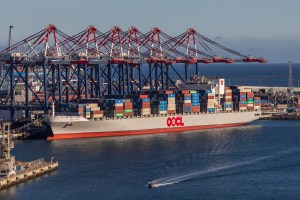
“We’re not really seeing anything in April that would tell us seasonality is back in check,” said Saia’s chief financial officer, Matt Batteh, on the call. Volume has already started to slow down at major West Coast ports like Los Angeles and Long Beach, hurting truckers normally
Volvo Trucks North America also said it would lay off as many as 980 employees across three facilities in the next few months. Private equity firm Apollo Global Management said in a presentation earlier this month that more layoffs are expected to hit the trucking and retail industries in late May-early June.