The trucking industry is weighing in on the potential scrapping of the de minimis provision and the proposed addition of fees for Chinese ships to dock at American ports.
In commentary filed with U.S. Customs and Border Protection (CBP) on Monday, the American Trucking Associations (ATA) warned that amending the regulations for the entry of low-value shipments into the U.S. would be a costly overhaul and require more education to be effective.
The nation’s largest trucking lobby comprising 30,000 trucking companies recommends that the CBP begin a period of “informed compliance” for one year once a final ruling on de minimis is made. Under informed compliance, the CBP would educate importers on how to comply with new laws and regulations.
Related Stories
“These changes will require major capital investment in system infrastructure to create mechanisms to identify if a shipment qualifies for the administrative exemption,” said Kaitlyn Holmecki, senior manager, international trade and security policy, ATA, in the Monday filing. “Moreover, these changes will place logistics firms on a steep learning curve while they determine which parties own the new data elements and the optimum approach to collecting the data and consolidating it for submission to CBP.”
CBP is proposing to create a new process for packages entering the U.S. that are valued at less than $800, so that it can target high-risk shipments with synthetic opioids like fentanyl more effectively.
The future of the duty-free de minimis provision brings plenty of uncertainty to importers. If the trade exemption was axed, e-commerce retailers that ship the majority of goods via air freight out of China like Shein, Temu and even Amazon, would no longer be able to ship tax free.
At the same time, logistics providers on the ground would be forced to deal with the headache of package backlogs at customs, resulting in shipment delays for consumers.
This was the primary reason the suspension of low-value shipments entering the U.S. from China at the start of February lasted just days before being lifted.
“It became clear that CBP did not have the necessary resources to collect tariffs on all the products that no longer qualified for the de minimis exemption,” Holmecki wrote. “Efficiency is paramount to ensure the safe movement of trade across borders, therefore it is imperative that CBP roll out this new policy in a thoughtful and measured manner.”
The ATA came up with several other recommendations for the Trump administration as it issues its final ruling, including coordinating advance manifest listings with bills of lading, consolidating data from different parties in the supply chain into one submission and providing flexibility in implementing provisions related to the $800 shipment limit.
De minimis shipments make up just 12.8 percent of the total volume of goods imported into the U.S. on trucks each year—174.2 million of a total 1.36 billion packages, according to CBP—but Holmecki stressed that it was still important for efficient processing methods at land ports of entry like Laredo and Nogales.
These shipments can be money makers for trucking companies, making customs efficiency more vital to all parties involved.
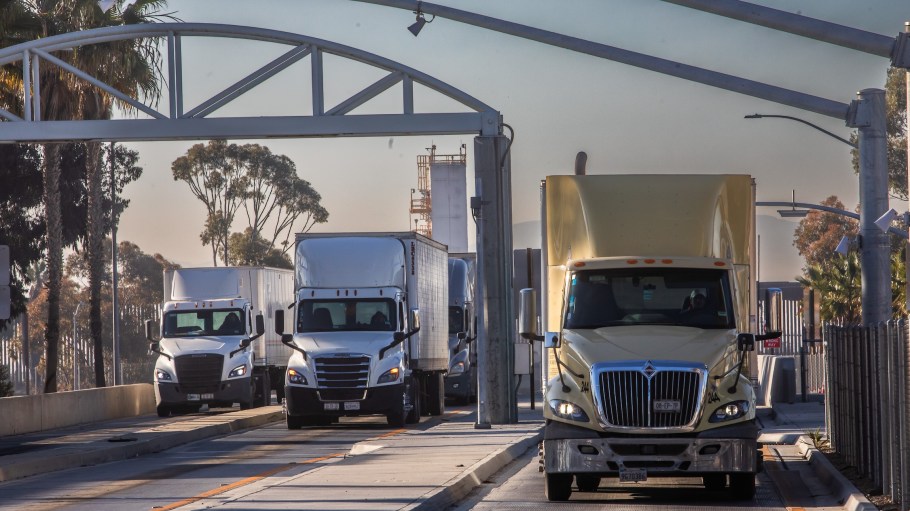
Trucks are responsible for hauling 85 percent of surface-transported cargo that crosses the U.S.-Mexico border and 67 percent of the goods crossing the Canada-U.S. border, equating to $17.73 billion in revenue generated for trucking companies.
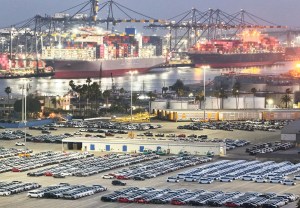
Changes to U.S. import policies, particularly the proposed port fees on Chinese ships, could also alter freight patterns for trucking companies picking up cargo at U.S. ports, according to ATA chief economist Bob Costello.
Those fees for Chinese-built ships could escalate up to $1.5 million per port call, while Chinese-operated vessels would either pay up to a $1 million charge per ship for each call, or pay as much as $1,000 per net ton of the vessel’s capacity.
The U.S. Trade Representative’s (USTR) office unveiled the proposal last month in response to a nine-month probe into the Chinese maritime, shipbuilding and logistics industries, which ruled that the practices have given the country an unreasonable dominance in those fields.
Since a fee would be doled out for each individual port stop, it would incentivize more port skipping if multiple hubs on the same route are nearby, Costello said at the Truckload Carriers Association’s annual convention in Phoenix.
“What they’re probably going to do is dump all of the cargo in one port and move on,” Costello said. This would essentially require logistics companies to shift more trucking capacity closer to preferred port stops.
Areas with a string of smaller ports, namely the East and Gulf Coasts, could be affected the most, he said.
“There’s a good chance a lot of these ocean carriers are not even going to make that call and not go to [the Port of] Mobile anymore,” Costello said. That could be a problem for exporters that need to make swift decisions on where they can move their goods before they get picked up by the vessels.