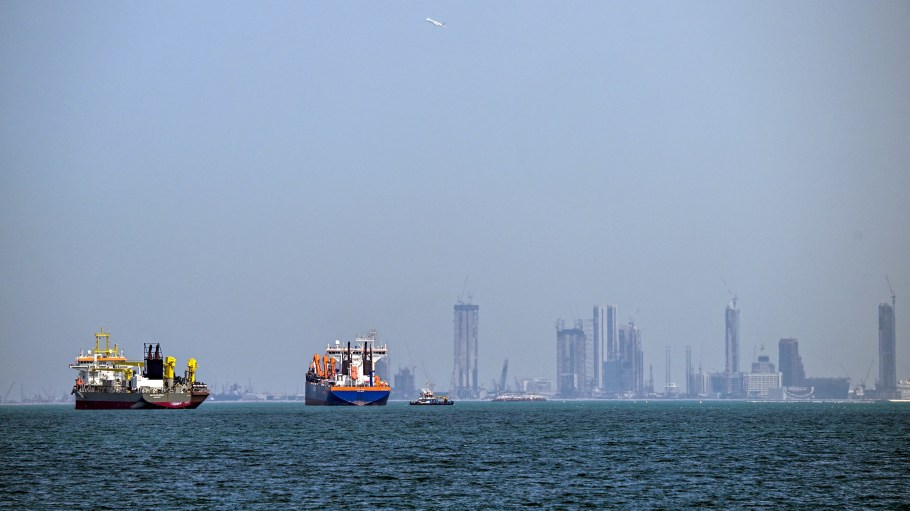
Three vessels near the Strait of Hormuz were hit by unknown projectiles starting late Tuesday into Wednesday morning as the war in Iran reached its 12th day, according to the United Kingdom Maritime Trade Operations (UKMTO) Centre.
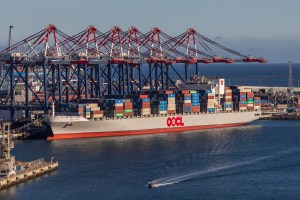
Among those struck include the ONE Majesty container ship from Ocean Network Express, which was anchored in the Persian Gulf, according to a company spokesperson. A report from the UKMTO indicates the attack occurred northwest of U.A.E.-based port city, Ras Al-Khaimah.
Related Stories
All crew were accounted for with no injuries, with the Japan-flagged ship sustaining some hull damage above the waterline. The carrier said that the vessel remains fully operational and seaworthy. The ship is part of the “WIN” West India-to-U.S.-East Coast service line and was scheduled to stop next at Mundra Port in India.
A Thai‑flagged bulk carrier Mayuree Naree was targeted and damaged approximately 11 nautical miles north of Oman, resulting in a fire on board. Among the 23 crew members on board, three of them were reported missing following the strike, according to the Thai Enquirer.
The third commercial vessel, Star Gwenyth, reported damage after being hit by a projectile 50 nautical miles northwest of Dubai. No casualties were reported on the Marshall Islands flagged bulk carrier.
Shipping traffic through the Strait of Hormuz has stopped for the most part in response to the attacks and repeated threats from Iranians. This has forced ocean carriers to largely avoid the area and add surcharges to cover for stops at alternate ports, similar to when the industry began skirting the Red Sea when the Houthis began their repeated drone and missile attacks on shipping in late 2023.
According to Hackett Associates founder Ben Hackett, it is too soon to see an impact on U.S. container imports stemming from the wider Middle Eastern conflict.
“The immediate impact on containerized traffic to the United States is not likely to be substantial since little U.S.-bound container cargo is sourced from the region,” Hackett said. “While it is too early to measure in the monthly data, increasing oil and gasoline prices will inevitably drive structural inflation if the conflict persists. That, in turn, could squeeze consumer discretionary spending and U.S. manufacturing, and ultimately drive down import volumes in the longer term.”
The monthly Global Port Tracker from the National Retail Federation (NRF) and Hackett Associates projects that imports at major U.S. container ports are expected to remain below last year’s levels for the first half of 2026.
Inbound cargo volume from January to June is expected to be 12.21 million 20-foot equivalent units (TEUs), down 2.5 percent from 12.53 million TEUs during the same period in 2025.
Jon Gold, vice president for supply chain and customs policy at NRF, said the trade association was closely watching the situation in Iran and its potential impact on retail supply chains.
Globally, apparel supply chains have continued to get upended by the Middle Eastern conflict, particularly in countries in south Asia.
Cascale, the nonprofit formerly known as the Sustainable Apparel Coalition, has postponed its upcoming forum in Colombo, Sri Lanka due to the ongoing conflict and widespread disruption to major international travel hubs in the region.
Initially scheduled for March 30-April 1, the event will now take place on March 17-18, 2027, with side events and facility tours planned for March 16 and March 19, 2027.
Despite Inditex’s insistence that the Iran war is unlikely to affect consumer prices, the fast fashion giant appears to be among those that have to worry about getting their goods to customers without delay.
A Sunday report from Reuters indicated that shipments of garments for the Zara owner and other major apparel retailers are stranded at airports in Bangladesh and India as several airlines cancel flights.
Shovon Islam, managing director of manufacturer Sparrow Group, told the publication some of his company’s apparel consignments are currently stuck at Dhaka’s Hazrat Shahjalal International Airport. Sparrow manufacturers apparel for European companies including Inditex, Marks & Spencer (M&S), Next and Primark.
“They were supposed to be flown to the U.K. via Dubai, but with operations at Dubai airport suspended, we are now in a very difficult position,” Islam said. “We’re trying to figure out alternative routes, but none of them are simple or cost-effective.”
Most airspace in the Middle East is still closed since the conflict began on Feb. 28, forcing airports in Dubai, Abu Dhabi and Doha to shut down for several days with airlines including Qatar Airways, Emirates and Etihad Airways now operating on limited schedules.
More than half of Bangladeshi air cargo and 41 percent out of India travels via Persian Gulf-based airports, Frederic Horst, managing director at logistics consultancy Trade and Transport Group, told Reuters. Horst refered to Emirates and Qatar Airways as the most important carriers for moving cargo out of the area.
With other global air carriers also avoiding the Middle East, those airlines have increased their freight rates since there is no direct route from Bangladesh to the U.S. A report from supply chain publication The Loadstar said some airlines are charging triple the price out of Bangladesh to Europe amid the capacity crunch, with rates climbing from around $2 per kg to $6 per kg. Rates to the U.S., in line, have increased from roughly $4.50 per kg to roughly $7 per kg.
As rates across both air and ocean escalate, one major south Asian port dealing with its own congestion concerns is looking to give exporters a reprieve amid the disruption.
India’s Jawaharlal Nehru Port, also known as Nhava Sheva Port, is waiving ground rent and dwell time charges for 15 days for all cargo that entered the port from Feb. 28 through March 4. Over the same time, operators of the port’s five container terminals will also offer an 80 percent rebate on extra charges for refrigerated containers loaded with perishable goods.
The port is also providing additional storage area to the terminals for stacking such additional cargo.
The decisions follow a nationwide call from India’s Ministry of Ports and Shipping to ports and terminal operators to actively coordinate with shipping industry players and give priority consideration to all export cargo returning from the Middle East.