The closure of checkpoints on the Thailand-Cambodia border in June has effectively frozen cross-border trade in the region. But with the lion’s share of exports traveling by sea, the closures are forecast to have a limited impact on overall trade between the bordering Southeast Asian nations.
During the first five months of 2025, Thailand’s total exports to Cambodia stood at 145.5 billion baht ($4.5 billion), with border exports contributing 63.1 billion baht ($1.9 billion).
Thailand’s department of foreign trade estimated that if the border closure persists through the end of the year, it is expected to result in a 60 billion baht ($1.8 billion) reduction in border exports.
Related Stories
However, on a wider scale, that would only reduce border trade across all of its neighboring countries—Cambodia, Laos, Myanmar and Malaysia—by roughly 1 percent.
The rising border tensions between the two countries has caused Cambodia to revive a 20-year-old law, beginning a mandate for men to serve a two-year compulsory military commitment starting in 2026.
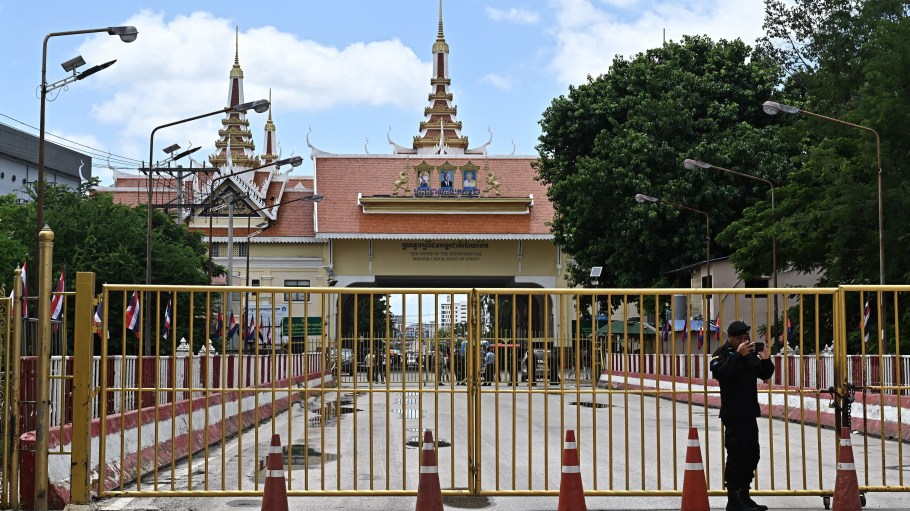
While tensions between both countries had often been on rocky footing, they escalated last month when 16 land crossings on the border were closed off by the Thai military after an armed skirmish resulted in the death of a Cambodian soldier.
Cambodian Prime Minister Hun Manet said Monday that Thailand is responsible for reopening all the border checkpoints if the countries want to reopen the flow of trade and resolve their ongoing border tensions.
At a ceremony to mark Cambodia’s Military Police Day, Manet set three conditions: Thailand must reopen all the checkpoints it shares with Cambodia; the checkpoints must operate in the same conditions they did before June 7; and it must commit to refraining from future unilateral closures.
Although Thailand has since partially relaxed border policy by allowing Cambodian nationals to enter the country using border passes or passports, this lack of trade on land has forced businesses in the region to rethink their supply chains.
In the wake of the closures, Bangkok-based logistics services provider Leo Global Logistics said it has immediately switched its main transportation route to shipping by ocean or air. The company also added a new route that passes through the Bavet checkpoint, located on the Cambodia-Vietnam border.
Kettivit Sittisoontornwong, CEO of LEO Global Logistics, told Thai publication Kaohoon International that the company has leveraged the border dispute to introduce new transportation routes to Thailand’s exporters. Sittisoontornwong added that shipping costs are higher due to the alternative routes, accounting for roughly 15 percent of the cargo’s value.
And Voratat Tantimongkolsuk, president of the Thai-Cambodian Business Council, told another Thailand-based publication The Nation that a delivery route that previously spanned 500 km through Sa Kaeo, Thailand to Sisophon, Cambodia, now stretches up to 1,500 km, tripling transport costs.
Multiple regional media outlets have indicated that Vietnamese companies are increasing their market presence in Cambodia as border trade with Thailand came to a standstill.
Cambodian retailers in Koh Kong, a province bordering Thailand, are reportedly bringing in more imports from Vietnam to fill the role of Thai products that are no longer entering their country, says the Bangkok Post.
According to Cambodian newspaper Khmer Times, marketing teams for Vietnamese brands have visited Cambodia’s capital, Phnom Penh, to strike deals with the country’s retailers.
While Cambodian sellers are becoming more reliant on Vietnam, both countries are in the middle of maneuvering through their ongoing trade negotiations with the U.S., with a new set of tariffs looming on Aug. 1.
Cambodia had one of the highest initial “Liberation Day” duty rates at 49 percent before President Donald Trump delayed those tariffs for 90 days. Trump recently revised the country-specific tariffs as part of his second extension to Aug. 1, with Cambodia now expected to pay a rate of 36 percent.
Thailand also now faces blanket duties of 36 percent, unchanged from the original April levels.
On July 4, ahead of the second tariff delay, the Cambodian government said it had agreed with the U.S. on a draft framework. The government has not given an update on negotiations since the tariffs were revised down.
Thailand is considering offering zero tariffs on 90 percent of U.S. imports, Finance Minister Pichai Chunhavajira said during a business seminar Monday. The government is also preparing 200 billion baht ($6.1 billion) worth of low-interest-rate loans to ease the impact of tariffs on local businesses.
According to the U.S. Census Bureau, Cambodia exported $7.8 billion in apparel to the U.S. in 2024, the second largest such number in the Southeast Asian region after Vietnam’s $18.6 billion worth of merchandise.
Thailand comes in fourth at $2.7 billion in apparel exports last year.