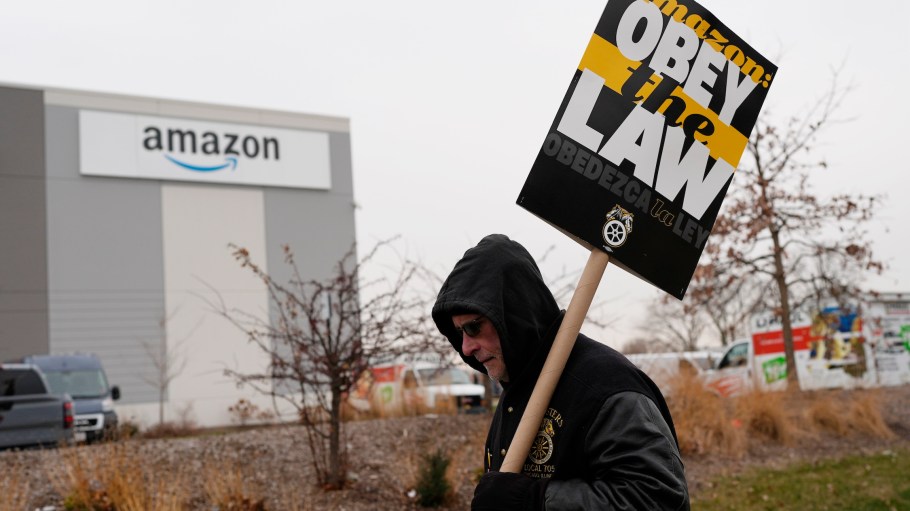
Teamsters-affiliated workers at several Amazon warehouses went on strike Thursday morning as the e-commerce giant stares down holiday shipping deadlines.
According to the union, nearly 10,000 Amazon workers are affiliated with the Teamsters. The union says workers at seven warehouses—one in Queens, N.Y.; one in Atlanta; three in Southern California; one in San Francisco; and one in Skokie, Ill.—would join the picket line to demand higher wages, better benefits and safer working conditions. The strike first hit the Queens facility first at 6 a.m. local time.
Related Stories
The Teamsters said Amazon workers at other facilities “are prepared to join them,” and that local Teamsters branches are also putting up primary picket lines at hundreds of Amazon fulfillment centers nationwide.
Despite the rhetoric ramped up by the union over the past week when members at various facilities authorized the work stoppage, the strike represents less than 1 percent of Amazon’s total employee base. It is unclear how long the strike will last.
Jason Miller, interim chairperson, department of supply chain management at Michigan State University’s Eli Broad College of Business, said the strike is likely to be “minimally disruptive to the flow of goods to consumers.”
“Relative to Amazon’s network of locations, these stoppages will be highly isolated events,” Miller said in a post on LinkedIn. “Santa should still be able to get your Christmas presents there on time.”
An Amazon spokesperson said the tech titan has not seen any impact on its operations.
As of the 2024 first quarter, Amazon has 1,363 total facilities in its U.S. network, according to data from supply chain consulting firm MWPVL International.
“Within major metro areas, Amazon has multiple fulfillment centers stocking the same types of goods (akin to Walmart having multiple stores within the same metro area),” said Miller. “As such, if one facility focusing on large non-sortable products like furniture were to strike, another facility would be able to fulfill demand with limited challenge.”
The Teamsters, which formally aligned with the Amazon Labor Union (ALU) over the summer, have had the online marketplace on its radar since launching a dedicated division to the company’s labor practices in 2021. After securing a five-year contract for 340,000 unionized UPS workers last year, the union and its brash president Sean O’Brien shifted more of a public focus to securing rights for Amazon’s workers.
“If your package is delayed during the holidays, you can blame Amazon’s insatiable greed. We gave Amazon a clear deadline to come to the table and do right by our members. They ignored it,” said O’Brien. “These greedy executives had every chance to show decency and respect for the people who make their obscene profits possible. Instead, they’ve pushed workers to the limit and now they’re paying the price. This strike is on them.”
Amazon sees things differently, with the company never having recognized the unionization of the Staten Island, N.Y. warehouse, which officially joined the ALU upon a vote in April 2022. The company has appealed the voting results with the National Labor Relations Board (NRLB).
Amazon also doesn’t acknowledge the Teamsters affiliations, with the Big Tech firm maintaining that the union illegally coerced its workers to join. The company also has always upheld that these workers are contractors for its delivery service partners (DSPs), and not Amazon employees, despite driving Amazon-branded vans and exclusively delivering Amazon packages.
One such group of 84 Teamsters-affiliated delivery drivers and dispatchers that were based out of an Amazon warehouse in Palmdale, Calif. has drawn attention to the contractor-employee paradigm after picketing dozens of other facilities over the 18 months.
Those employees work for former Amazon delivery provider Battle-Tested Strategies. The tech titan cut ties with the delivery company last year ahead of the picketing, but Amazon has always contended that the delivery service was terminated for poor performance.
“What you see here are almost entirely outsiders—not Amazon employees or partners—and the suggestion otherwise is just another lie from the Teamsters,” said Amazon spokesperson Kelly Nantel in a statement. “The truth is that they were unable to get enough support from our employees and partners and have brought in outsiders to come and harass and intimidate our team, which is inappropriate and dangerous.”
The Teamsters have claimed that under a rule announced by the NLRB, that the workers can be considered to have joint employers—both the DSP and Amazon. But Amazon and other business groups are challenging that rule.
In October, the NLRB issued a formal complaint against Amazon for unfair labor practices, namely for refusing to bargain with the delivery drivers in Palmdale.
Amazon claims the Teamsters’ wider narrative is a public relations play, and that there have been no elections held or bargaining orders mandated.
“For more than a year now, the Teamsters have continued to intentionally mislead the public—claiming that they represent ‘thousands of Amazon employees and drivers.’ They don’t, and this is another attempt to push a false narrative,” Nantel said. “The truth is that the Teamsters have actively threatened, intimidated and attempted to coerce Amazon employees and third-party drivers to join them, which is illegal and is the subject of multiple pending unfair labor practice charges against the union.”