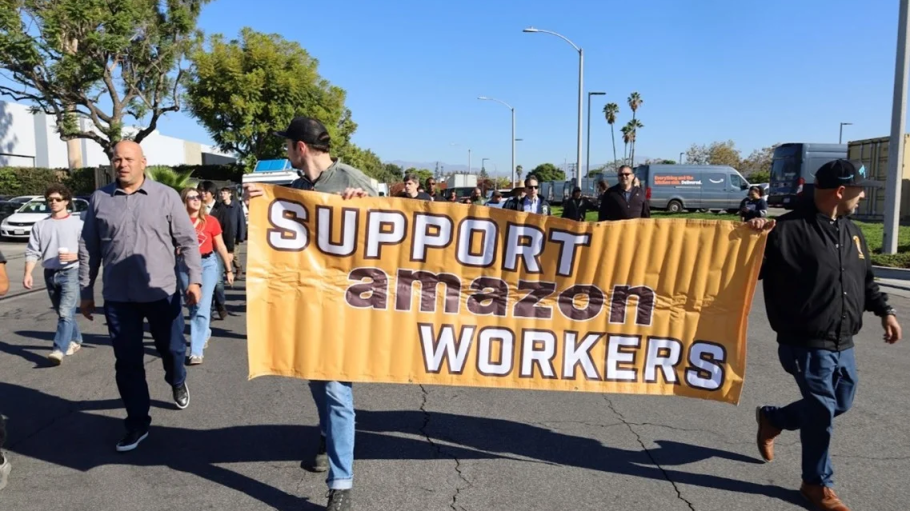
As Amazon feels the pressure from Sen. Bernie Sanders and other top U.S. lawmakers on its warehouse working conditions, employees at eight of the e-commerce giant’s facilities have authorized strike action in the past week.
According to the Teamsters, workers at four Southern California facilities in San Bernardino, Palmdale, Victorville and City of Industry had authorized a work stoppage, alongside those at a delivery station in Skokie, Ill., and two warehouses in Staten Island and Queens, N.Y.
Related Stories
On Wednesday, the union announced that employees in an Atlanta-based delivery station, DGT8, voted unanimously to authorize a strike after Amazon refused to recognize their Teamsters affiliation.
Similar complaints have come out of the Queens, California and Illinois warehouses, leading the Teamsters to give Amazon a Dec. 15 deadline to agree to bargaining dates for a union contract or face labor action.
Neither the Teamsters nor any of the workers have indicated when a work stoppage would take place.
“The corporate elitists who run Amazon are leaving workers with no choice,” said Teamsters general president Sean O’Brien in a statement. “Greedy executives are pushing thousands of hardworking Americans to the brink. Amazon rakes in more money than anybody, they subject workers to injury and abuse at every turn, and they illegally claim not to be the rightful employer of nearly half their workforce. This rigged system cannot continue. Amazon must be held accountable to workers and consumers alike. If workers are forced onto the picket line, Amazon will be striking itself.”
The Staten Island facility, JFK8, was the first Amazon warehouse to successfully unionize with the formation of the Amazon Labor Union (ALU) in 2022, although the tech titan has never recognized the victory and has appealed the voting results.
Two years later, the ALU officially affiliated with the Teamsters, with delivery drivers at the DBK4 station in Queens joining the union in September.
The back-and-forth between Amazon and the Teamsters has endured amid a continued contention from the online marketplace that the drivers of delivery service partners (DSPs) that work out of these facilities are not Amazon employees, but independent contractors.
In August, the National Labor Relations Board (NRLB) ruled that Amazon is a joint employer of subcontracted drivers at two of its DSPs, leading the e-commerce giant to sue the board over claims that its structure is unconstitutional and that in influenced the JFK8 unionization vote.
One of the DSPs in question is Battle-Tested Strategies, which Amazon cut ties with last April. That last-mile delivery provider unionized with the Teamsters shortly after, with dozens of its drivers picketing Amazon warehouses across the U.S. in the time since.
“For more than a year now, the Teamsters have continued to intentionally mislead the public—claiming that they represent ‘thousands of Amazon employees and drivers.’ They don’t, and this is another attempt to push a false narrative about the independent small businesses who deliver on our behalf,” said Eileen Hards, an Amazon spokesperson, specifically referring to the recent strike authorization in Skokie.
“The truth is that the Teamsters have actively threatened, intimidated and attempted to coerce Amazon employees and third-party drivers to join them, which is illegal and is the subject of multiple pending unfair labor practice charges against the union,” said Hards.
The DSP program itself remains under scrutiny by the U.S. Senate, particular over Amazon’s alleged mistreatment of its contracted delivery drivers.
This problem isn’t limited to the U.S., according to a report from U.K.-based publication The Guardian.
Amazon is settling a group claim from delivery drivers that it shorted them on payments totaling “thousands of pounds,” with the Guardian report saying the e-commerce giant will have to pay up 140 million pounds ($178 million).
The DSP drivers are classified as self-employed, meaning they are not entitled to benefits such as holiday pay and the minimum wage, while they also do not have an employment contract with Amazon. Despite that, these drivers wear Amazon-branded vests, drive Amazon-branded vans and exclusively deliver Amazon packages.
According to The Guardian, law firm Leigh Day brought a claim against Amazon and its DSPs in 2021, arguing that at least 3,000 drivers were entitled to an average of 10,500 pounds ($13,350) in compensation for each year they had worked for the online retailer.
It is not yet clear how many drivers have received settlement offers or how much the settlement will cost Amazon and its DSPs.