Walmart and Target had diverging sales results in the second quarter, but they share common ground in their fulfillment ambitions.
Target’s Q2 was a mixed bag which saw skyrocketing profit in contrast with another revenue dip, but the retailer’s distribution network has remained one of its consistent bright spots this year.
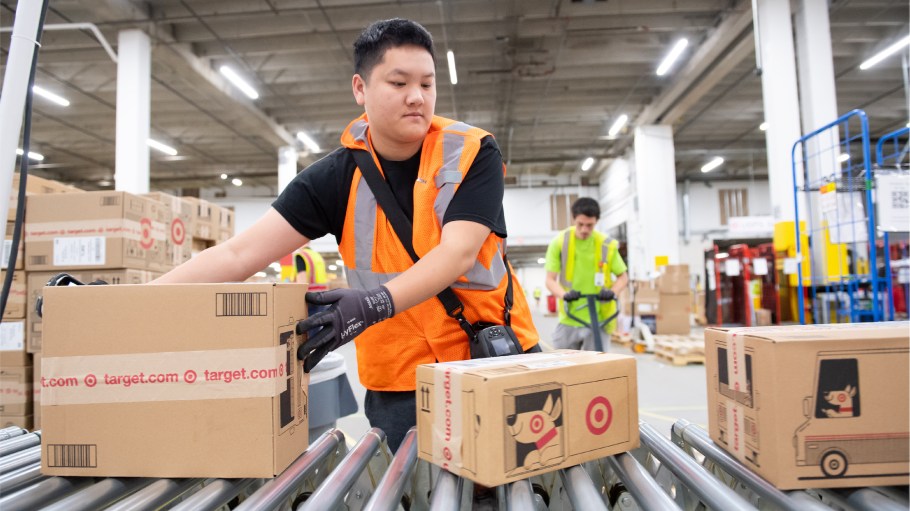
The company’s last-mile investments continue to pay off. The Minneapolis-based retailer, which already fulfills 97 percent of sales directly from stores, has gotten a boost from using sortation centers to orders to online shoppers even faster.
Related Stories
“In markets where we operate a sortation center, the average click-to-deliver time is nearly 1.5 days shorter than the network average, with about a third of the packages arriving in only one day,” said John Mulligan, executive vice president, chief operating officer, Target, in a statement. “As we continue to open new buildings and test and iterate on their operating model, we expect these speed metrics will continue to improve in the future.”
Target currently operates 10 sortation centers positioned further downstream from stores to accelerate delivery speed and efficiency. It expects to open at least six more in the next few years as part of a $100 million investment.
This current group of sortation centers is expected to process more than 35 million packages this year, short of the 50 million it originally expected. But this still represents a more than 20 percent increase from a year ago and a more than sixfold increase from 2021.
Up to 70 percent of the packages processed by these facilities stay in the local market, with Target leveraging its quick-turn delivery service Shipt to handle the last mile. Target acquired the delivery company in 2017 for $550 million—a deal that set the tone for the retailer’s omnichannel fulfillment strategy.
Walmart measures deliveries in ‘hours rather than days’
As Target expands its delivery network, chief competitor Walmart saw 24 percent e-commerce growth in the U.S., led by double-digit growth in store-fulfilled pickup and delivery.
America’s largest retailer offers same-day delivery from 4,600 Walmart and Sam’s Club stores in the U.S., with CEO Doug McMillon saying in the company’s second quarter earnings call that Walmart is “increasingly measuring those deliveries in hours rather than days.” These stores fulfill more than 50 percent of digital orders.
“What we’re ultimately trying to do with supply chain in the entire e-commerce business, is densify our inventory at the first mile, make the middle mile as efficient as possible and then shorten the last mile,” said McMillon in the call. “And our store locations, in addition to the fulfillment centers, enable us to do that.”
In China, where the company delivers from all of the 360 stores it runs in the market, it delivers 80 percent of digital orders in one hour, McMillon said.
Walmart’s fulfillment services are impressing third-party sellers on its marketplace as well, with the total of merchants using them increasing more than 50 percent, according to executive vice president and chief financial officer John David Rainey.
The company also opened its first automated fulfillment center in Alberta, Canada in June, which expands two-day shipping to 97 percent of Canadian residents.
“Our automated e-commerce fulfillment centers are achieving efficiencies of 30 percent higher units per hour than non-automated buildings,” said Rainey in the call. “We’re also seeing increased productivity from the more than 15 percent of stores now being served by automated regional distribution centers. It’s early in the rollout process, but we are encouraged that some of these facilities are driving operating leverage well beyond our initial expectations.”
Target’s ‘outstanding’ drive-up returns results
Target’s Mulligan brought attention to the implementation of drive-up returns it first piloted late last year. Following the successful test, Target launched the service nationwide in April and May.
“The results have been outstanding,” said Mulligan. “Once a guest arrives at a drive-up lane, the average wait time for a team member to process their return is within three minutes, consistent with our standards for a traditional drive-up order.”
Target has cut inbound backlogs at regional distribution centers by more than one day since last year. “Flow centers” designed to draw from a common inventory pool and send smaller shipments to stores to enable quicker turns and lower stock levels, are also seeing improvements “across multiple performance metrics” as they scale up.
“In support of their primary role in replenishing store inventory, these facilities were designed and equipped to support our ‘stores as hubs’ strategy, with newly developed automation that can assemble customized, pre-sorted and sequenced shipments for every store they serve,” Mulligan said. “With these shipments, stores see faster replenishment times, require less labor to unload a trailer, and maintain lower levels of backroom inventory.”
Stores serviced by these flow centers have seen a 20 percent reduction in lead times on average since Target started building them in 2018, enabling them to quickly respond to evolving customer demand.