In 2023, less than a year into her tenure as Target’s supply chain head, Gretchen McCarthy came to a realization—the mass merchant’s logistics operation would vastly benefit from the data customers were accessing when search for products within the Target mobile app. Two years later, better use of this data combined with more than $100 million invested into the retailer’s sortation centers has helped Target’s same- and next-day delivery expansions take off.
Target had been measuring out-of-stocks as the primary inventory reliability metric for years, according to McCarthy, but consumer research by the retailer learned that shoppers using the app had the best grasp of what was available at their local store, as they had access to more accurate real-time product location data.
Related Stories
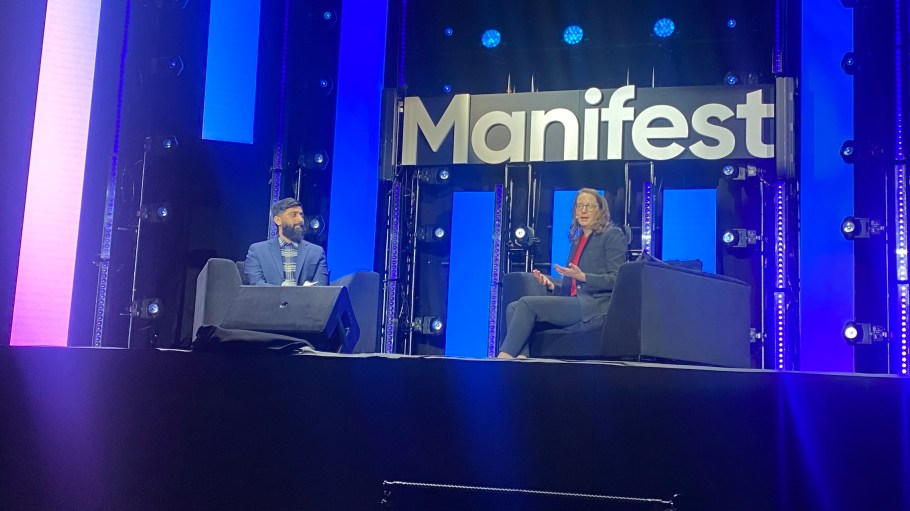
“That kind of understanding really caused us to step back and think, the front door to a guest isn’t the Target store. The front door to a guest is our app,” McCarthy, officially the company’s executive vice president and chief supply chain and logistics officer, said during a one-on-one keynote at the Manifest supply chain and logistics conference.
“You need to understand, is my item eligible? Is my item available? Is it eligible for all fulfillment types? Are we tracking every single item in our catalogue?” McCarthy said.
She noted that by collecting more of that granular data, Target can more confidently direct its wider product assortment to different fulfillment options depending on their location, including same-day delivery, next-day delivery, in-store pickup or the Drive Up curbside pickup option.
“We have talked about the power of having 75 percent of Americans live within 10 miles of a Target store, but what we hadn’t done was really connect the end-to-end ecosystem and value stream, starting from our stores all the way through our Target last-mile delivery. We weren’t able to promise a delivery that was as fast as it is, given where our stores are located, but the teams took that on,” said McCarthy. “They solved that problem horizontally, and now being able to connect our stores to our sortation centers to target last-mile delivery.”
In its most recent quarter, the retailer saw nearly 20 percent growth in same-day delivery and double-digit growth in the Drive Up curbside pickup option. In November, chief operating officer Michael Fiddelke said average shipping times were nearly one day faster than in the year prior, with the company’s now 11 sortation centers have saved the company “tens of millions of dollars” in last-mile delivery costs in 2024.
As Target keeps investing in its expanding distribution network to shorten the last mile, it is also looking to improve the efficiency of the warehouse-to-store journey.
McCarthy said the mass merchant is testing technology within select distribution centers that sorts individual cartons to be placed within designated custom block locations of a store.
This is designed to speed up the trailer unloading process once a truck reaches a store on its delivery route, and help the facilities “ultimately be better partners for our stores,” McCarthy said.
“If you ask any of the 2,000 store directors what is going to make or break their day, they will tell you it’s the trailer unload—when a trailer comes from one of our distribution centers,” said McCarthy. “That sets the tone for the day. These trailers have thousands of SKUs across up to 3,000 cartons, and it’s hard. It drives payroll, it drives potential safety issues and ultimately, it’s not very efficient.”
Target is also leveraging AI technology to bolster its inventory planning and purchasing across the supply chain, using an “inventory-not-found” modeling system to predict the availability of products in a store.
“Ultimately, I see that as one of the biggest long-term drivers,” said McCarthy. “We can bring down the amount of inventory that we own.”
McCarthy also shared some of the sustainability wins that the business is looking to generate throughout the supply chain, with the company committing to a net-zero enterprise by 2040.
By optimizing trailer fill for deliveries to stores, Target was able to reduce 20 million miles in store delivery alone. And with the expansion of its sortation centers in recent years, and improvements in inventory position nationwide, the retailer has brought down excess packages.
Additionally, McCarthy highlighted Target’s first “TRUE Certified” location designation from the TRUE Certification for its Hawaii flow center in 2022, meaning 90 percent of the waste that building produces is diverted from landfills.