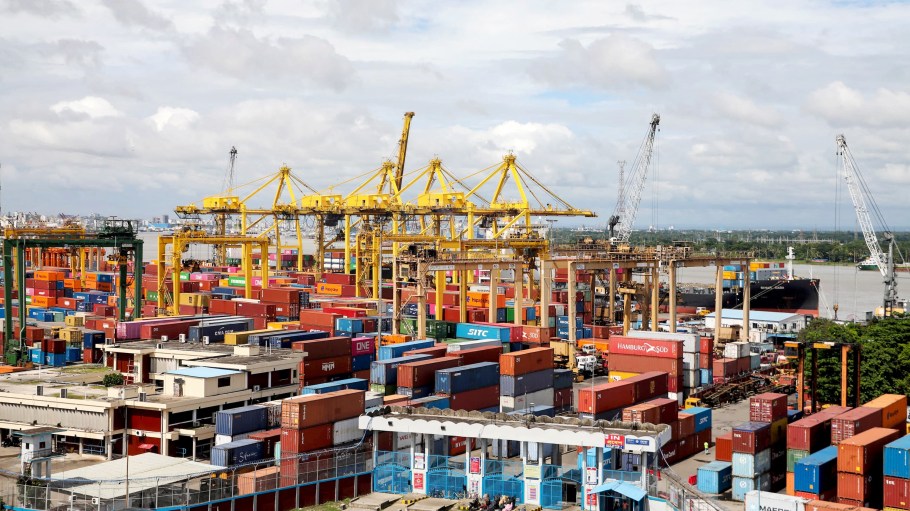
A two-day strike at Bangladesh’s biggest port shut down the movement of containers over the weekend, grinding shipping activity in the area to a standstill before the country’s government issued a back-to-work order late Sunday.
At Chattogram Port, customs officials walked off the job on Saturday and Sunday in solidarity with the federal government’s National Board of Revenue (NBR), the parent organization of the Chattogram Customs House.
NBR officials implemented a “complete shutdown” program on Saturday, with the agency’s employees all stopping work in tax, customs and VAT offices across the country. The agency has already held several labor disruptions, including hunger strikes and human chains, in protest of an ordinance on May 12 that would abolish the organization and establish two new entities in its place.
Related Stories
The absence of customs clearance officers at Chattogram Port effectively stalled the hub’s import-export processes, as there was no one to scan, inspect and clear the goods, preventing the port from releasing any cargo. Employees who were present did not perform any duties, a Chattogram Customs House told Bangladeshi publication The Business Standard.
Cessation of customs activities spread to multiple land ports on the border of India, including the Akhaura Land Port and Bhomra Land Port, halting trade through Sunday. The Indian government had already restricted imports including readymade garments (RMGs) through these land gateways.
In a statement shared with Reuters, the interim government of Prime Minister Muhammad Yunus said that import-export operations must continue uninterrupted to protect the economy, and that all NBR jobs were deemed essential services.
During the two-day stretch, transportation of import and export containers to and from Chattogram Port had also been entirely suspended.
This meant none of the 19 private inland container depots (ICDs) in Dhaka—which are typically used to alleviate congestion at Chattogram by adding more area for container handling—sent export-laden containers to the port.
More than 14,000 containers piled up across the ICDs due to the NBR shutdown over the weekend, according to a report from The Business Standard. Under normal circumstances, the depots collectively hold roughly 10,000 to 11,000 containers, according to Mohammad Ruhul Amin Sikder, secretary general of the Bangladesh Inland Container Depot Association.
“In the past two days alone, around 3,000 to 3,500 containers were supposed to move from the ICDs to the port for shipment. But due to the shutdown, they couldn’t be transported,” Sikder told The Business Standard,
At least four vessels were unable to depart the port because they could not receive containers from the ICDs, the report said.
On Monday, the Chattogram Port (also known as Chittagong Port) is scheduled to dispatch between 6,000 and 7,000 containers on five vessels.
At the port, clearing and forwarding agents resumed work Monday morning.
According to the Chattogram Port Authority, 10 container vessels are were berthed at the port’s jetties as of Monday morning, while 19 more ships are waiting at the outer anchorage.
Mahmud Hasan Khan Babu, the recently elected president of the Bangladesh Garment Manufacturers and Exporters Association (BGMEA), said the suspended port operations would cost the country’s RMG industry an estimated $222 million.
“The cost of recovery will be staggering—beyond comprehension—and many factories risk going bankrupt,” he told French news agency Agence France-Presse (AFP).
Apparel is the backbone of Bangladesh’s export economy, with the southeast Asian nation exporting $36.6 billion in RMGs throughout the first 11 months of the 2024-2025 fiscal year through May, according to the Export Promotion Bureau.
Chattogram has recently been a hotbed for congestion, seeing significant delays due to the country’s political unrest last year and other events like flooding and a software glitch that coincidentally caused the port’s customs clearance systems to malfunction.
Ahead of the strike, Kuehne + Nagel identified the Chattogram port as “heavily disrupted” in a Thursday update. Average waiting times for ships to berth at the port totaled 4.89 days in the week prior to the update, the logistics giant said.
At the time, the port had a yard occupancy rate of around 79 percent, with the company saying the yard is facing “severe space constraints” due to the extended Eid al-Adha holiday in early June.
The lack of space has more heavily affected imports slowing vessel operations at two of Chattogram Port’s terminals: New Mooring Container Terminal (NCT) and Chittagong Container Terminal (CCT).
Export loads are also limited because of “time consuming” cargo unloading operations, worsened by CPA equipment issues, according to Kuehne + Nagel.
Due to a rail shortage, dwell times for Dhaka ICD-bound imports are seven to 10 days for 20-foot containers and two to three days for 40-foot containers.