A Red Sea return may not imminently be in the cards for the container shipping industry despite the recent Israel-Hamas ceasefire, but such a move could lead to more European port congestion if carriers made the commitment.
According to an analysis from maritime advisory firm Sea-Intelligence, there would be two primary impacts of an industrywide resumption of Suez Canal transits: a significant release of global vessel capacity currently absorbed by longer voyages around Africa, and a potentially disruptive surge in cargo arrivals into Europe.
Related Stories
A mass return to the Suez would release approximately 2.1 million 20-foot equivalent units (TEUs) of nominal capacity, equivalent to 6.5 percent of the current global fleet, Sea-Intelligence says.
The analysis quantified the capacity absorbed by round-Africa diversions across Asia-to-Europe and some Asia-to-North America East Coast services, accounting for roughly four additional vessels needed per round trip for affected services.
Sea-Intelligence modeled the European import surge under different scenarios, ranging from an instantaneous switch back to the Suez by all shipping lines, to a more gradual phase-in over two, four or six weeks.
An immediate switch back to the Red Sea would shorten supply chains dramatically, causing a temporary doubling of arrivals from Asia to Europe for two weeks. This translates to a 39 percent surge in total port handling volumes across the continent compared to the previous all-time peak in March 2025, said Sea-Intelligence CEO Alan Murphy.
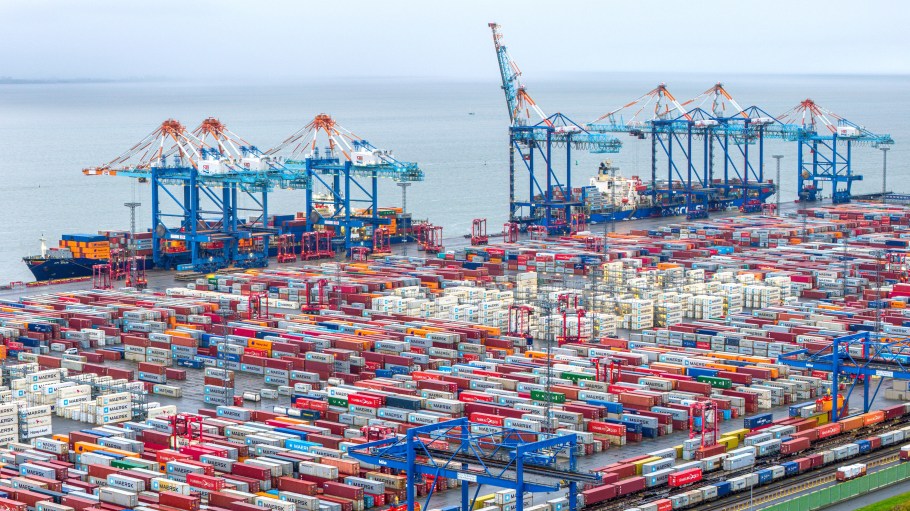
European ports like Rotterdam and Antwerp have been slammed with congestion throughout the year due to various labor strikes and disruptions, as well as schedule changes brought upon by the Red Sea diversions.
“Even a phased switchover presents a considerable challenge for port infrastructure,” Murphy said in the recent update.
A two-week phase-in would result in a 19 percent increase in European port volumes, including both imports and exports. On a four-week basis, these volumes would increase 13 percent. Even if the phase-in took six weeks, it would still add 10 percent more cargo to the continent’s ports compared to the early 2025 peak levels.
Currently, there is no indication from most major container shipping firms that they will make a routine return to the Red Sea, despite the Suez Canal Authority’s efforts to incentivize a consistent comeback.
After the canal’s operator urged Maersk to gradually resume transits in the waterway in the wake of the Gaza ceasefire, the ocean carrier indicated it was still too early to assess how progress in the region would influence the situation.
The Houthi militants who have been attacking commercial vessels since late 2023 in response to Israel’s offensive against Hamas have not declared a ceasefire of their own. And without a security guarantee that the Yemeni group will not attack again, Maersk and rivals like Mediterranean Shipping Company (MSC) remained steadfast in avoiding the region altogether.
Adding to the security concerns is the overall cost to shifting networks. Maersk CEO Vincent Clerc noted in February that it would cost “hundreds of millions of dollars” if the liner returned to the Suez Canal, only to have to revert to the Cape of Good Hope route in the event of new attacks.
As decision making on the Red Sea situation continues to move slowly, freight rates out on the ocean have seen a recent uptick as carriers sought to curb the months-long rate slide with their own general rate increases (GRIs).
After a decline of 17 straight weeks, the Drewry World Container Index (WCI) has seen two consecutive weekly increases in rates. As of Thursday, the WCI increased 3 percent from the week prior to $1,746 per 40-foot container.
Spot rates from Shanghai to Los Angeles increased 4 percent to $2,290 per container, while those to New York rose 6 percent to $3,420. Drewry expects rates to increase slightly next week due to the GRIs implemented in mid-October.
According to research firm, carriers are planning to implement new GRIs on Nov. 1 and Nov. 15 on these trade lanes to secure higher prices before the effect of the current rate increases completely fades away.
Another freight rate benchmarking platform, the Freightos Baltic Index, has seen an even bigger jump in container prices on the Asia-to-U.S. West Coast route.
“Trans-Pacific prices to the West Coast increased 18 percent last week from a year-to-date low of about $1,400/FEU the week before to about $1,700/FEU, with daily rates this week above the $2,000/FEU mark so far,” said Judah Levine, head of research at Freightos, in a Wednesday update. “Daily rates to the East Coast of $3,357/FEU are more than $300/FEU higher than a week ago.”
Both benchmarks had increases on the Asia-to-Europe trade lanes, although the rate growth was more substantial on the Freightos index.
Asia-to-Northern Europe container prices increased 13 percent to $1,975 per 40-foot container, while Drewry’s Shanghai-to-Rotterdam rate jumped 4 percent to $1,736 per box.
According to Drewry, major shipping lines have announced new freight all kinds (FAK) rates on the route effective Nov. 1, ranging between $2,600 and $2,700 on average.
Levine noted that despite the expected incoming GRIs, the rates climbing during low demand “has many observers skeptical that prices will remain elevated.”