Labor actions have swept through two of the busiest ports in Northern Europe, further compounding the congestion that has pervaded in the region throughout 2025.
On Wednesday afternoon, approximately 700 lashers at the Port of Rotterdam began a 48-hour strike. Lashers are the dockworkers responsible for securing and fastening cargo on ships.
As a result, arriving ships cannot be unloaded and already loaded ships cannot depart. Vessels that are already docked near the terminals are experiencing delays or interruptions in their load and discharge operations.
Related Stories
The work stoppage is expected to last until 3:15 p.m. local time Friday, but could extend further into the weekend pending the result of ongoing negotiations between the union and its employers.
The number of ships in the queue to dock at the port has doubled from a normal six to seven ships up to 13, a port spokesperson told Reuters early Thursday.
Sourcing Journal reached out to the Port of Rotterdam.
“While terminal infrastructure (including tugs and pilots) remains operational, vessel operations are currently being significantly impacted due to the suspension of services by these independent lashing companies,” said Maersk in an advisory to customers Wednesday.
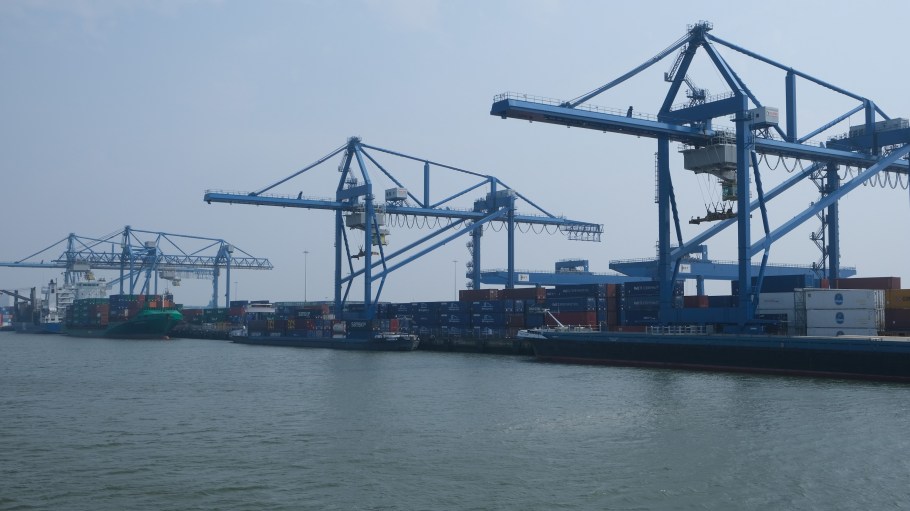
The strike is affecting all major terminals in Rotterdam, including APM Terminals Maasvlakte II, Hutchinson Ports Delta II, ECT Delta and Rotterdam World Gateway.
The Netherlands Trade Union Confederation (FNV) said the lashers work for two companies that handle all loading and unloading at the port, International Lashing Services and Matrans Marine Services.
The FNV union is calling for a 7 percent pay increase for the workers and for wages to rise in line with inflation, with the employers having proposed annual wage increases of 4 to 6 percent.
An FNV spokesperson told Reuters the union would meet with Matrans and ILS on Friday at noon local time. If an agreement is reached, lashers will resume work. If not, the union has threatened to continue the strike over the weekend.
In a statement late Wednesday, Matrans and ILS called the strike “unjustified and very harmful,” noting that dockworker wages have already risen by roughly 25 percent over the past four years.
“The FNV’s excessive demands will push prices even higher, and it is unlikely our customers will cover the cost,” the employers stated. “We believe the limit has been reached.”
The Rotterdam strike followed labor action at Belgium’s Ports of Antwerp-Bruges and Zeebrugge ongoing since Monday. Through the week, harbor pilots that help captains guide cargo ships into the port have operated strictly under office hours.
With this action, pilots man the ships from 10 a.m. at the earliest to 5 p.m. at the latest, instead of their typical 24-hour cadence. In total, roughly 300 maritime pilots that handle ocean and inland shipping are part of the protest.
The work slowdown has significantly disrupted shipping operations at both ports.
As of Thursday morning, there were 65 vessels at Antwerp without a known schedule for entering or leaving the port and 27 vessels experiencing delays. In Zeebrugge, seven vessels are experiencing delays.
Maersk expects “severe delays to vessel arrivals and departures in the coming days.”
The Professional Association of Pilots conducted the “work-to-rule” action due to an enduring labor dispute with the Belgian government over federal pension reforms. The parties reached a provisional deal over the summer, but talks have since stalled.
A report from The Brussels Times indicates the union has been critical of perceived unequal treatment within their pension compared to that of employees in other industries. Younger pilots could be facing up to a 45 percent decrease in their pensions under the proposed reforms.
According to German container logistics services provider Contargo, port congestion had already been accelerating ahead of the Rotterdam strike.
As of Tuesday, the average waiting time before container handling at Rotterdam was 66 hours, while the wait Antwerp was 51 hours. A week prior, the averages were 58 hours and 45 hours, respectively.
Congestion at these ports may be crunching capacity and causing delays, but it hasn’t prevented freight rates from declining in the region.
According to Drewry, spot rates on the Asia-to-Europe trade lane have recorded their ninth straight weekly decline, approaching levels prior to the Red Sea attacks. As of Thursday, the spot rate for a 40-foot container is now at $1,577 from Shanghai to Rotterdam, representing a 2 week over week drop. Trans-Atlantic cargo shipped from New York to Rotterdam also dipped 2 percent to $830 per container.