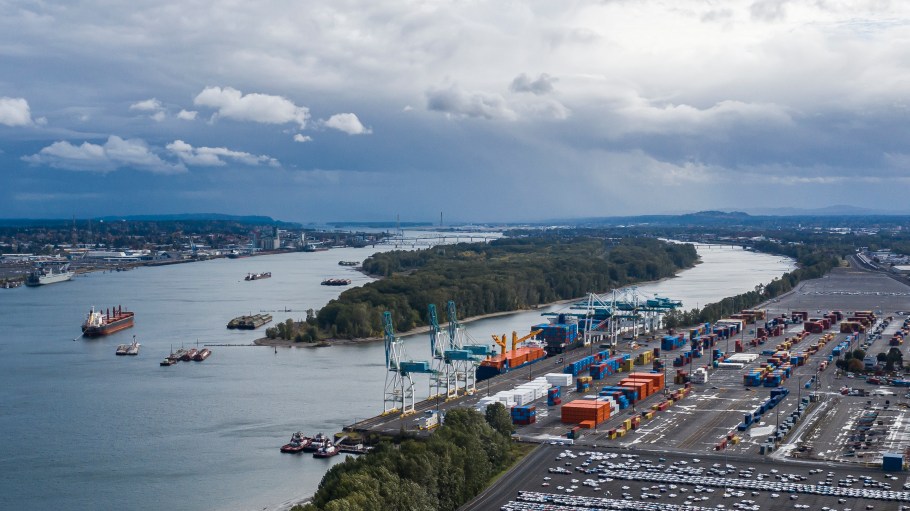
The only container terminal at Oregon’s Port of Portland is getting a second wind after the gateway was in danger of shutting down.
At a launch event Wednesday, the port’s Terminal 6 was rechristened the Oregon Container Terminal (OCT), with its new operator establishing plans to double the cargo shipments handled there in 2026.
“This terminal has existed for over 40 years. The infrastructure is here. The people are here. The commodities are here,” Tim McCarthy, president of the OCT, said during the event. “But what didn’t exist is stability—stability and the guarantee that this terminal is staying open.”
Related Stories
McCarthy estimated the terminal handles 30 percent of the state’s cargo.
“We want to bring that back, all the rest of it, 70 percent, back to the state,” McCarthy said at the event.
The Port of Portland had long sought a partner that would be able to keep the terminal afloat, with the gateway experiencing financial woes that led port management to consider closing the terminal entirely as early as April 2024. The port reversed course one month later after Governor Tina Kotek committed to providing $40 million in state funds.
OCT is seeking to win back traffic that it has lost over the past decade. The terminal lost more than 95 percent of its container service in March 2015 when Hapag-Lloyd and now-defunct Hanjin Shipping pulled out of service there.
In May 2016, the container service was shuttered after another local carrier, Westwood Shipping, said it would stop calling at the port. The service returned in January 2000 when South Korean carrier SM Line began its weekly service at the terminal.
But the terminal has had a tough time bringing back container shipping companies due to its location, which sits inland on the Columbia River. Its positioning is a drawback for larger cargo vessels, and limits the size and number of vessels the port can host.
Through November last year, the then-Terminal 6 handled 60,734 TEUs, according to S&P Global’s PIERS bill of lading database. The figures are a stark drop from those posted from 2000 to 2005, when the port handled more than 300,000 TEUs annually.
To start its revitalization, the port leased the 419-acre facility to California’s Harbor Industrial Services in September, which officially assumed control of the operation on Jan. 1. The company has a seven-year lease with four renewal options, each for five years. It also purchased the facilities’ seven cranes.
“Securing a long-term operator for container service at Terminal 6 means exporters and importers across the state and region can keep moving their goods efficiently, competitively and closer to home while supporting thousands of family-wage jobs and our state’s economy,” said Port of Portland executive director Curtis Robinhold in a statement.
Under the new management, OCT offers direct vessel services, dual-rail connectivity via BNSF and Union Pacific and future barge services connecting with inland locations.
Weekly container service has already begun, with two vessels arriving and departing from the terminal.
The SM Shanghai stopped at the port on Dec. 29, before setting sail on Dec. 31. On Monday, the SM Yantian docked at the terminal, before leaving Wednesday. Both ships are currently sailing westward to South Korea’s Port of Busan.
A third vessel, the SM Long Beach, is set to arrive at Sunday morning.
SM Line had operated the only regular service at the port. Mediterranean Shipping Company (MSC) also had a weekly service from Asia to Portland earlier in 2025, but that service was paused after U.S. tariffs kicked in, as the carrier shifted space on the vessels to make room for cargo from other ports.
McCarthy said at the event he expects MSC will start shipping through the terminal again in the second quarter of 2026.
“We already have lots of interest from the other shipping lines to come in because the cargo is here in Oregon,” McCarthy said.
As of Jan. 16, the container terminal will be handling imports and exports five days a week, up from the current four days of operations. The terminal currently services China and South Korea, and features five ship berths and an on-dock rail yard.
“We want to invest in bringing in more trade destinations,” including Japan, other parts of Asia and the Mediterranean, McCarthy said.
Truck gates are open Monday through Friday from 8 a.m. to 5 p.m., although additional time can be extended, if pre-arranged. Trucks picking up or dropping off dry containers that are in line at 4 p.m. will be serviced.