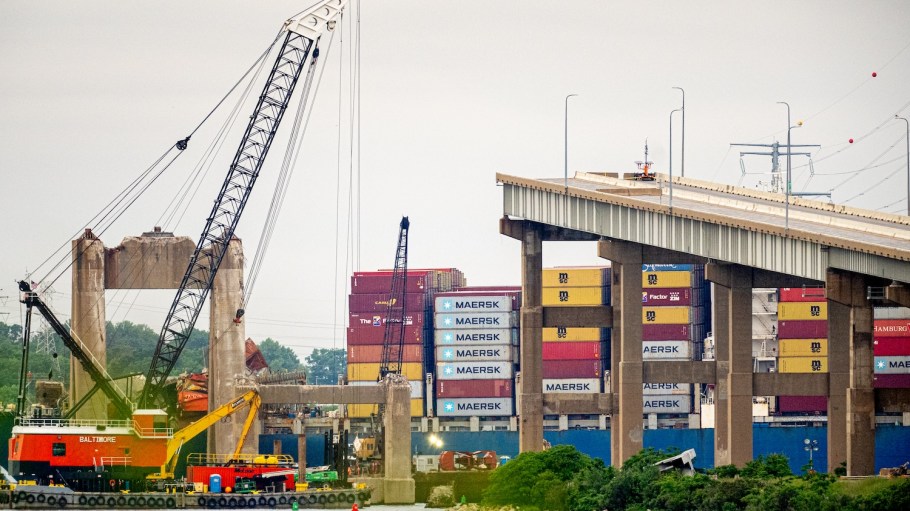
The main channel to the Port of Baltimore is set to reopen Monday more than two months after the deadly collapse of the Francis Scott Key Bridge.
Full restoration to the channel was projected to take place June 8-10, after an initial weeklong delay. U.S. Coast Guard Commander Baxter Smoak said Friday that the channel will be open Saturday or Sunday, depending upon the results of a survey of the channel.
Ten weeks after the bridge’s collapse, which closed off commercial vessel traffic to and from the Port of Baltimore, salvage crews successfully removed the final large steel truss segment blocking the 700-foot-wide Fort McHenry Federal Channel across the two-day span of June 3-4.
Related Stories
The Unified Command team in charge of recovery at the bridge wreckage in the Patapsco River says they used concrete breakers, underwater surveys and torches to separate tons of concrete roadway, cable and steel rebar, while removing debris with clamshell dredges.
Upon refloating the damaged Dali ship responsible for crashing into the bridge and causing its collapse, Unified Command crews had previously cleared the federal channel to a width of 400 feet and a depth of 50 feet to allow commercial vessels access to the Port of Baltimore.
Typically, approximately 200 deep-draft vessels, which are ships that require use of the federal channel, come to Baltimore each month, but that traffic was stalled by the bridge collapse. Since April 1, there have been nearly 150 ships that have used one of the river’s temporary channels to reach the port.
Ocean carrier giants including Mediterranean Shipping Company (MSC), Maersk and Hapag-Lloyd already have made their return to the port. Most recently, Evergreen Marine started accepting import bookings for Baltimore on its neo-Panamax Asia-to-U.S. East Coast Service (AUE).
With the larger channel opening, the Port of Baltimore appears to have easily resumed business as usual, with vessels seeing the lowest berthing times since the bridge collapsed, according to data from supply chain visibility platform Project44.
Vessel berthing times—the amount of time it takes for a ship to be processed once reaching a port—at the Port of Baltimore decreased from a peak of over 10 days after the bridge collapse to just 0.19 days at the end of May.
Project44 reported a spike in import dwell when the port was closed due to limited containers being processed, escalating from roughly five days to 35 days in the month after the crash. Afterwards, dwell dropped to zero for a few weeks when any remaining containers were gated out. Last week, dwell times saw a return to three days on average as new containers entered the port for processing.
Export dwell also saw a spike in the immediate aftermath of the bridge’s collapse, from a 10-day waiting time to a 15-day dwell. This is due to containers being dropped off or containers loaded onto the vessels stuck at port having nowhere to go. Throughout April, the export dwell times went down to zero before turning up back to 15 days when more shipping channels began opening.
“This will likely remain high for a few more weeks as the backlog of exports are loaded onto vessels,” the Project44 analysis said.
As the Port of Baltimore preps for the return of more cargo, another scare similar to the Key Bridge incident occurred outside the Port of Charleston.
The 2.5-mile-long Arthur Ravenel Jr. Bridge in Charleston, S.C. was temporarily closed in both directions Wednesday afternoon after a crew lost control of a large container ship after it left the port. The 997-foot MSC Michigan VII was leaving Charleston Harbor when the throttle malfunctioned early in its voyage, causing the vessel to lose propulsion and sending it barreling ahead at twice the typical speed.
The U.S. Coast Guard was alerted to an “out of control vessel” in the Cooper River around 12:17 p.m. Wednesday, when authorities shut down the bridge before the ship passed underneath.
The vessel passed safely under the bridge and didn’t hit any of the bridge’s support beams. Eventually, the crew was able to regain control of the engines and anchored the vessel about 8.5 nautical miles offshore, before several tugboats ushered the ship back to the port.
The near disaster is generating increased scrutiny of cargo ships and what appear to be more routine power failures across the U.S. as they continue to grow in size.
An April analysis from the Washington Post found that 424 cargo ships longer than 600 feet reported losing propulsion in U.S. waters over the past three years. About a quarter of the incidents occurred near a port, bridge or other infrastructure, the analysis found.
The incident happened two weeks after the South Carolina ports were forced to briefly shut down to a software issue. The shutdown led to weeklong backlogs for vessels docking at the state’s gateways.