Bookings for cargo entering the Persian Gulf are plummeting amid concerns for the safety of commercial vessels traversing the Strait of Hormuz. But for cargo that is already in transit, shippers are staring down an uncertain future where the destination port, total costs involved and overall responsibility after drop-off all remain unknown.
On Thursday, container tracking intelligence company Vizion reported an 81 percent two-day drop in daily bookings placed by shippers looking to import goods into Gulf-based ports. That amounts to a decline of 8,087 20-foot equivalent units (TEUs) per day from the previous 30-day rolling average.
Related Stories
Given the state of the war in Iran, Ben Tracy, vice president of strategic business development at Vizion, said the declines indicate a more-than-expected optimism among shippers that goods will make it to their destination without speed bumps.
“The fact that it’s not a 100 percent drop, and only an 80 percent drop, was actually surprising to me,” Tracy told Sourcing Journal. “Carriers have announced they’re not accepting new bookings. So clearly, some are still getting through. These might be bookings going from the U.S. East Coast to the Jeddah Port in Saudi Arabia. That’s a 45-to-60-day transit journey. That’s an optimistic booking being placed by the shipper and accepted by the carrier, that two months from now, those containers can get into the Strait of Hormuz and into these Arabian ports.”
For bookings that were made ahead of the Middle East hostilities, the circumstances of where containers are dropped off has become less clear.
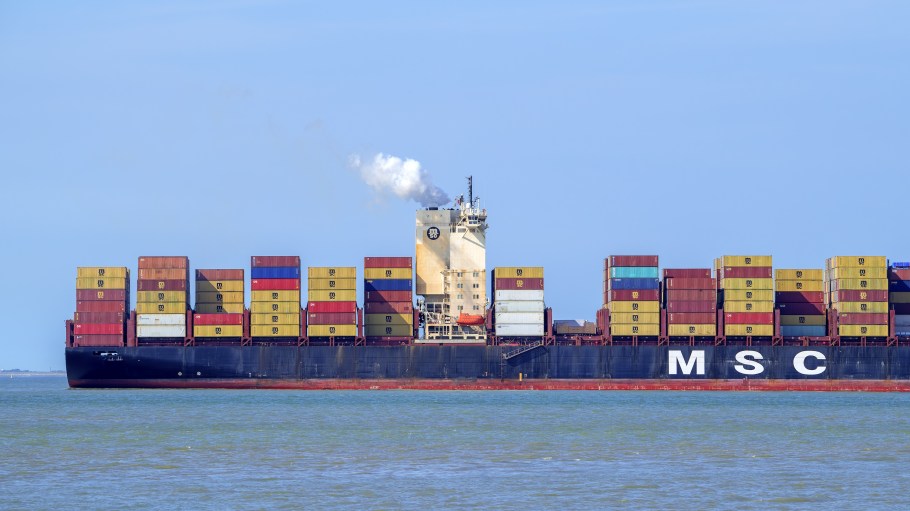
While most major container shipping firms are skirting the Persian Gulf, Mediterranean Shipping Company (MSC) and Regional Container Lines (RCL) have gone even further by declaring “end of voyage” for Mideast-bound cargo in transit.
Under these terms, the carriers will divert their routes to the next safe port of discharge, where they will drop off the cargo. To cover these deviation costs, MSC is charging $800 per container affected, while RCL is charging $500.
In an end of voyage declaration, shippers or consignees must take full responsibility for the cargo at the alternative port, including local handling, storage and customs. This means they must arrange a new booking to move cargo onward.
With Vizion’s data covering roughly 40 percent of all containers moving around the world, the company estimates that MSC has approximately 350,000 TEUs Gulf-bound cargo that would be impacted by the changes.
Citing calculations by container shipping expert Lars Jensen, an 80/20 split between 40-foot and 20-foot containers would likely net MSC in the ballpark of $150 million from the end of voyage costs, according to Tracy.
“Obviously MSC is facing all kinds of increased costs and delays and insurance fees, but that’s one example where the carriers are trying to recoup,” Tracy said. “You see the surcharges being applied for any new shipments being booked as a part of that as well.”
In one example based on Vizion analysis, an MSC container loaded on Feb. 22 at the Port of Savannah is scheduled to reach the Dammam port in Saudi Arabia on April 22. That port sits on the Persian Gulf and is currently a no-go for the ocean carrier.
The MSC Kleven vessel carrying the container, which includes goods for Saudi dairy company Almarai, stopped at Mexico’s Port of Veracruz Friday morning.
Tracy noted that it remains unclear where the container will be finally dropped off, and what decision Almarai will have to follow up with.
Although end of voyage has not been declared en masse by the industry, MSC and RCL’s decision brings into question whether other carriers would follow suit based on the circumstances.
“If I were to read the mind of someone like MSC, they don’t think this is going away anytime soon,” Tracy said. “If they’re declaring end of voyage for containers that are scheduled to arrive in 45 days, that would indicate that they’re planning for this to drag out, or at least, you know, covering their bases in case it does.”
The world’s largest ocean carrier, alongside competitors like Maersk, Hapag-Lloyd, CMA CGM and Ocean Network Express (ONE) have all tacked on extra war-risk and emergency surcharges on routes impacted by the Middle East disruptions.
The booking declines and uncertainty for goods in transit will only be compounded as major container shipping companies take more cautious approaches to journeying through the conflict-ridden waterway.
“Everything is wait and see,” Tracy said. “If I’m a big importer, how can I plan for lead time projections in Q2? I’m guessing at this point how long it’s going to take to go from, for example, Chennai port to Rotterdam, because none of the carriers are promising certain rates and predicted transit times.”
Carriers continue to shift Middle Eastern services
Already having halted bookings across several Middle Eastern countries, Maersk and Hapag-Lloyd suspended multiple shipping routes into and out of the region Friday as the U.S. and Israel continue their military offensive in Iran for the seventh day.
The Gemini Cooperation is suspending the joint FM1/AGX service that connects the Far East to the Middle East, as well as the Middle East-to-Mediterranean ME11/IMX service.
The alliance is also scrapping the Port of Jebel Ali, the largest port in the Middle East, from the ME11/IOS Middle East-to-North Europe loop. That service will continue to call India’s Mundra and Nhava Sheva ports and Oman’s Port of Salalah.
Hapag-Lloyd halted two service lines that looped from India to ports in Iraq and Kuwait, respectively, as well three additional shuttles on the Arabian Peninsula. The PKS Pakistan-to-Arabian Peninsula service has also temporarily stopped calling at Jebel Ali.
As the Gemini carriers drop the riskier services, they launched a joint Asia-to-Mediterranean AE19/SE6 service that stops in the Port of Jeddah.
CMA CGM, which already suspended all Middle Eastern bookings Tuesday, said Friday that the Middle East developments “will be key factors influencing market balance and freight rate trends” that could throw a wrench in the moderate growth expected for container shipping in 2026.
As the uncertainty lingers, an end to hostilities in the region would also be likely to add to the supply chain issues, rather than calm them, according to maritime expert and Campbell University associate professor Sal Mercogliano, during his What’s Going on with Shipping? video series Thursday.
“I am waiting for that snap. That snap that’s going to trigger those ships to go through the straits. And once that happens, get ready for the flood,” Mercogliano said. “To be clear, disruption is bad. Resumption is equally bad because once everything starts flowing, it’s going to cause chaos down the system for oil, for refined products, for liquefied and natural gas, and liquefied petroleum, for containers, for bulk carriers—you name it. It’s going to be a mess.”