On the same day President Donald Trump reiterated during his inaugural address that he wants the Panama Canal back under American control, Panama’s authorities began an audit of the company that controls two of the waterway’s adjacent ports.
The Panamanian comptroller’s office sent a team of auditors to the local offices of the Panama Ports Company, a subsidiary of Hong Kong-based CK Hutchison Holdings, to open the probe.
According to a Monday post on X, the audit is “aimed at ensuring the efficient and transparent use of public resources.”
Related Stories
President Trump first unveiled his desires to “take back” the canal in December, before suggesting earlier this month that he would even consider using military force to gain control of the 51-mile waterway.
Panama has owned the canal since Dec. 31, 1999, when the U.S. transferred control under the provisions of a 1977 treaty signed by President Jimmy Carter.
In his inaugural address, Trump bemoaned “the purpose of our deal and the spirit of our treaty has been totally violated,” repeating the claim that China is operating the Panama Canal.
Trump has not produced any evidence of this claim, and Panama’s government and President José Raúl Mulino have repeatedly denied that there is any Chinese presence at the canal.
“I fully reject the insinuating words by President Donald Trump at his inaugural address relating to Panama and its canal,” Mulino said in a statement Monday. “The canal is and will remain Panamanian and its administration will remain under Panamanian control with respect to its permanent neutrality.”
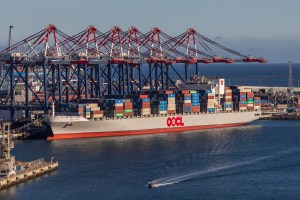
The president’s concerns probably stem from the fact that Hutchison operates two ports at the canal’s northern and southern entrances—the Port of Balboa on the Pacific side of the route while the Port of Cristobal operates on the Atlantic end.
New Secretary of State Marco Rubio called Hutchison’s China ties a “very legitimate concern” at his Senate confirmation hearing. While Hutchison is not owned by the Chinese government, the company is still subject to a broadly defined national security law that Beijing imposed on Hong Kong in 2020.
“If these companies control both ends of that canal in a time of conflict and the Chinese tell them, ‘Shut it down and don’t let the U.S. go through there,’ we’ve got a big, big problem—a big economic problem and a big national security and defense problem,” Rubio said at the hearing.
However, Seattle-based SSA Marine operates the largest container terminal in Panama at the Cristobal port, the Manzanillo Internal Terminal. Other terminal operators like Taiwan’s Evergreen Marine and PSA Singapore have long-term leases at the ports.
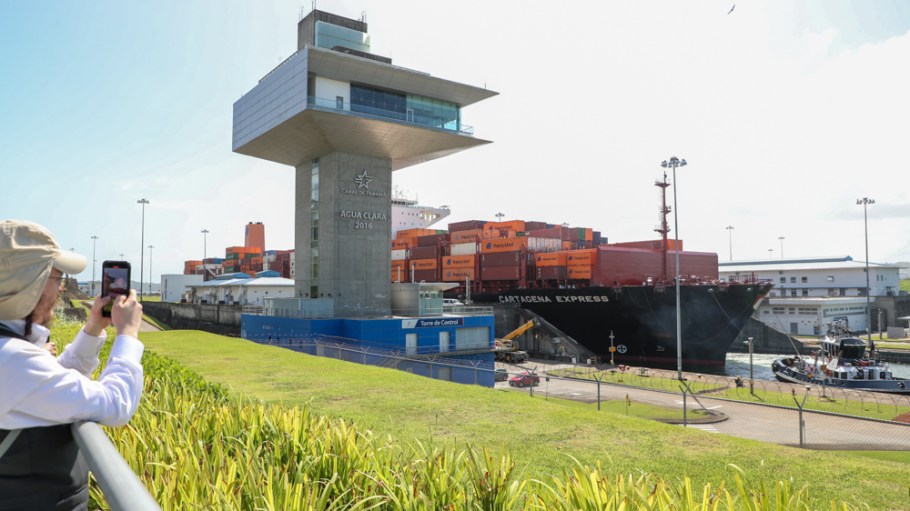
The Panama Canal is one of the most vital trade arteries worldwide, serving as the connector for cargo shipped between both the Atlantic and Pacific Oceans. The canal delivers a significant strategic supply chain advantage to the U.S., in that it accounts for 46 percent of the total market share of containers moving from Northeast Asia to the East Coast, according to the U.S. Department of Commerce.
One of Trump’s other major gripes is the contention that American ships “are being severely overcharged and not treated fairly in any way, shape or form.” These claims haven’t been substantiated.
“Rates are not a whim,” Mulino said in a statement last month. “They are and will be established, publicly and in an open audience, considering market conditions, international competition, operating costs and the maintenance and modernization needs of the interoceanic waterway.”
Panama Canal Authority (ACP) administrator Ricaurte Vásquez Morales also pushed back on Trump’s assertion that U.S. ships should get preferential rates.
“Rules are rules and there are no exceptions,” Vásquez told the Wall Street Journal. “We cannot discriminate for the Chinese, or the Americans or anyone else. This will violate the neutrality treaty, international law and it will lead to chaos.”
Rates are set by the size and type of ship, though the canal also runs auctions for slots for time-sensitive cargo. That practice was experimented with during the months-long drought period in 2023 and early 2024, when the ACP limited the number of daily transits allowed through the waterway.
Tolls average roughly $750,000 per passage, but typically range anywhere between $300,000 and $1 million.
The United States is the canal’s biggest user, accounting for 74.7 percent of canal traffic in fiscal year 2024. China comes in a distant second at 21.4 percent.
The Panamanian government formally raised concerns with the United Nations over President Trump’s threats to retake the canal, noting any threat of force would violate rules.
In a letter to U.N. Secretary General António Guterres, Panama highlights U.N. Charter language that directs members to “refrain in their international relations from the threat or use of any force against the territorial integrity” or independence of another state.