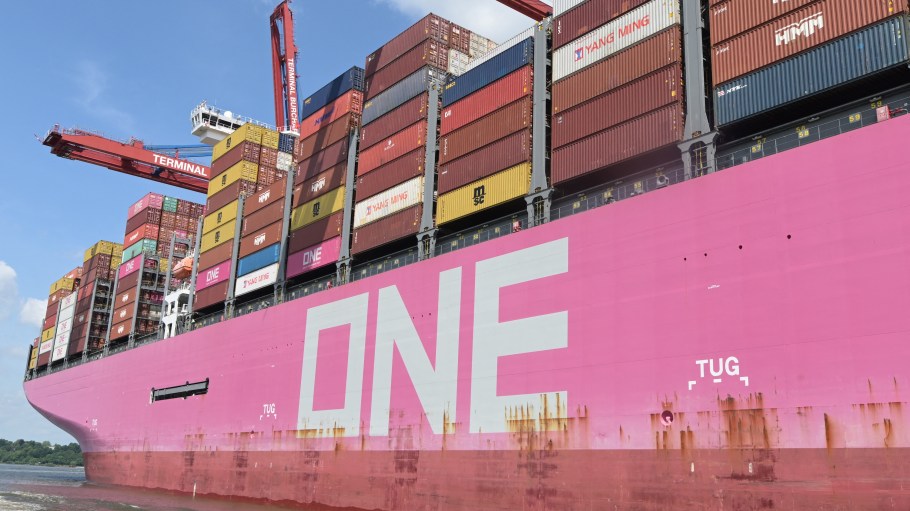
Ocean Network Express (ONE) downgraded its 2025 full-year outlook, saying the overall container freight market environment “may not prove as robust as initially projected” in its forecast.
The Japan-based ocean carrier more than halved its annual net income forecast from $700 million to $310 million, marking the second time this year the firm cut full-year projections. In August, at the end of its first quarter, ONE downgraded its forecast from a prior expectation of $1.1 billion in net profit.
Related Stories
The new estimate assumes that the second half of ONE’s 2025 fiscal year will see a net loss of $61 million as uncertainties from U.S.-levied tariffs on trade partners and expected to pervade. Previously, ONE had called a profit of $150 million in the half.
Projections still hinge on how the Red Sea situation plays out, namely whether vessels return to the Suez Canal. ONE says security risks persist, with ships expected to continue routing around the Cape of Good Hope.
Those diversions have essentially prevented an overcapacity situation from cramping the global supply chain that has already seen plenty of congestion at Asian and European ports throughout 2025.
If all the container ships currently on the Cape route are redirected to the Suez, it could release over 130 ships, or 1.95 million 20-foot equivalent units (TEUs), back into global capacity, according to data from Linerlytica.
That would represent 5.9 percent of the global fleet, which would trigger severe disruptions to the freight and charter markets, the consultancy said. Most of those vessels would go back to the Asia-to-Europe trade lane, with 4.2 percent of the global fleet returning to either the Far East-to-Northern Europe route or the Far East-to-Mediterranean course.
In combination with questions on the Red Sea, ONE also anticipates market conditions will be affected by the ongoing delivery of new vessels expected to persist throughout the fiscal year.
ONE itself says it has 51 new vessels in its order book.
“We maintain a cautious outlook for the full year given current market dynamics,” said Jeremy Nixon, CEO of Ocean Network Express, in a statement. “We will continue to take steps to adapt our network and optimize our fleet, ensuring we meet market demands and provide customers with long-term reliability.”
For the second quarter, the company saw revenue decrease 24 percent to $4.5 billion on net profit of $285 million.
During the quarter, ONE only moved 1 percent more TEUs than the year prior, with the carrier transporting 3.3 million containers. With that in mind, the container shipping firm was generating less for its services, as revenue per TEU is down 25 percent from the year prior.
Like many of its contemporaries, ONE saw cargo demand surge in July due to front-loading ahead of looming U.S. deadlines in August that put the country’s “reciprocal” tariffs in effect, especially on the Asia-North America trades.
Capacity increases led to drops in vessel utilization, which declined year-on-year from 100 percent to 91 percent on the trans-Pacific eastbound route, and from 97 percent to 91 percent on Asia-Europe westbound route.
Backhaul utilization, where the carrier makes a return trip to its origin, dropped even more sharply. Trans-Pacific westbound utilization rates plummeted from 39 percent to 24 percent, while Europe-to-Asia eastbound levels dropped from 45 percent to 36 percent.
“On the Pacific, ONE saw eastbound volume decline 2.6 percent whereas backhaul westbound volumes plummeted 26.7 percent, likely in a reflection of the impact of the U.S. trade war,” said Lars Jensen, CEO of Vespucci Maritime, in a Tuesday post on LinkedIn. “Last year ONE’s imbalance on the Pacific was that for every 2.6 full containers into North America from Asia there would be cargo for one container going back. Now there is only cargo for one container back for every 3.5 full containers going into North America.”
To handle the recent changes to the current market, ONE says it is conducting a continuous review of its cargo portfolio and vessel deployment—like the recent scrapping of its West Coast Pacific South Loop 5 (PS5) service—to enhance yield management and maximize profitability.
As ONE seeks to better manage rates via capacity shifts, its average freight rate in the July-to-September quarter was slightly higher than the prior quarter even while spot rates tumbled for two straight months. The higher average led to a massive sequential increase in profit from $86 million to $285 million even amid the uncertain market conditions.
Freight rate indices such as Drewry’s World Container Index (WCI) and the Shanghai Containerized Freight Index (SCFI) have seen a rapid rebound in recent weeks as more carriers scramble to blank sailings and implement new general rate increases to keep prices stable.
Although the WCI has increased for three straight weeks, with another 4 percent bump on Thursday, Drewry expects the momentum to be short-lived, with rates expected to decline soon after.