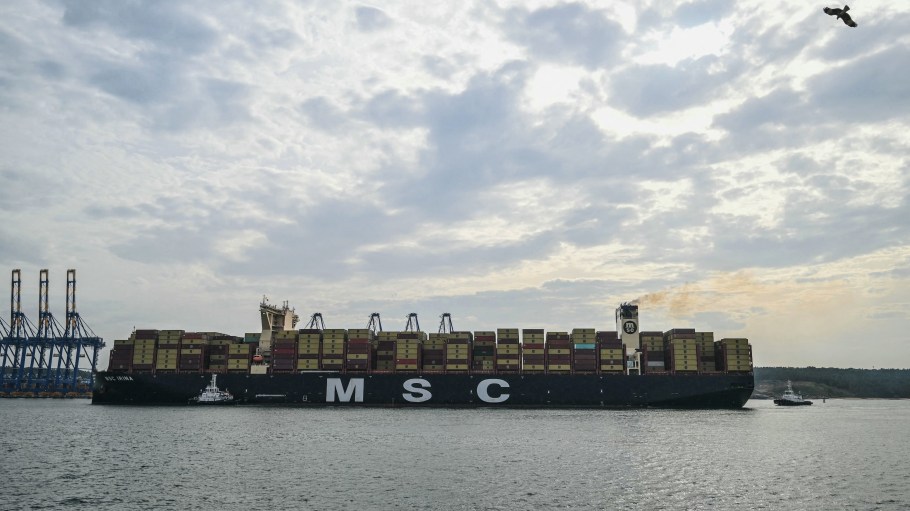
Mediterranean Shipping Company (MSC) is reportedly in the mix to be the new owner of container shipping competitor ZIM.
According to a report from Israeli business publication Calcalist, the world’s largest ocean carrier submitted a bid to ZIM’s board of directors to acquire the fellow shipping company.
A previous report from another Israeli publication, Globes, said MSC had expressed interest in an acquisition while indicating that another major carrier, Hapag-Lloyd, had put in its own bid. Hapag-Lloyd has never confirmed the report.
Related Stories
The Calcalist called MSC, the “leading contender” for the bid.
Last month, ZIM’s board of directors confirmed that it put the company under strategic review after rejecting a prior takeover over from a group co-led by CEO Eli Glickman. The board is currently undergoing a proxy fight, with a minority investor group aiming to replace three board directors.
Sourcing Journal reached out to MSC.
MSC and ZIM already have a slot-swapping and vessel-sharing partnership, launching their own trans-Pacific cooperation in February. Under that three-year partnership, the carriers share vessels across six weekly services between Asia and the U.S. East and Gulf Coasts, with some stops at select Mexican and Caribbean ports.
ZIM also had a prior arrangement with MSC from Asia to the Pacific Northwest. The ZIM North Pacific line stops at Yantian, Shanghai and Qingdao in China, and then South Korea’s Port of Busan, before crossing the Pacific Ocean to reach Canada’s Port of Vancouver.
ZIM’s shares increased nearly 6 percent in Monday morning trading on the report.
MSC has more container-carrying capacity than any other ocean carrier, with its estimated 967 vessels able to transport nearly 7.1 million 20-foot equivalent units (TEUs), according to container shipping research database Alphaliner.
That makes up a 21.3 percent of total market share by TEU. ZIM, on the other hand, carries the 10th most capacity at 704,000 TEUs, a 2.1 percent share of the fleet.
Neither of the companies are part of the three major vessel-sharing alliances—the Ocean Alliance, the Premier Alliance and the Gemini Cooperation.
A sale of ZIM is likely to have some barriers despite the board’s strategic review.
ZIM’s workers’ committee clamored for Israel’s Transportation Minister Miri Regev to block the Hapag-Lloyd sale after the Globes report came out. The employees argue that foreign control could endanger Israel’s supply chain and potential national security in the event of another war.
The committee’s main concern is that 98 percent of Israel’s trade goes by sea, with the workers harping that ZIM was the only ocean carrier that stopped at the country’s ports regularly throughout its war with Hamas.
Selling to Hapag-Lloyd set off bells and whistles for the committee, given that the state investment wings of the Qatari and Saudi Arabian governments collectively own more than 20 percent of the German shipping company.
MSC is privately owned, with the majority of shares held by the Italy-based Aponte family. While the ownership group doesn’t have ties to countries with tenuous relationships with Israel, any potential foreign buyer is still going to generate scrutiny.
Israel’s government has a “golden share” in ZIM, which is likely to play a role in any potential transaction to a foreign entity. This mechanism is designed to protect the country’s interests in private companies deemed essential for national security and transportation.
The provision gives the government veto powers over potential acquisitions if more than 24 percent of the company is sold.
With its golden share, the government requires ZIM to have a majority-Israeli board, an Israeli chairman and a fleet of 11 ships available for state use in emergencies.
According to the Calcalist report, ZIM employees are also concerned about potential layoffs should a foreign buyer acquire the company and consider relocating its headquarters abroad.
The rumors also come as MSC is seeking to push through a $23 billion proposed acquisition of 43 ports worldwide from Hong Kong-based port operator CK Hutchison. The shipping company is partnering with BlackRock in the deal, but it is still hanging in regulatory limbo due to various contentions from China and Panama.
That deal would shift two critical ports on the opposite sides of the Panama Canal under MSC’s ownership, which Panama Canal officials argue could put its operating neutrality at risk due to heavy concentration under one carrier. China has held the deal up under antitrust review, and has held gripes with a U.S. entity having control over the Panama Ports.