A top exec at Mediterranean Shipping Company (MSC) is concerned that a win for Donald Trump in next month’s 2024 presidential election could deliver hurdles to decarbonization efforts across container shipping.
“It’s a challenge for us in shipping to convince a Republican administration that decarbonization is not only something that our business needs…but it also an enormous economic opportunity that I believe both Europe and the U.S. have slept on,” Bud Darr, executive vice president of maritime policy and government affairs at MSC, told the Shipping UK conference in London on Oct. 8.
Related Stories
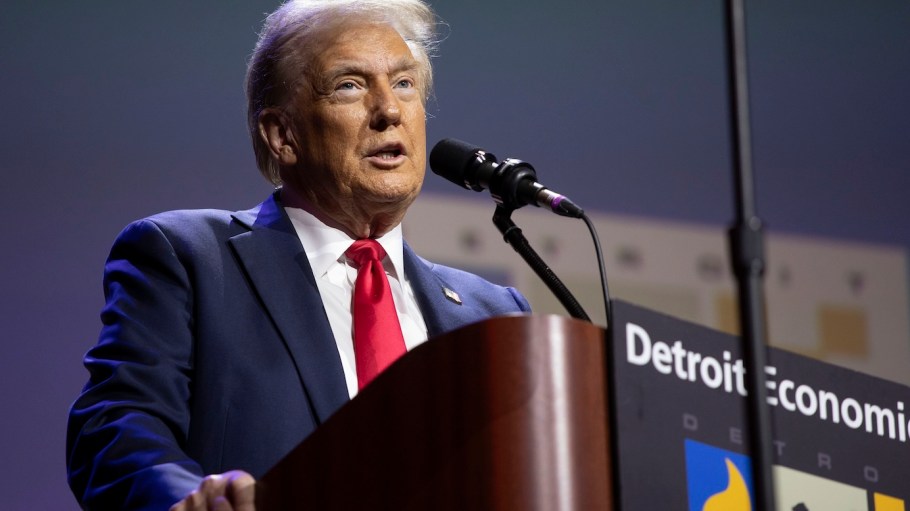
The Trump presidency was heavy on deregulating existing climate legislation, with the U.S. becoming the world’s largest oil producer in 2018 and remaining in that spot ever since. A second Trump term is likely to see more regulatory rollbacks, as well as repeals of tax incentives for corporations to adopt renewable energy.
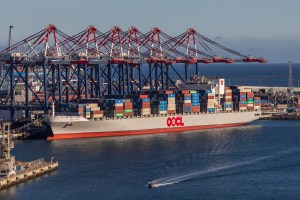
While none of the world’s ocean freight giants are American, U.S. energy policy has a significant impact on their operations and costs. Despite debuting its own green methanol-enabled Alette Maersk vessel at the Port of Los Angeles in August, Maersk says the fuel now costs two to three times more than fossil fuels due to scarce production of green methanol. Currently, there is nowhere in the U.S. where the Alette could refill with the low-carbon alternative.
MSC CEO Soren Toft and Maersk CEO Vincent Clerc were two of five major shipping leaders at the 2023 United Nations Climate Change Conference last winter who called on the International Maritime Organization (IMO) to set new regulatory conditions to accelerate the industry’s transition to green fuels.
Last month, MSC confirmed that it firmly supports and is committing to net decarbonization by 2050.
MSC’s fleet renewal strategy includes over 100 dual fuel liquefied natural gas (LNG) container ships on order and over 300 retrofits now underway throughout the existing fleet.
“There’s huge potential for developing and bringing to market the technologies, and, more importantly, the fuels that are required for the energy transition,” Darr said. “We’ve got to convince a Republican administration that it’s in their interest if we do change White Houses.”
Darr pointed out some of the disadvantages the container shipping industry has endured during the current Biden administration, including 220 percent tariffs for container chassis coming out of China. He also outlined how the Biden administration slapped a 25 percent tariff on ship-to-shore cranes when there was no production available in the U.S.
A Trump win on Election Day would mean the imposition of more tariffs, which Darr said would “make a difference,” but not cause a wider slowdown in global trade even if prices escalated.
“They may change trade patterns, but let’s face it, when manufacturing of these particular consumer goods went outside the U.S. and Europe, the same dynamic happened there,” Darr said. “Consumers weren’t willing to pay the price of the domestically produced goods. That fundamental doesn’t change because control of the White House changes and control of Congress changes.”
Maersk powers Levi’s Ohio distribution center
While MSC preps for what the container shipping landscape will look like under a second iteration of a Trump White House, its chief competitor is still looking to expand beyond its ocean carrier roots.
Maersk is assisting Levi Strauss & Co. as the denim giant further outsources its distribution and logistics capabilities in the U.S.
In August, the logistics firm opened a new 1.2 million square foot omnichannel fulfillment facility in Groveport, Ohio, to help serve Levi’s wholesale, retail, and e-commerce channels. Maersk calls the warehouse a “capstone” to its support for the apparel seller, bolstering its suite of end-to-end solutions offered, including origin consolidation, deconsolidation storage and distribution.
The new facility is built to help lower LS&Co.’s costs while reducing container handling time and enhancing speed and efficiency as it keeps pushing a DTC-first business model. The site’s strategic location in Ohio aligns with Levi’s desire to reach more U.S. consumers faster.
“This Maersk-designed and operated facility is an important step in our strategy to transition to a hybrid distribution and logistics network that balances omni-capable owned-and-operated facilities with technologically advanced 3PL facilities like this one,” said Craig Jones, senior vice president of global distribution and logistics operations at
LS&Co., in a statement. “Collectively, this will improve customer experience, capacity, on-time performance, and efficiency across our business.”
In the next several months, the Maersk operations team will install advanced EuroSort systems capable of processing 100 million outbound units annually. The facility will feature Maersk’s proprietary warehouse management system.