An expected steep decline in U.S. container volumes in the wake of the country’s ongoing trade war with China bodes poorly for American ports, according to a top credit rating agency.
Moody’s knocked down the 2025 outlook for U.S. ports from “stable” to “negative” in a Thursday research note due to the anticipated slowdown in trade.
The note came out the same day Drewry said it expects global container shipping volume to fall 1 percent because of the trade policies—which would mark only the third year since the maritime consultancy beginning tracking that data in 1979 that volumes would inch downward.
Related Stories
Container volumes sank 8.4 percent during the Great Recession in 2009, and 0.9 percent in 2020 during the Covid-19 pandemic, according to the firm.
In North America, Drewry predicts a volume decline of 5.5 percent, followed up by a 4.6 percent decline in 2026.
Container shipping expert John McCown had a more bearish projection for U.S. cargo embedded within his monthly newsletter, The McCown Report.
“Growth in 2025 will be well off the 2024 pace,” said McCown. “In fact, if the tariffs and USTR ship fees in place now continue, my view is that it is almost certain there will be a double-digit percent reduction in annual volume for all of 2025, compared with 2024.”
When accounting for the existing tariff policies in place across both China and the remaining U.S. trade partners, as well as a potential midyear reduction in the duties, Moody’s forecasts U.S. cargo volumes to decline in the 7 percent to 12 percent range.
The observations from Drewry’s and Moody’s, as well as the scenario floated by McCown, follow a bleak outlook for the middle of May out of the biggest port in the U.S. This week, the Port of Los Angeles said it expected a 33 percent dip in year-over-year import volumes for the week of May 4-10. The projections come as many container vessels that would typically be exiting Chinese ports were halted to a standstill as U.S. businesses paused or cancelled shipments due to the hefty tariffs imposed on the country’s imports.
Tariffs for products exported from China to the U.S. have escalated to 145 percent since the start of April. Drewry assumes that if two-thirds of the current tariffs remain in place, imports from China could fall by 40 percent.
Moody’s highlighted the concerns American shippers have going into May, when the impacts of the tariffs are expected to kick in further.
“The higher cost of imported goods will reduce import volumes, while uncertainty over tariff policy has impacted business planning and consumer sentiment, increasing the risk for a recession this year,” said David Kamran, associate vice president at Moody’s Ratings in a statement. “With demand for container cargo historically correlated with U.S. real GDP and retail sales, any slowing economic activity will further weaken U.S. trade volumes.”
The slowdown in eastbound trans-Pacific cargo has been magnified in recent weeks. Cancellations on this route rose sharply from 22 to 65 between weeks 16 and 19 of this year, according to data from Drewry.
“We could change the outlook to stable if we expect cargo volumes to stop declining and return to low growth,” Moody’s said in the note. “A positive outlook could result if volume growth is on pace to top 3 percent on a sustained basis.”
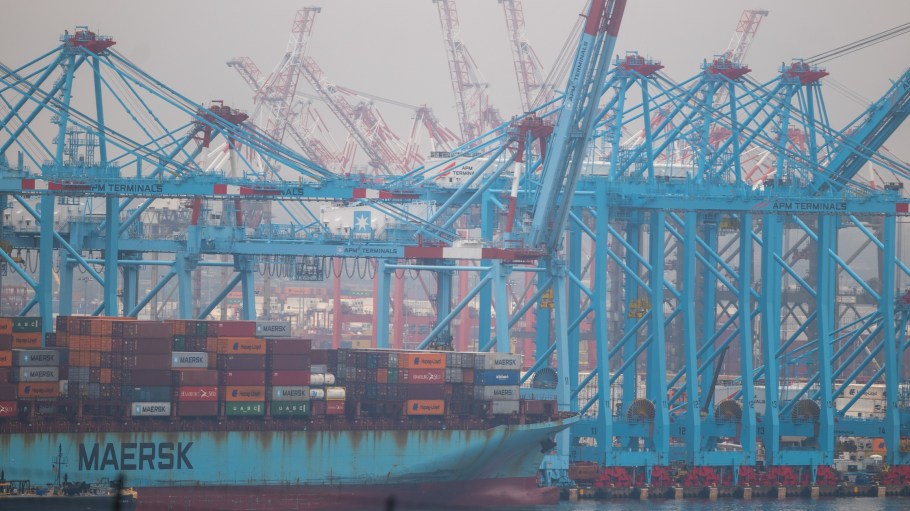
Moody’s move comes after multiple analysts downgraded ocean carrier giant Maersk’s shares amid the bleak container shipping outlook. Within just over one week’s span, Arctic Securities relegated company stock from “buy” to “hold” before Fearnley Securities demoted its rating from “hold” to “sell.”
Despite the collapse in cargo exiting China, and the negative impact it would also have on Maersk and other ocean carriers like China’s own Cosco Shipping, trans-Pacific freight rates have largely held up over the past month due to the mass blank sailings.
According to Drewry’s World Container Index (WCI), a 40-foot container from Shanghai to Los Angeles costs $2,617, down 2 percent from the week prior, but up 5 percent from $2,487 on March 27. Shanghai-to-New York freight rates declined 3 percent this week to $3,611 per container, but have stayed relatively flat from one month ago, when they were $3,722.
While the blank sailings are currently working in minimizing capacity on the route to prevent rates from falling, concerns of overcapacity in the industry could make the stalling temporary, especially if the U.S.-China tensions remain static.
“This is really only a stop-gap solution,” said Simon Heaney, senior manager of container research at Drewry, in a Thursday webinar. “I think, longer-term, carriers will need to consider a more holistic downsizing of their fleets.”
As newbuildings of ships continue to come online, carriers will likely need to start scrapping old ships or even delay or cancel new orders.