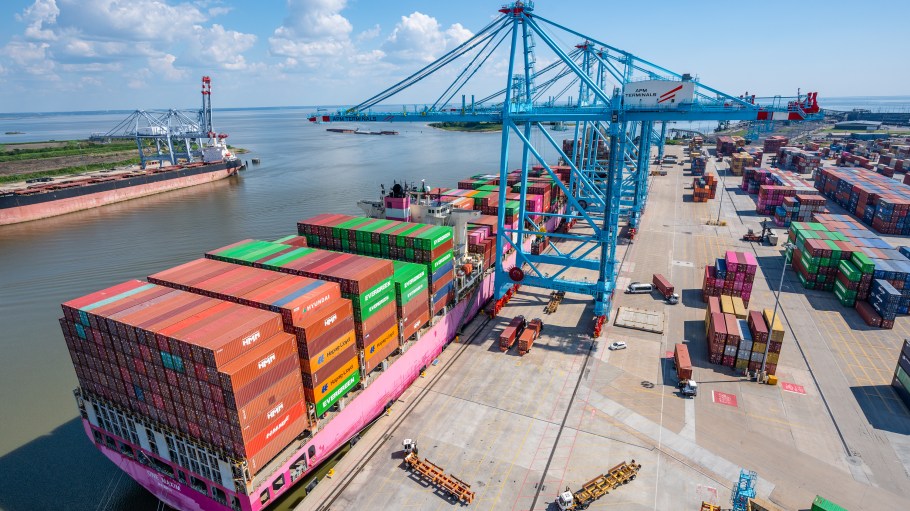
Maersk’s terminal operator is set to build a new 1,300-foot container berth at Alabama’s Port of Mobile that would expand capacity at the gateway by 50 percent.
The Alabama Port Authority and APM Terminals Mobile are funding the $131 million project, which will enable the terminal to handle three ultra-large container vessels simultaneously.
For APM Terminals Mobile, this marks the fifth phase of expansion for the container terminal, which has scaled via multiple projects dating back to 2017.
Related Stories
The plans for the new berth follow the completion of upgrades to Mobile’s container yard, as well as a recently finished dredging project that deepened the Mobile Harbor by five extra feet to 50 feet.
That $366 million project made Mobile the deepest container port in the U.S. Gulf Coast, enabling it to better compete against gateways like Port Houston. Completed in tandem with the U.S. Army Corps of Engineers, the project also widened three miles of the port’s shipping channel by 100 feet to allow for two-sway ship traffic.
Construction on the new berth is expected to begin in 2026, with completion targeted for 24 months after groundbreaking.
Once the additional dock is completed, the annual berth capacity of APM Terminals Mobile will be 1.4 million 20-foot equivalent units (TEUs), supported by a total of seven ship-to-shore cranes.
“This expansion is about more than infrastructure—it’s about cementing Mobile’s position as the Gulf’s premier container gateway,” said Doug Otto, interim CEO and director of the Alabama Port Authority, in a statement. “With the channel deepening complete, a new berth underway, the Phase IV expansion in progress, and APM Terminals’ continued partnership, we’re connecting businesses across Alabama—and across the nation—to global markets faster and more efficiently than ever before.”
The Mobile container terminal only operated two cranes before it underwent its “Phase II” expansion in 2017, when it got two more cranes delivered that could carry up to 20,000 TEUs.
The $50 million third phase was completed in 2020, and included an extension of the docks that allowed the terminal to handle two 1,000-foot-long ships at the same time, pushing the terminal’s maximum capacity to 650,000 TEUs per year.
And “Phase IV” is still ongoing, with the expectation that terminal capacity would reach 1.1 million TEUs by 2027 on $72 million of work to build out additional container yard storage. APM is also completing upgrades to Mobile’s railyard, including a flyover bridge for bringing containers from the yard.
Two more cranes were delivered in July 2024 as part of the most recent phase, bringing the Alabama terminal’s total to six.
Once complete, the new berth aims to boost the port’s operational flexibility, reduce vessel wait times, and improve schedule reliability for carriers and shippers across the southeastern U.S.
The berth will be located at the southern end of the existing container terminal and is adjacent to 25 acres of land that could be developed in the future for container handling, value-added logistics or storage needs.
“This new berth is a strategic next step in making sure Mobile stays ahead of the growth curve,” said Brian Harold, managing director of APM Terminals Mobile in a statement. “As cargo volumes grow, we’re committed to scaling further in full partnership with the Port Authority and our customers.”
APM and the Alabama Port Authority also agreed to a 20-year lease extension to operate the container terminal as part of the project. Their partnership now runs through 2058 with two 10-year extension options.
Beyond the APM partnership, the Alabama Port Authority has sought to bolster its ports access and value proposition elsewhere, with the organization teaming with CSX earlier this year to break ground on an intermodal container transfer facility in nearby Montgomery.
That inland facility, expected to be completed in 2027, will have a throughput capacity of 30,000 shipping containers and will provide rail and truck connectivity between central Alabama and the Port of Mobile.
The Alabama port’s container berth news came weeks after the Port of Los Angeles unveiled it would build its first new container terminal since 2002, which would have two new berths and approximately 3,000 feet of new available wharf.
Among major U.S. ports, the proposed Louisiana International Terminal in New Orleans and Sparrows Point Container Terminal in Baltimore are the only other standalone container terminal projects in development.
Hugh K. Leatherman Terminal at the Port of Charleston is the most recently built major terminal in the U.S., having been completed in 2021.