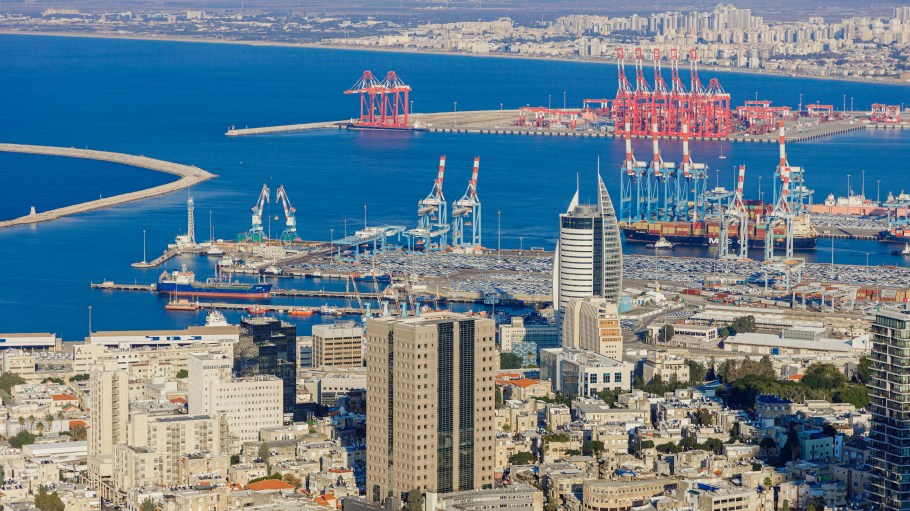
Less than a week after canceling its port calls to Israel’s Port of Haifa amid the country’s then-brewing conflict with Iran, Maersk began accepting imported cargo at the port again on Wednesday.
Israel and Iran have appeared to honor a Tuesday ceasefire after the countries traded missile attacks for 12 days, likely giving the Danish ocean carrier the go-ahead to clear ships to return to Haifa. The U.S. brokered the ceasefire after intervening in the conflict with airstrikes on Iranian nuclear facilities.
Related Stories
Maersk has yet to confirm when it will begin accepting export cargo.
“We are monitoring the situation very closely and based on the recent developments and with prospects of a ceasefire currently in place, we expect to be able to reopen export cargo acceptance once the lower safety risk of doing so has been reconfirmed,” said Maersk in a customer advisory update Thursday morning.
Maersk also noted that current diversion plans and contingencies for cargo from Haifa are actively being finalized on a case-by-case basis.
Throughout the conflict, the carrier had maintained operations at Israel’s Port of Ashdod, with the company saying it will promptly reassess both decisions based on security assessments and maritime advisories.
After the ceasefire announcement, maritime security firm Ambrey assessed that a threat to U.S.-affiliated merchant shipping was lowered, but acknowledged that there was a “realistic possibility that the conflict could restart.”
In the advisory, Maersk also gave updates regarding the opposite side of the Arabian Peninsula. According to the ocean carrier, the Strait of Hormuz remains navigable as of Wednesday, but that the team is working out contingency plans on a case-by-case basis to adapt to any other potential changes.
Worries that Iran would attempt to close off the Strait of Hormuz in some capacity appear to have subsided with the ceasefire, but security agencies dedicated to maritime risk assessment remain cautious.
The Joint Maritime Information Center (JMIC) said in a Thursday advisory note that the regional threat level across the Strait of Hormuz, Arabian Gulf and Northern Arabian Sea is still “significant,” although shipping in the strait has returned to normal levels.
On Wednesday, 127 ships traversed the Strait of Hormuz, the agency said, up from 103 on June 19. Last June, 114 vessels on average transited the waterway daily.
However, there are lingering threats of electronic interference that can impact a ship’s navigation systems with high levels reported during dark periods, JMIC says.
Angeliki Frangou, a CEO of Greece-based tanker Navios Maritime Partners, told CNBC Tuesday that many liners are only transiting during daytime because of the jamming of GPS signals of vessels.
According to tracking data from maritime risk analytics firm Windward, 55 vessels between June 12-24 transmitted 101 atypical destination messages such as “China owned” or “Russian crude” across the Arabian Gulf, Arabian Sea and Red Sea as protective measures since those ships are less likely to be targeted in an attack.
JMIC recommends shipping companies to adhere to security advisories and conduct detailed vessel- and voyage-specific risk assessments for any operations or transit through the region. Given the prevalence of electronic interference, the agency also said to employ enhanced visual lookouts and rely more heavily on visual, radar-based navigation.
What remains to be seen in the area is whether freight rates will react to the returning cadence of ships to the strait.
Ships didn’t even have to enter the Strait of Hormuz for customers to feel the heat of higher prices. Rates from Shanghai to the Port of Khor Fakkan, located on the UAE’s coastline on the Gulf of Oman, accelerated 76 percent over mid-May, according to data from Xeneta. As of Monday, an average 40-foot container on that route cost $3,341.