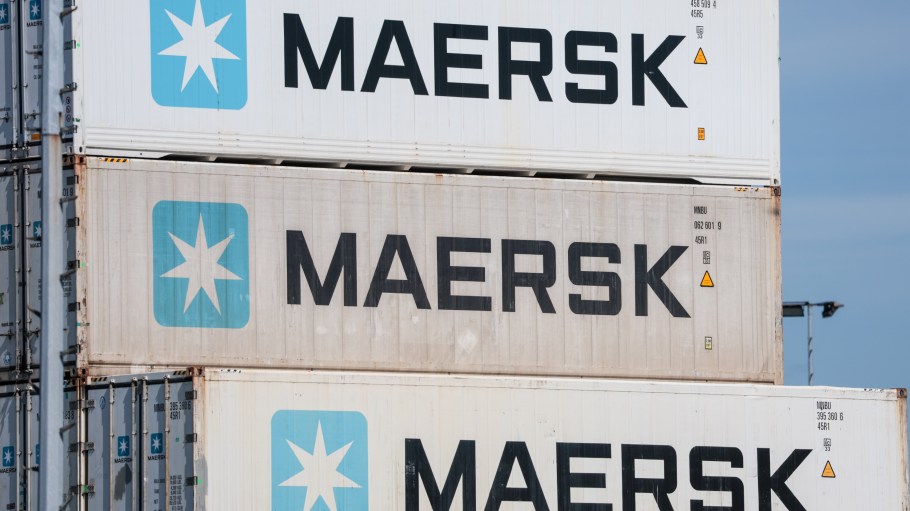
Maersk is making its first full-time return to the Red Sea after months of deliberation following improved stability in the waterway.
Vessels traveling from Middle Eastern and Indian ports to and from stops on the U.S. East and Gulf Coasts on the MECL service line will be the first to return to the Suez Canal route.
Last month, the Singapore-flagged Maersk Sebarok sailed through the trade artery, which was the first time in two years a vessel from the carrier made the Red Sea voyage. A second vessel from the MECL loop, the U.S.-flagged Maersk Denver, is currently sailing through the Red Sea and is expected to voyage through the Suez Canal in the coming days.
Related Stories
The first sailing in the “structural change” of the MECL service will be the Cornelia Maersk on the westbound trans-Suez route voyage, departing the U.A.E.’s Port of Jebel Ali on Thursday.
The Maersk Detroit voyage, which departed from North Charleston, S.C. on Jan. 10, will be the first eastbound sailing to use the trans-Suez route, with all subsequent sailings following this routing.
“Maersk will continue to monitor the security situation in the Middle East region very closely, and any alteration to the MECL service will remain dependent on the ongoing stability in the Red Sea area and the absence of any escalation in conflicts in the region,” the company said in a statement. “The safety of crew, assets, and customers’ cargo remains the highest priority.”
Since December 2023, major ocean carriers have largely avoided the Red Sea due to the presence of Houthi militants in Yemen, who had coordinated missile and drone attacks on commercial vessels throughout 2024 and early 2025. The onslaught had forced container shipping companies to sail around southern Africa’s Cape of Good Hope to reach destinations in Europe, North America and South America, lengthening ocean freight transit times in many cases by one to two weeks.
The Houthis had eased up on the number of attacks throughout 2025, and opted to suspend the onslaught entirely in November after Israel and Hamas came to a ceasefire in Gaza.
For the most part, ocean carriers have taken a cautious approach to a return, with Maersk indicating early in 2025 that it could cost the company hundreds of millions if it made a full Red Sea return, only to have to revert again to the Cape of Good Hope route. War-risk insurance premiums were a major concern of the carriers as well, with the rates escalating through the crisis amid the attacks.
Maersk says it has contingency plans in place should the security situation deteriorate, which may necessitate reverting individual MECL sailings or the wider structural change of the MECL service back to the Cape of Good Hope route.
The MECL service is solely operated by Maersk, and does not impact the services of Gemini Cooperation partner Hapag-Lloyd.
Maersk credited its partnership with the Suez Canal Authority as playing a key role in the planning of the return. Since September, the authority had urged Maersk to make a return to the waterway as part of a wider appeal to the industry to being traffic back to the canal.
A report from the Journal of Commerce indicated Thursday morning that the vessel-sharing alliance will see a Red Sea return of its own on the India-Middle East-Mediterranean trade “shortly.”
The weekly loop is identified as ME11 for Maersk and IMX for Hapag-Lloyd. According to the report, Maersk is working out schedule readjustments out with Hapag-Lloyd to resume the Suez transits.
Maersk is following in the footsteps of fellow carrier CMA CGM, which periodically sent vessels through the Red Sea during the crisis and plans to resume transit via the Indamex India-to-U.S. service this month.
Maersk’s shares fell more than 5 percent Thursday morning on the news, as the diversions away from the Red Sea had constrained capacity, thus inflating ocean freight rates. If more vessels return to the area on a regular basis, freight rates are likely to decrease due to the shorter transit times.
The number of container ships sailing via the Suez Canal increased to 26 in the week ended Jan. 11, with 13 traveling northbound and 13 headed southbound, according to a new Red Sea diversion tracker launched Tuesday by Drewry Shipping Consultants.
The number of transits via the Suez Canal remains considerably below the normal level of about 55 per week northbound and 25 per week southbound before the Red Sea crisis started in late 2023, says Drewry.