U.S. military forces delivered a fourth series of strikes against Houthi missile targets in Yemen Wednesday night, as the multinational coalition continues ongoing efforts to prevent the Iran-backed militant group from launching more attacks on maritime traffic in the Red Sea.
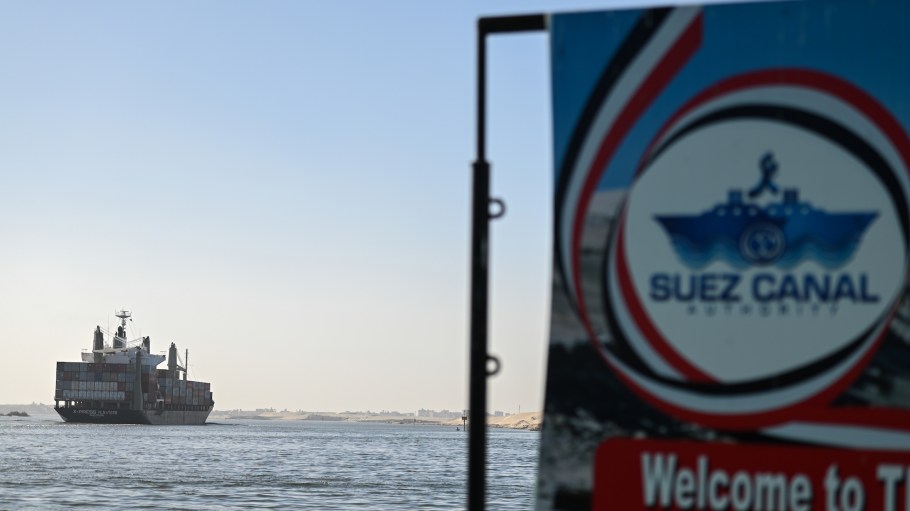
However, some of the biggest names in global logistics still anticipate prolonged impacts on the supply chain as container shipping giants keep avoiding the conflict-ridden waterway—and by proxy, the Suez Canal.
Related Stories
At the World Economic Forum in Davos, Switzerland, the CEOs of Maersk and DHL gave a harrowing preview of what may be to come.
Maersk CEO Vincent Clerc told the Reuters Global Markets Forum Wednesday that Red Sea-related disruptions should be expected for a few more months.
“This will mean longer transit times and probably disruptions of the supply chain for a few months, at least, hopefully shorter, but it could also be longer because it’s so unpredictable how this situation is actually developing,” said Clerc.
And DHL CEO Tobias Meyer said in a panel discussion that the attacks on container vessels in the Red Sea could lead to a shortage of containers in Asia in the coming weeks. He later told Reuters that DHL still had available air freight capacity, echoing the sentiment of FedEx CEO Raj Subramaniam at the National Retail Federation (NRF) Big Show earlier in the week.
In a client advisory Wednesday, logistics giant C.H. Robinson agreed that the domino effect of the disruption would occur “over the next several months,” noting that more shippers were proactively shifting part of their freight from ocean to air.
C.H. Robinson also acknowledged the concerns about equipment shortages for Asia exports as capacity is constrained.
According to Balika Sonthalia, senior partner and Americas co-lead in the operations and performance practice at Kearney, apparel is a sector to watch if the conflict continues.
“With apparel, there is little European supply that’s coming into the U.S.—there’s more Asian supply. With the China plus one strategy, companies moved to Central America to diversify sourcing, but still the lion’s share of product comes from Asia,” said Sonthalia. “I don’t see that impacted in the near term, but if the situation continues, this could be a sector to watch out for, in particular as they prepare for the summer holiday season and seasonal time frames.”
A lingering increase in ocean freight rates has been one of the few certainties resulting from the ongoing Houthi attacks.
Drewry’s World Container Index (WCI) had yet another significant weekly increase as of Thursday, jumping 23 percent to $3,777 per 40-foot container. The rapidly escalating ocean spot rate measurement has shot up 173 percent since Nov. 30, when average container prices were $1,382.
Although the Asia-to-Europe trade lanes had primarily been the most affected by the mass diversions of vessels, the knock-on effects are appearing to be felt elsewhere, as per the Drewry data. The three largest weekly price changes occurred on the Rotterdam-to-Shanghai route (50 percent), Shanghai-to-Los Angeles (38 percent) and Shanghai-to-New York (35 percent).
On top of the spot rates, war-risk insurance premiums are still increasing as the U.S.-led coalition carries out more strikes. Underwriters are now charging between 0.75 percent and 1 percent of the value of the ship to sail through the region, a report from Bloomberg said.
Quotes for insurance coverage were about one-tenth of that amount just one month ago, the report said, posing the risk of making it too expensive to traverse the vital waterway. To make matters more difficult, a growing number of insurers are refusing to cover American, British and Israeli vessels against war risks.
Of course, the price increases only bring more implications for the end consumer, Sonthalia observed.
“The lesson from the pandemic chapter, when rates were up 200 percent or even more, was that there is going to be an impact on consumer costs,” Sonthalia said. “Specifically for retail, it’s been felt more with the outbound transportation cost, which has a first-order impact on customer pricing, than with inbound transportation. Inbound transportation usually happens over a very large volume scale and tends to get absorbed on a per unit basis. When this starts to break down is if, for example, a Walmart has to charter its own container because it couldn’t get enough capacity; or when certain trade lanes see exploding rates per container.”
As of Tuesday, 549 carrier vessels accounting for roughly 7.5 million 20-foot equivalent units (TEUs) of capacity are actively diverting, will divert, or have already diverted the Suez Canal, according to Flexport. This represents almost 25 percent of global capacity.
Maersk and Mediterranean Shipping Company (MSC), partners in the soon-to-be-dissolved 2M shipping alliance, are both attempting to soften the blow of the Red Sea by adding extra vessels to services between Asia and the U.S. East Coast as container imbalances emerge from the rerouting of ships around southern Africa.