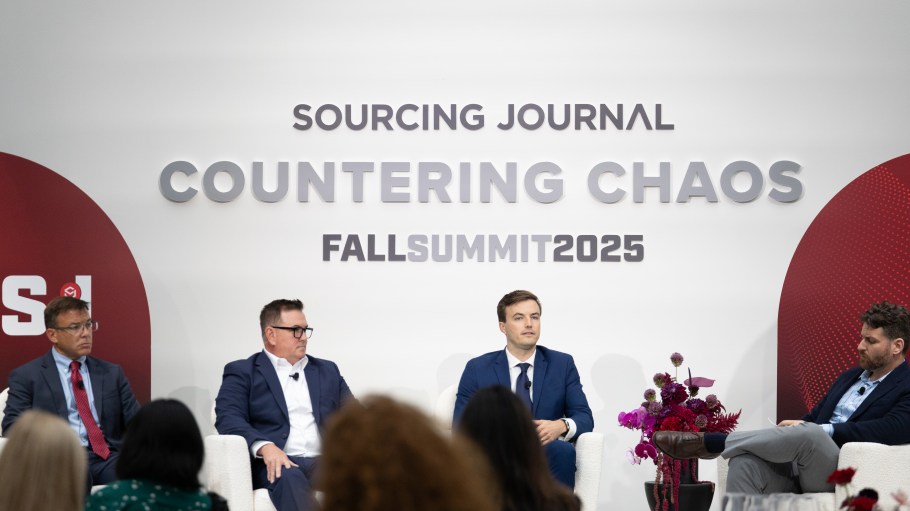
The only constant in logistics this year has been change. At Sourcing Journal’s Fall Summit, executives from Flexport, OEC Group and the Port Authority of New York and New Jersey unpacked what shifts in tariffs, consumption and carrier partnerships have meant for logistics this year. The panel, moderated by logistics editor Glenn Taylor, also covered what to expect heading into the next few quarters.
This continual change has made communication between customers and carriers all the more critical, said Jack Sheehan, director, ocean freight, Northeast, Midwest and Canada at Flexport. “Forecasts are out the window…things are changing day by day,” he said. “As long as everyone has the same information, we can manage your business as effectively as possible.”
Related Stories
In response to the initial “Liberation Day” tariff announcement from President Trump on April 2, the panelists saw companies frontload cargo. The rush to move cargo ahead of tariff deadlines led to the Port Authority of New York and New Jersey’s second strongest August in its history across imports and exports, and the port’s overall 2025 volumes are up 4 percent year over year.
Stephen Glennon, vice president, national accounts at OEC Group, noted that there wasn’t the typical peak season this year. Cargo tends to moves slowly in the fourth quarter after the rush of getting shipments in ahead of Golden Week factory closures and the holiday season, but Sheehan foresees an “unusually soft” Q4 due to the frontloading and continued tariff uncertainty. Also contributing to a slower end of year is a later Lunar New Year in February 2026.
With the de minimis provision gone, air freight has declined around 30 percent, per Glennon. Although this volume has moved toward less-than-container load (LCL) ocean shipments, the slow overall market meant that there was no significant boost in ocean freight from this shift.
As volumes have softened, so have rates. While importers may consider this a positive, Glennon sees rate declines as a “worrisome” sign that U.S. consumers aren’t shopping. One tactic to deal with lower demand and softer rates could be blank sailings. “The [ocean] carriers are in a bad spot, and they’re going to pull as much capacity as they can to try and match it to what the Q4 forecast is, and it’s not great,” said Glennon.
Another tariff response strategy has been shifting sourcing maps. Some of the “winners” from a migration out of China have been Vietnam, Thailand, Malaysia, Indonesia and Cambodia. For a while, Mexico and India were getting more attention, but after additional tariffs on these nations’ imports were announced, this took a downturn. Some of this trade movement has also resulted in more cargo bound for East Coast ports. “The community has learned to diversify and not put all their eggs in one basket,” said Mike Bozza, deputy director, port department at the Port Authority of New York and New Jersey, noting that this diversification has been happening since the pandemic.
Prepping for this influx of shipments, the Port Authority along with its tenants—including the ocean carriers that own stakes and terminals in the port—made investments between 2021 and 2023 that included deepening channels to 50 feet and raising the Bayonne Bridge. While 43 million customers live within a four-hour drive of the port, rail investments have provided further access to consumers across the U.S. Midwest and Canada. Maintaining lines of communication, the Port Authority has a council on port performance—consisting of parties from railroads and truckers to labor—that meets regularly to discuss and address any issues.
Changing the country of origin comes with transportation considerations, since business practices, travel times, document deadlines and more may differ. Compared to China, other countries often have less availability of direct services, requiring practices like transshipments. “You’re not only maybe extending transit time by a couple days to a week,” said Sheehan. “You are really changing everything about that origin piece as well.”
Landed costs also vary. “Sometimes it’s a win,” said Glennon, adding that in some cases, it can go in the opposite direction. “If you moved a cotton shirt manufacturer to India right now, you’re not real happy, because those costs went right back up again.”
With port congestion becoming more of a frequent occurrence than a rarity, companies must keep a laser focus on their lead time needs, particularly if they are facing the potential for chargebacks if a shipment is late. Sheehan noted that customers tend to be used to this following Covid era issues, and they are buffering their timelines to account for “unpredictable events.”
Despite concerns about ocean carrier alliance changes early in 2025, Sheehan said it’s a rarity for customers to ask about them, showing that the shift went “seamlessly.” He added that if freight picks up in 2026, that will be more of a test of the new partnerships and models.
Although there were some “hiccups” with this change, the new alliances are now running smoothly, said Bozza. “Whether it’s Covid or tariffs or what have you, it’s an extremely resilient industry.”