With fresh funding rolling in, one supply chain tech company is giving warehouse operators another set of eyes on every pallet passing through their loading docks.
Kargo, a developer of AI-powered, computer vision-based systems that can automate shipping and receiving processes at warehouse loading docks, has closed a $42 million Series B funding round.
Private equity firm Avenir Growth led the round, with participation from Linse Capital, Hearst Ventures and Lightbank, and previous investors Matter Venture Partners and Sozo Ventures. This is the second fundraising for Kargo this year, with the tech company announcing $18.4 million in investments led by Matter in May.
Related Stories
Advertising itself as “AI for loading docks,” the company says the new capital will be used to accelerate its push to bolster real-time inventory data infrastructure across warehousing and logistics operations.
Founded in 2019, Kargo’s technology is built to turn the loading dock into a source of more accurate, actionable data that employees can use to make better decisions.
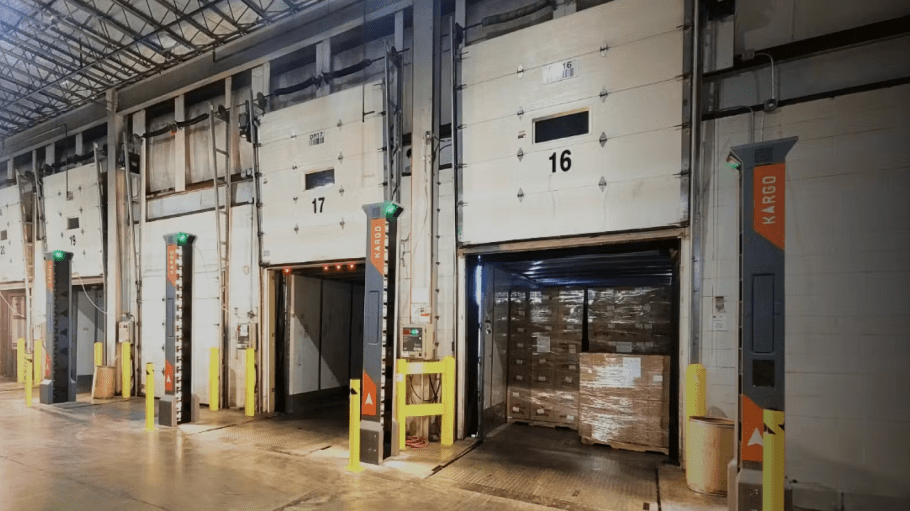
Using physical towers and lifts at docks and gateways, hardware computer vision sensors can connect to the Kargo platform to automate all shipping and receiving operations without manual scanning, intervention or change management.
With the sensors, the nearly 11-foot towers can gather information on freight labels, cases and product condition, capturing barcodes and QR codes, safety labels, lot numbers, cargo dimensions and more.
The system automatically inspects arriving freight for damage, verifies shipments against bills of lading and can push inventory data directly to customers’ systems for real-time status and compliance. Using large language models (LLMs), issues and exceptions are flagged and documented with visual evidence, which can help enable teams to resolve freight claims more efficiently while managing customer relationships.
The platform also consolidates scheduling, driver check-in and dock door allocation into a single workflow designed to automatically adapt to real-world conditions, such as inclement weather. With this information centralized, teams can make informed decisions about labor allocation and shipment discrepancies.
Since its $25 million Series A in 2022, Kargo has expanded its enterprise customer base from three to more than 45, deploying more than 1,000 towers across the country.
“Once Kargo sensors are deployed in a warehouse, customers want Kargo upstream and downstream in their supply chain,” said Sam Lurye, founder and CEO of Kargo, in a statement. “We typically see additional orders by the same customers within three months because the data accuracy is recognized immediately and the ROI is often realized in weeks.”
Kargo says its annual revenue tripled from 2024 to 2025. As of May, the company said it processed $200 million in inventory and roughly 20,000 pallets per day on average. The system makes 2 million automated scans weekly.
According to Grand View Research, the global market for AI solutions embedded in warehousing operations is expected to grow from $11.2 billion in 2024 to $45.1 billion by 2030. This reflects a compound annual growth rate of roughly 26 percent as warehouses seek faster, more accurate automation and seek to improve real-time decision making to meet rising demands and labor challenges.
Looking ahead, Kargo aims to build on its proprietary data layer by offering more applications to its customers.
Using advances in agentic AI and empowered by images collected from Kargo’s cameras, the company is rolling out Kargo Intelligence. This platform designed to automate back-office workflows such as invoicing, claims dispute, financial reconciliation and customer service.
The funding comes as the well has largely dried up for supply chain technology investments in recent years. Venture capital investors committed $7.8 billion to supply chain technology companies this year through the third quarter, still less than half of 2024’s full-year total of $16.5 billion, according to Pitchbook’s Q3 Supply Chain Tech VC Trends report released in November.