A ceasefire between Israel and Hamas likely won’t be enough to bring major ocean carriers back into the Suez Canal in the near term.
Both parties initially agreed to the truce Wednesday, which would pause 15 months of fighting in the Gaza Strip and see the release of dozens of hostages and Palestinian prisoners.
The deal is expected to be implemented Sunday, although Israel has delayed a cabinet vote on the ceasefire, blaming Hamas for reneging on parts of the agreement.
Related Stories
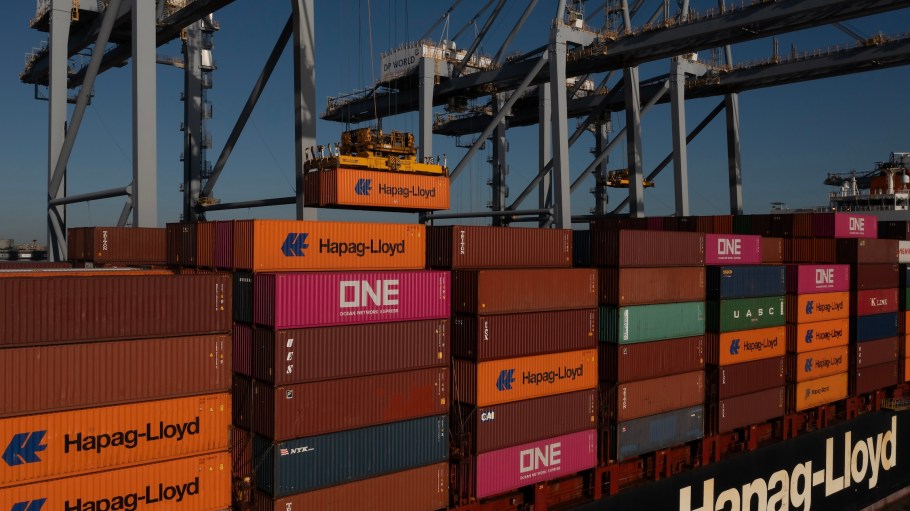
Hapag-Lloyd remains non-committal to any Red Sea return. A recurring barrage of drone and missile attacks by Yemen-based Houthi militants in the Red Sea and neighboring Gulf of Aden has lingered since November 2023, shortly after Israel’s offensive in Gaza began.
“The agreement has only just been reached,” a Hapag-Lloyd spokesperson told Sourcing Journal. “We will closely analyze the latest developments and their impact on the security situation in the Red Sea. Otherwise, the following applies unchanged: we will return to the Red Sea when it is sufficiently safe to do so.”
The container shipping giant has been skeptical of returning to the Red Sea even if a ceasefire took place, initially saying last June that an immediate truce “does not mean that the Houthi attacks will stop immediately.”
At the time, the carrier said it would take at least four to six weeks after a ceasefire to rearrange schedules and for operations to return to normal.
“It is still too early to speculate about timing,” a Maersk spokesperson told Reuters.
Peter Sand, chief analyst at freight rate benchmarking platform Xeneta, said a Red Sea return is “definitely closer than a few weeks ago,” but noted that a ceasefire doesn’t guarantee a situation where the Houthis aren’t attacking international ships.
“We need a real safe passage, as was the case before the Houthis started to seize ships back in 2023,” Sand said. “There’s still a little bit of distance between where we are, and an absolute restoration” of shipping through the Suez Canal.
In the time since the attacks started, most major container shipping firms have avoided the canal altogether, instead opting to travel around southern Africa’s Cape of Good Hope, which tacked on an extra week or two to typical transit times.
According to data from Project44, shipments from Southeast Asia to the U.S. East Coast now take 47 percent longer than they did at the start of the Red Sea crisis, while shipments to Europe take 33 percent more time to arrive. Transit times from China to Europe have risen by 25 percent.
However, it appears the ocean carriers have adjusted better to the new routes. In November, carriers experienced a median delay of four to six days beyond their original estimated arrival time. This is a significant improvement, particularly for Southeast Asia to Europe, which peaked at a median of almost 13 days late in February 2024.
The Iranian-backed militants have long claimed that the attacks are in protest of the Israel-Hamas war and in support of Palestinians.
Two months ago, Houthi armed forces spokesperson Yahya Saree said the attacks would “continue until the aggression stops and the siege on the Gaza Strip is lifted.”
However, it remains unclear if the group will stop the attacks if a ceasefire is implemented.
“With this battle reaching its conclusion with the declaration of a ceasefire in Gaza, the Palestinian cause was and will remain the first cause for which the nation must assume responsibility,” said Houthi spokesperson Mohammed Abdul Salam in a post on X celebrating the ceasefire. “There will be no real peace for the region except with the disappearance of this emergency entity planted by a Western American force that provides it with the means to survive at the expense of the Palestinian people and the peoples of the region.”
Despite the Yemeni faction’s claims that the Red Sea assault is rooted in the war in Gaza, their attacks have been largely indiscriminate—sometimes hitting ships unaffiliated with Israel or its allies. That has posed questions as to whether the Houthis would stop their onslaught even if a truce was called.
Dan Shapiro, the deputy assistant secretary of defense on Middle East policy for the Department of Defense, said last February that the attacks are “almost entirely unrelated to Israel and Israeli-affiliated shipping.”
“These are indiscriminate acts that are as much an affront to maritime commerce as piracy, having affected the interests of more than 55 nations and threatened the free flow of commerce through the Red Sea—a bedrock of the global economy,” Shapiro said at a Senate hearing.