India’s ambitions to become a global maritime stronghold now have a hefty price tag—a cool $1 trillion.
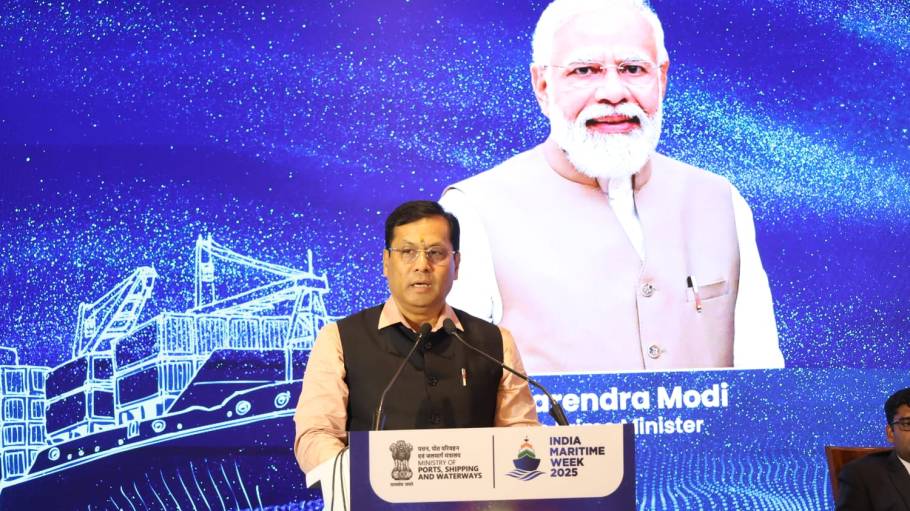
Speaking at a roundtable event in New Delhi on Aug. 28, India’s union minister of ports, shipping and waterways Sarbananda Sonowal said the government has introduced a roadmap aimed at transforming the country’s ports, shipping and logistics capabilities.
Speaking to envoys from 28 countries, along with senior Indian officials and industry leaders, Sonowal highlighted what he called a “strong potential” for joint ventures in developing ports and cargo terminal operations, as well as multi-modal terminals.
Related Stories
The plan extends to other areas of focus for India’s maritime industry, including strengthening shipbuilding, ship recycling and ship repairs, and the launch of green hydrogen hubs and sustainable shipping solutions.
The roundtable served as a precursor to India Maritime Week 2025, which will be held in Mumbai from Oct. 27-31. Prime Minister Narendra Modi is set to attend the weeklong event, and deliver the keynote address at the Global Maritime CEO Forum.
Shantanu Thakur, state minister of ports, shipping and waterways, also addressed the roundtable session, underscoring reforms in port modernization, inland waterways expansion and green shipping.
Following Sonowal’s call for more joint ventures, Thakur also urged greater private sector involvement.
India’s ministry of ports, shipping and waterways developed its Maritime India Vision 2030 in 2021 in an effort to propel the country into a maritime powerhouse for trade and become a top-10 shipbuilding nation. At the time, India had no major ports that could host 300 million metric tons per year, with plans to build three by the end of the decade.
In 2023, India laid out a more comprehensive, 25-year plan expanding on the 2030 objectives called the Maritime Amrit Kaal Vision 2047, aligning with Prime Minister Modi’s larger ambitions for the country to become a developed economy by 2047. By then, India expects to crack the top five in shipbuilding nations worldwide.
The port goal was fleshed out further, so that it could focus on creating four port clusters with capacity to hold 300 million metric tons annually, as well as two more port clusters with a capacity to hold 500 million metric tons per year.
The $1 trillion figure floated by Sonowal is expected to be invested through the 2047 goal.
Currently, ports are being built and expanded upon all throughout India, with two mega ports currently in development. North of Mumbai, India is currently building out the nine-terminal $9 billion Vadhvan Port, which is projected to handle 23.2 million 20-foot equivalent units (TEUs) by 2040.
By the time the port is completed, it is expected to be the largest container handling hub in India, and one of the 10 biggest in the world. The port will have a natural depth of 65.5 feet, designed to accommodate ultra-large container ships entering the country.
Another massive port project nearly 1,000 miles off the southeast coast of India is being planned for construction in Galathea Bay on the southern tip of the Nicobar Islands. That $5 billion project would be located just 40 nautical miles from the Malacca Strait, the vital East-to-West shipping corridor sitting between Malaysia and Indonesia.
The proposed International Container Transhipment Port (ICTP) is expected to handle 4 million TEUs after its first phase of construction, which was initially set for 2028. Over the next 30 years, this capacity would expand to 16 million containers.
Aside from these port construction projects, India has made it a point to forge ahead with capacity expansions in its current major seaports, including Nhava Sheva, Mundra, Paradip and Deendayal.
At the Water Voyage Northeast conference on Tuesday, Sonowal highlighted that port capacity across India has nearly doubled over the past decade, cargo handling has reached 1.6 billion metric tons and average turnaround time at ports has been cut to 22 hours.
“From five operational waterways in 2014, we now have 30 today,” said Sonowal. “Cargo movement on inland waterways has grown from 18 million metric tons in 2013-14 to 145 million metric tons last year. These are not just statistics; they are milestones of transformation.”
By 2047, Sonowal said India has a goal to handle 10 billion metric tons of export-import cargo and 500 million metric tons through inland waterways.
Bangladesh closes three land ports along Indian border
As India throws its weight behind its ambitions at sea, the country’s land trade with neighboring Bangladesh continues to deteriorate.
Bangladesh’s interim government shuttered three land ports near the Indian border on Aug. 29, 10 months after a committee found them to be “inactive and unprofitable” due to a lack of trade.
Chilahati Land Port, Daulatganj Land Port and Tegamukh Land Port were closed, while operations at a fourth location, Balla Land Port, have been suspended.
“Politicians from border areas sometimes secured approval for these ports based on political considerations,” said Shafiqul Alam, the press secretary of Bangladesh Chief Adviser and interim government leader Muhammad Yunus, in a statement. “But in reality, there has been little to no trade activity through them. This imposes unnecessary costs on the government.”
India and Bangladesh have had a rocky relationship of sorts since former Prime Minister Sheikh Hasina’s government was overthrown last summer, which has spilled over into trade between the bordering countries.
The move occurred months after India banned some exports to the country via land routes and restricted some shipments to ocean routes.