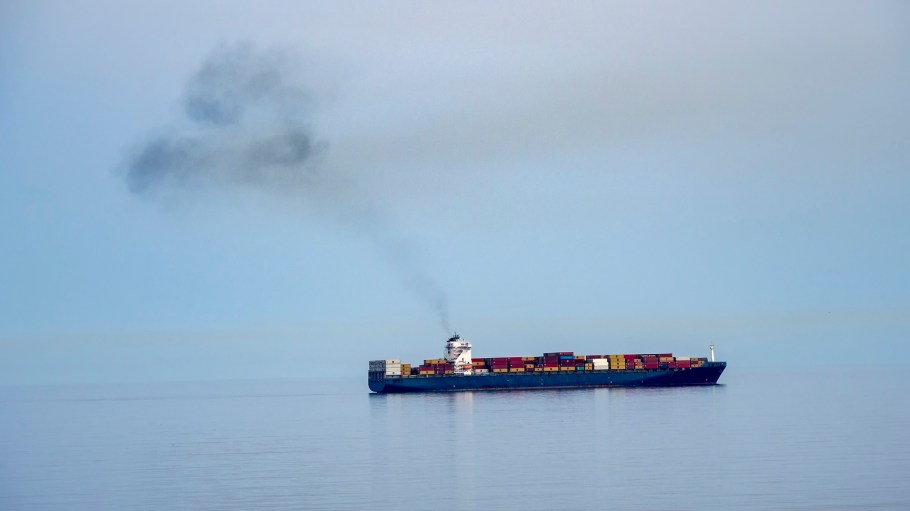
The International Maritime Organization (IMO) approved a compromise deal Friday that would push the ocean shipping industry further toward its goal to achieve net-zero greenhouse gas (GHG) emissions by 2050.
A levy on GHG emissions and a carbon credit trading plan are set to be formally adopted in October 2025 before going into effect in 2027, when it will become mandatory for large oceangoing ships over 5,000 gross tonnage. The IMO says those vessels emit 85 percent of the total carbon dioxide emissions from international shipping.
Related Stories
Starting in 2028, shipping companies worldwide must either transition to less carbon-intensive fuels, or pay fines via a two-tiered system. The pricing mechanism establishes a levy of up to $380 per excess metric ton for excessive emissions beyond a “base target,” as well as another charge of up to $100 per every metric ton emitted beyond a “direct compliance target.”
The measure is expected to generate the industry $30 billion to $40 billion by 2030, some of which is expected to go toward making expensive zero-emission fuels more affordable.
In 2030, the base target limit will require ships to cut the emissions intensity of their fuel by 8 percent compared with a 2008 baseline, while the stricter direct compliance target will demand a 21 percent reduction. By 2035, the main standard will cut fuel emissions by 30 percent, versus 43 percent for the stricter standard.
Vessels that emit above the set thresholds can balance their emissions deficit by trading surplus carbon credits with other ships or using surplus credits they already secured.
The framework also leaves room for companies to use any alternative fuels that meet emissions criteria, including first-generation biofuels made from food crops like palm and soybean oil.
“This is a major milestone for climate policy and a turning point for shipping. Our industry has long been labelled as ‘hard to abate,’ but record industry investment and a new global measure can turn the tide on that,” said World Shipping Council president and CEOJoe Kramek in a statement. “Liner shipping has already moved to kick-start decarbonization, with nearly 1,000 renewable-capable ships set to be on the water by 2030. However, a global regulation is necessary to deliver the renewable fuels at a commercially viable price.”
Currently, there are nearly 200 renewable-capable liner ships on the water today, and an additional 700 to be delivered by 2030.
Despite the U.N. shipping body coming to a framework to levy for the first time in 10 years, there has been disagreement among member states of the IMO of how a plan should play out.
The deal was nearly derailed after the U.S. pulled out of the talks in London and Saudi Arabia forced a last-minute vote, but it eventually passed on Friday.
The proposal passed by a majority vote, with 63 nations in favor including E.U. states, the U.K., China and India. Sixteen members opposed, including Saudi Arabia, Russia and Venezuela. The US was absent from the meeting, and 24 member states abstained.
An initial stronger flat carbon tax on all shipping emissions was dropped after opposition from oil-producing countries including the U.S., China, Brazil and Saudi Arabia, many which argued the proposal could reduce exports from the developing world and raise food prices. The carbon tax would have generated an estimated $60 billion per year in fees.
With the new agreement projected to achieve an 8 percent absolute emission reduction by 2030, this still falls well short of the IMO’s own target of 20 percent.
The Global Maritime Forum acknowledged that while the emissions targets were “laudable,” they weren’t enough to drive needed investments to reach net zero by 2050.
“While the targets are a step forward, they will need to be improved if they are to drive the rapid fuel shift that will enable the maritime sector to reach net zero by 2050,” said Jess Fahnestock, director of decarbonization at the Global Maritime Forum, in a statement.
“While we applaud the progress made, meeting the targets will require immediate and decisive investments in green fuel technology and infrastructure. The IMO will have opportunities to make these regulations more impactful over time, and national and regional policies also need to prioritize scalable e-fuels and the infrastructure needed for long-term decarbonization.”