Yemen’s Houthis claim they will resume attacks on Israeli ships in the Red Sea after Israel did not lift its blockade of humanitarian aid to the Gaza Strip.
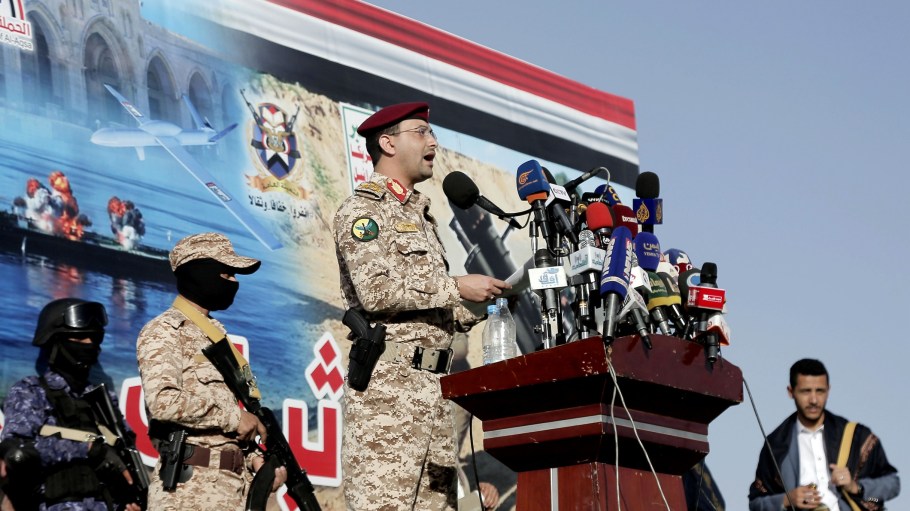
Yahya Sare’e, the military spokesperson of the Yemeni Armed Forces, said Tuesday night that the militant group’s “ban” on vessel passage through the waterway would take effect immediately. The Houthis had threatened last Friday that they had set a four-day deadline for Israel to end the blockade, or they would restart “naval operations.”
Related Stories
“Any Israeli ship attempting to violate this ban shall be targeted in the declared zone of operations,” which also includes the Bab el-Mandeb Strait, the Gulf of Aden and the Arabian Sea, Sare’e said in a statement.
The ban will remain in effect until the crossings to the Gaza Strip are reopened and aid, including food and medical supplies, is allowed to enter.
While no actual attacks have at this point been reported, United Kingdom Maritime Trade Operations (UKMTO) received reports of electronic interference from multiple vessels on Monday in the Strait of Hormuz, east of the Arabian Peninsula. The disruptions lasted several hours, affecting navigational systems and requiring vessels to use backup methods.
Such concerns come nearly two months after Israel and Hamas came to a ceasefire, in which the Houthis said they would cease military operations against vessels in the area.
In an email to various industry shipping organizations, fleet operators and news agencies, the Houthis’ Humanitarian Operations Coordination Center (HOCC) is targeting vessels “wholly owned by Israeli individuals or entities, and/or sailing the Israel flag.”
While the Houthis identified Israeli ships as the offenders, the Iran-backed group had a history of indiscriminately targeting vessels that were unaffiliated with Israel throughout 2024.
It is unclear what the Houthi approach will be as the second phase of the ceasefire kicks in and negotiations including Israel, Hamas and the U.S. continue in Qatar.
More than 130 Houthi attacks occurred throughout the region since November 2023, according to crisis mapping and data collection firm Armed Conflict Location and Event Data. But ahead of the ceasefire, the group curbed the attacks, with the U.S. Navy intercepting their last attempt in between Nov. 30 and Dec. 1.
None of the major ocean carriers have shown much interest in returning to the Red Sea with so much uncertainty involved, citing the security risks and the lack of guaranteed safety for a return.
Since late 2023, soon after the Houthi attacks started, container ships have mostly avoided travels through the Suez Canal, instead opting to travel around southern Africa’s Cape of Good Hope. This has lengthened container transit times by one-to-two weeks, in most instances.
According to data from Lloyd’s List Intelligence, transits through the Bab el-Mandeb Strait and Suez Canal declined 11 percent year over year in January and 21 percent in February. Container shipping represents a small portion of the returning vessels, accounting for 186 of the 1,309 voyages recorded since the Jan. 19 ceasefire.
Israel’s largest ocean carrier, ZIM, did not mention the Houthi statement in its Wednesday earnings call, but said its base scenario assumes the Red Sea will not open earlier than the second half of the year.
“As we speak, we are still thinking it is more likely than not that the Red Sea will reopen sometime this year,” said CEO Eli Glickman in the call. In assuming a significant decline in freight rates throughout 2025 due to the projected reopening, ZIM forecasts more of the profit to come in the first half of the year as rerouting still absorbs more shipping capacity.
Glickman said carriers have tools to manage short-term overcapacity as needed, including slow steaming, blank sailings or putting vessels on idle.
On that call, Glickman also deflected market reports that the company would be taken private on a management-led buyout.
“Our policy has been since we went public in 2021 to not comment on market rumors, so we are not going to start today,” Glickman said. “What I can say is that management clearly continues to be focused on executing the strategy that we laid out for ourselves already since quite some time, which aims at ensuring that we build resiliency within the company for the longer term.”