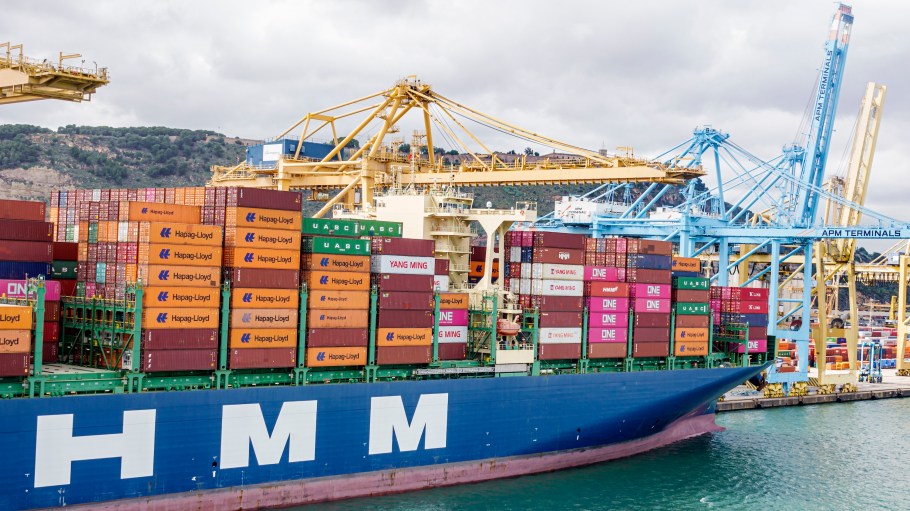
Hyundai Merchant Marine (HMM) has rolled out an early retirement program for employees aged 50 and older in another apparent cost restructuring measure from an ocean carrier.
South Korean publication Maeil Business Newspaper first broke the news Tuesday.
“This is a voluntary program for employees aged 50 and over, designed to create a virtuous cycle in the organization and improve management efficiency,” an HMM spokesperson said. The company is not implementing a fixed headcount target.
Related Stories
Applicants will receive at least 24 months of base salary as severance pay, depending on their years of service, along with support for re-employment or starting a business.
According to the Maeil report, HMM’s management team is reportedly considering implementing the early retirement program annually, rather than as a one-off restructuring measure.
HMM previously instilled a voluntary retirement program to generate worker attrition in December 2022, temporarily targeting corporate employees with at least 10 years of service. However, only around 30 people are said to have applied.
The container shipping company has been the subject of recent chatter regarding a possible sale. South Korean seafood distributor Dongwon Industries and steel manufacturer Posco Holdings have both publicly expressed interest in acquiring the ocean carrier, but both companies said in January no decision has been made.
According to the spokesperson, the new program has nothing to do with the possible sale, nor does it relate to the company’s plans to relocate its headquarters from Seoul to Busan.
The move comes as the container shipping industry at large is reeling from declines in freight rates over the past year, hampering the bottom lines of many carriers.
However, HMM denied that the state of the current container market was a reason for the decision.
Last Thursday, Maersk said it would cut 1,000 jobs as part of its own cost restructuring. That headcount reduction represented nearly 17 percent of its 6,000 corporate staff and will cut $180 million in expected annual costs at Maersk.
“As we head towards leaner times, a very hard focus on cost is absolutely paramount,” said Maersk CEO Vincent Clerc in Thursday’s earnings call. “We think that there is more than can be done there.”
Freight rates are expected to further decline in the coming weeks due to blank sailings ahead of China’s Lunar New Year next month, when factories throughout the country shutter for two weeks.
According to Drewry’s World Container Index (WCI) released Thursday morning, ocean spot freight rates decreased 7 percent from the week prior to $1,959 per 40-foot container. Those rates are currently flat with those in early November and December.
As global liners like HMM and Maersk undergoing their own restructuring, India’s first national ocean carrier is beginning to take shape.
On Tuesday, six state-owned Indian companies signed a memorandum of understanding to form a consortium to establish the Bharat Container Shipping Line (BCSL).
The shareholders comprise of Container Corporation of India (CONCOR, 30 percent), Shipping Corporation of India (SCI, 30 percent), Sagarmala Finance Corporation Ltd. (SMFCL, 20 percent), Jawaharlal Nehru Port Authority (10 percent), V.O. Chidambaranar Port Authority (5 percent) and Chennai Port Authority (5 percent).
Tentative plans call for acquiring 51 vessels in the initial phase and scaling the wider fleet to more than 400 ships.
In total, the six companies will invest a combined 59,000 crore rupees ($6.5 billion) in the project to expand the fleet and domestic container manufacturing.
The formation of Bharat is part of India’s larger ambitions to become a maritime powerhouse, with Prime Minister Narendra Modi’s government committing a $1 trillion investment into the country’s ports and shipbuilding efforts. The investment is timed with India’s ambitions to become a developed economy by 2047.
Aside from the Bharat launch, a second memorandum was signed to finance an outer harbor project at the V. O. Chidambaranar Port. That agreement will provide joint funding of up to 15,000 crore rupees (roughly $1.65 billion) to expand the port’s capacity.
“The Bharat Container Shipping Line…will anchor India’s container trade in Indian hands, while the Outer Harbour financing strengthens our port backbone,” said India’s ports and shipping minister Sarbananda Sonowal in a statement. “It will likely play a multiplier role to enhance our strategic and commercial presence in global maritime trade.”