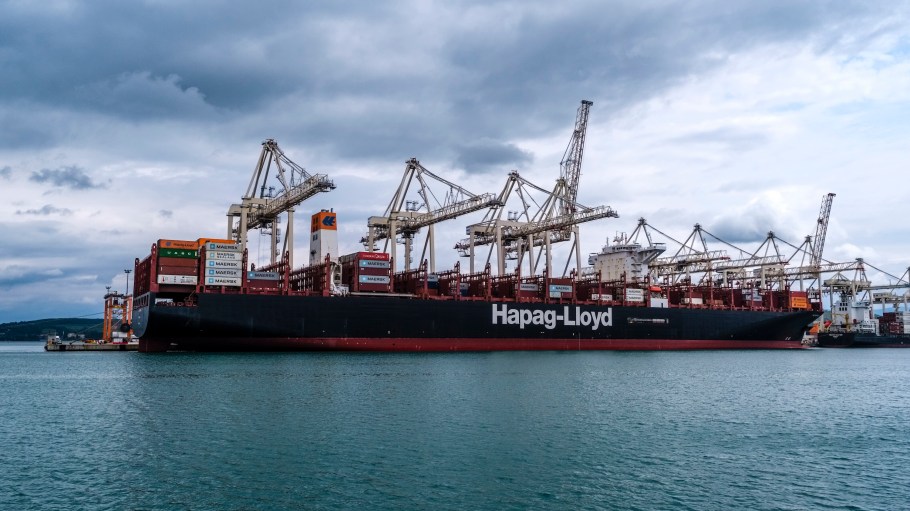
Hapag-Lloyd is returning to the Red Sea for the first time since abandoning the trade artery in December 2023, bringing back a service line through the Suez Canal route in conjunction with Gemini Cooperation partner Maersk.
The joint service is labeled as IMX for Hapag-Lloyd and ME11 for Maersk, opening the Gemini vessel-sharing alliance to its first Red Sea sailing since the ocean carriers partnered up in February 2025. The service connects India and the Middle East with several ports on the Mediterranean Sea, including Valencia in Spain, Tanger Med in Morocco and Said in Egypt.
Related Stories
The changes will take place starting mid-February, the companies said. Service changes will be implemented on westbound sailings starting with the Albert Maersk ship and on eastbound sailings beginning with the Astrid Maersk vessel. Both dual-fuel vessels carry roughly 16,500 20-foot equivalent units (TEUs).
As part of the initial Red Sea sailing, Albert Maersk will depart Mundra Port in India on Wednesday after arriving from the U.A.E.’s Port of Jebel Ali. On Feb. 12, the ship is expected to depart from the Port of Salalah in Oman, which is the last port before the Suez Canal. From there, westbound sailings will go at a weekly pace, with the Maersk Hanoi, Alexandra Maersk and Maersk Houston departing from Salalah in consecutive weeks.
Albert Maersk’s voyage from Salalah to Port Said will be a 19-day improvement from the Cape of Good Hope route, the carrier said.
For its eastbound voyage, the Astrid Maersk will depart Valencia on Tuesday, before making a stop at Tanger Med. The vessel will depart the Moroccan port on Friday. Two more eastbound sailings will take place from the gateway on Feb. 20 and Feb. 27.
All the vessels listed for future sailings are Maersk vessels.
According to Hapag-Lloyd, the implementation will be carried out “in a way that keeps disruption for customers to a minimum,” upholding the Gemini Cooperation’s focus on schedule reliability. In November and December, the Gemini Cooperation recorded 92.3 percent schedule reliability across all arrivals, according to data from Sea-Intelligence. The alliance outperformed the rest of the industry in reliability, with Mediterranean Shipping Company (MSC) coming closest at a 73.5 percent reliability rate.
In a note to customers Tuesday, J.P. Morgan called the announcement “another important milestone” for the container shipping industry. The bank said the move “demonstrates the willingness of container shipping lines to improve flows and increase sailings via the Suez Canal.”
The alliance will secure naval assistance to defend vessels against potential attacks. CMA CGM had procured the French Navy to escort its vessels through the Red Sea and Bab-el-Mandeb Strait when it sparingly made journeys in the waterway throughout the Red Sea crisis.
Ocean carriers began diverting their vessels around southern Africa at the start of the crisis, when Houthi militants based out of Yemen started launching missile and drone attacks on commercial vessels. The terrorist organization had started the onslaught in solidarity with Palestinians during the Israel-Hamas war in Gaza, and suspended the strikes after a ceasefire took place.
“Unless the situation with the Houthis suddenly deteriorates, this is highly likely to signal the beginning of a gradual return for all carriers over the coming months,” said Lars Jensen, CEO of container shipping consultancy Vespucci Maritime in a LinkedIn update Tuesday morning.
When possible, Hapag-Lloyd and Maersk will also implement changes to the shared SE1/AE12 and SE3/AE15 services to go through the Red Sea and the Suez Canal at a later stage. Those loops connect several ports on the Mediterranean Sea with major ports in China and Southeast Asia.
“Maersk and Hapag-Lloyd will continue to monitor the security situation in the Middle East region very closely, and any alteration to the Gemini service will remain dependent on the ongoing stability in the Red Sea area and the absence of any escalation in conflicts in the region,” both alliance partners said in separate press releases.
Contingency plans are in place should the security situation deteriorate, which may necessitate reverting individual sailings or the wider structural change of the service back to the Cape of Good Hope route, Maersk said.
The Danish container shipping giant indicated that it does not currently foresee any further Red Sea-related changes to the Gemini network.
Ocean carriers are navigating uncertainty as they attempt to return select services to the Red Sea. Maersk made its first structural return to the Red Sea in January by rerouting its standalone MECL service, which links the Middle East and India with the US East Coast via the Suez Canal. That resumption followed a trial run in December.