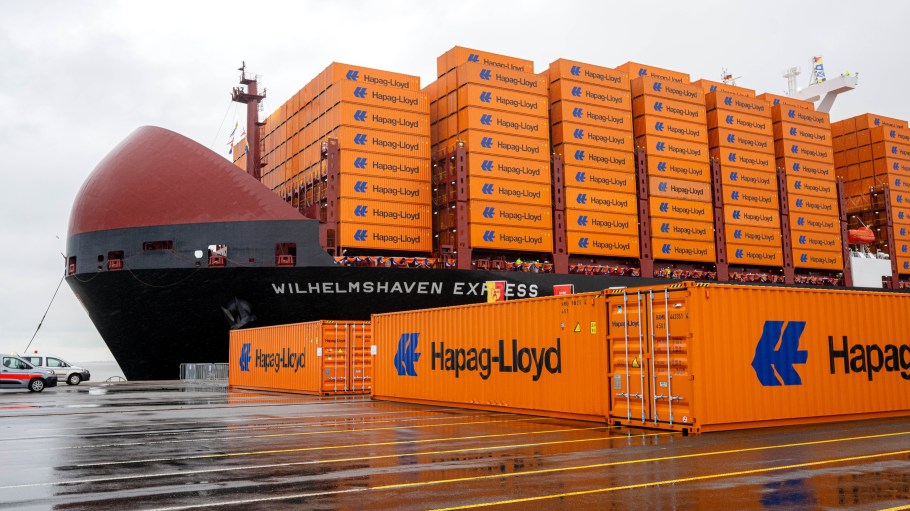
Hapag-Lloyd CEO Rolf Habben Jansen said container demand in 2025 is shaping up to be stronger than anticipated, reversing earlier warnings of a slowdown in the second half and signaling that global trade remains resilient despite U.S. tariffs.
The container shipping giant expects 4 percent growth in the container market this year, mirroring the projections of its Gemini Cooperation partner Maersk.
Although Habben Jansen said the effects of front-loading freight into the U.S. improved the company’s revenue and earnings on a sequential basis, he doesn’t anticipate the trend to continue now that the holiday season is near.
Related Stories
“Listening to and speaking to customers, I do not think that there are many of them that sit on very excessive inventory. What will be critical is what consumer demand will be towards the end of the year’s [peak shopping season],” Habben Jansen said. “That will probably drive what’s going to happen post-Christmas. I don’t see a huge amount of front-loading.”
Like Maersk, Hapag-Lloyd saw a strong jump in volumes in its third quarter, with total 20-foot equivalent units (TEUs) increasing 6.2 percent to 3.4 million. The biggest increase came on the trans-Pacific trade lane, where containers moved escalated 19.2 percent to roughly 1 million TEUs.
The increase in transport volume in the Pacific and Asia-to-Europe routes—which saw 0.9 percent growth—is primarily attributable to increased capacity. As of Oct. 30, Hapag-Lloyd had 305 owned and chartered vessels, up from 292 a year prior.
Container capacity is up 10.9 percent from the same period to nearly 3.8 million TEUs.
As the volumes go up, so have Hapag Lloyd’s transport costs, which increased 5.8 percent to $1,193 per TEU due to higher container storage costs, inland transport expenses, and anticipated Gemini startup costs.
Habben Jansen said the Gemini costs are more pronounced for Hapag-Lloyd than Maersk.
“For us, the new network represents a more significant transformation, which is temporarily associated with higher unit costs,” said Habben Jansen. “We have not only redesigned the network, but also changed the terminals we call at and the capacity we operate.”
Hapag-Lloyd seeks to slash $1.3 billion by 2027 as the firm phases into its vessel-sharing alliance with Maersk. According to Habben Jansen, the first cost savings from the Gemini Cooperation are starting to come in.
The CEO said the recent cost benefits have come via reduced ship system costs and lower bunker consumption.
Efficiency gains via the overlapping Hapag-Lloyd-Maersk ocean freight network are expected to save the former as much as $350 million to $400 million through 2026.
Overall, Hapag-Lloyd is targeting over half of the $1.3 billion in costs by 2026, with full realization expected by 2027.
Revenue for the liner declined 5.3 percent to $5.5 billion in the quarter, while net income declined 84 percent to $172 million amid $421 million more in total transport and terminal expenses. The dip in earnings also correlates with the significantly weaker overall freight rate environment, in which average freight rates at Hapag-Lloyd dropped 13 percent to $1,391 per TEU.
The container shipping company narrowed its full-year outlook for 2025, increasing the midpoint but lowering the top end.
Now, group pre-tax operating profit is expected to come in at $3.1 billion to $3.6 billion, compared to the previous $2.8 billion to $3.8 billion forecast.
Hapag-Lloyd is in close talks with Maersk and other partners over whether the carrier will return to the Red Sea after the Houthis indicated that they stop attacking commercial vessels in the region.
“At the moment, I do not see us returning very soon,” Habben Jansen said.
When asked about the growth of Hapag-Lloyd’s terminals business, which saw revenue increase 19.1 percent to $131 million, Habben Jansen said the improvements don’t necessarily shift how the company thinks about the mix of its business units.
“We will continue to grow that business,” Habben Jansen said. “I think if you take into account that we effectively only started somewhere in the beginning of this decade, and today we are engaged in 22 terminals, I think that’s actually a pretty good result.”
Habben Jansen also said the company has no plans to go into logistics services like contract logistics, customs or cold chain logistics, contrary to some of its ocean carrier contemporaries.