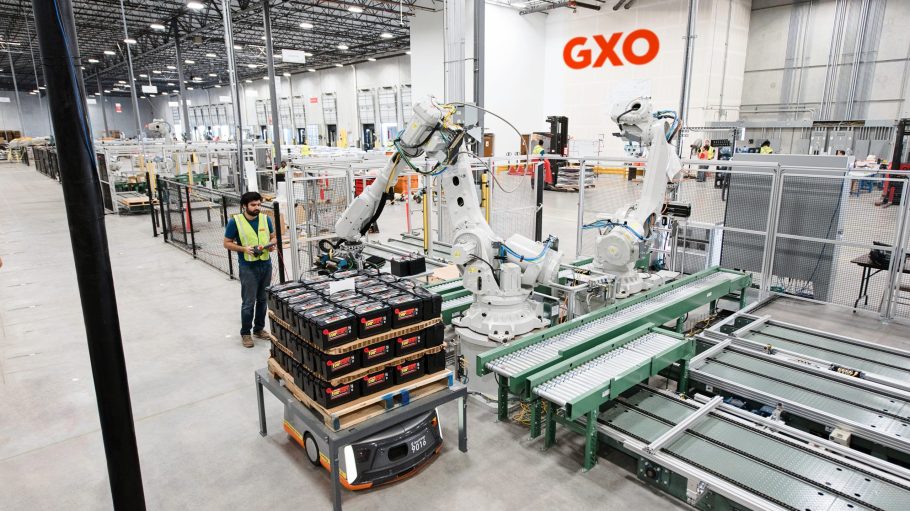
GXO’s stock cratered 15 percent in trading Thursday after the company issued a lower-than-expected guidance for 2025 as some customers scaled back their warehouse capacity with the logistics provider.
This capacity realignment, which was largely driven by three of its large customers, is expected to predominantly impact the contract logistics provider’s profit in the first quarter. According to chief financial officer Baris Oran, GXO “completely offset” any revenue impacts by onboarding new customers.
Related Stories
“These are one-off in nature,” said Oran during the company’s earnings call. “The network realignment is a short-term impact. They are not lost customers.”
One customer exited an older warehouse, and will enter four new sites throughout 2025, he said. Another warehouse that was freed up after a second customer left the facility will be refilled this year with a new customer. A third customer exited a site because of lower consumer volumes.
For 2025, organic revenue growth is expected to range between 3 percent and 6 percent, while adjusted EBITDA is projected within the $840 million to $860 million range.
In the fourth quarter, GXO saw revenue jump 25 percent year over year to $3.3 billion, with organic revenue jumping 4 percent. Most of the company’s annual sales growth comes from last year’s acquisition of U.K.-based logistics services provider Wincanton.
Net income increased to $100 million, compared with $73 million for the fourth quarter of 2023. Diluted earnings per share increased to 83 cents, up from last year’s 61 cents.
CEO Malcolm Wilson, who is retiring in 2025, said it was too early to gauge the impact of tariffs on GXO’s U.S. operation, but since it is a domestic business, “we don’t think there’s a likelihood of any material impacts feeding through in that regard.”
However, the outgoing CEO also said GXO’s sales team has generated inquiries from U.S. customers that want to bring more domestic business back as they seek to reorient supply chains in account of the tariffs.
And far as the back-and-forth fate of the de minimis exception goes, Wilson said “it doesn’t affect us right now. We don’t really work with customers that utilize that, but that will probably drive more customers to put local warehousing into the market…We’re pretty confident that a lot of those customers will ultimately need to convert existing supply chains to have a presence here instead of what they are doing today.”
By next week, the company expects to have an interim update on the regulatory review of the Wincanton deal. GXO acquired the British firm for $965 million in April.
Wilson said Wincanton contributed “very well” to fourth quarter results.
Omnichannel retail saw the strongest growth among GXO’s existing verticals, with the Levi’s, Nike and H&M partner generating a revenue increase of 41 percent to $1.54 billion.
The company closed more than $1 billion in new business in 2024, $366 million of which came in during the fourth quarter. The company also struck a $2.5 billion contract to operate fulfillment for an unnamed healthcare company.
Of GXO’s new contracts signed in 2024, 46 percent are sites won from competing third-party logistics providers (3PLs), while 25 percent are for facilities previously operated by customers in house. Another 29 percent represents new facilities.
In the call, Wilson highlighted the October 2022 $1.3 billion acquisition of U.K.-based Clipper Logistics as a chief catalyst for GXO’s growth in Germany, which is now the company’s fastest-growing market at 60 percent.
Chief strategy officer Christine Kubecki also shared an update on AI and technology advancements at the Greenwich, Conn.-based logistics firm.
“We began piloting our first proprietary AI applications in select warehouses across the U.S. last year,” Kubecki said. “We’ve now launched 22 instances of our proprietary AI apps across three key warehouse functions: proactive replenishment, SKU dimensioning and order routing. Our tools have delivered…productivity improvements of three to four times in stock replenishments for a major sporting goods retailer, a 50 percent improvement in order allocation plus a 22 percent improvement in carton fill rate, which drove efficiency and decreased transportation costs for an omnichannel retailer.”