As China’s “Golden Week” approaches, ocean carriers are becoming increasingly reliant on blank sailings to adapt to an already soft peak shipping season.
Container shipping lines have withdrawn an additional 544,000 20-foot equivalent units (TEUs) of cargo from the trans-Pacific and Asia-to-Northern Europe trade lanes over the past four weeks, according to data from Sea-Intelligence.
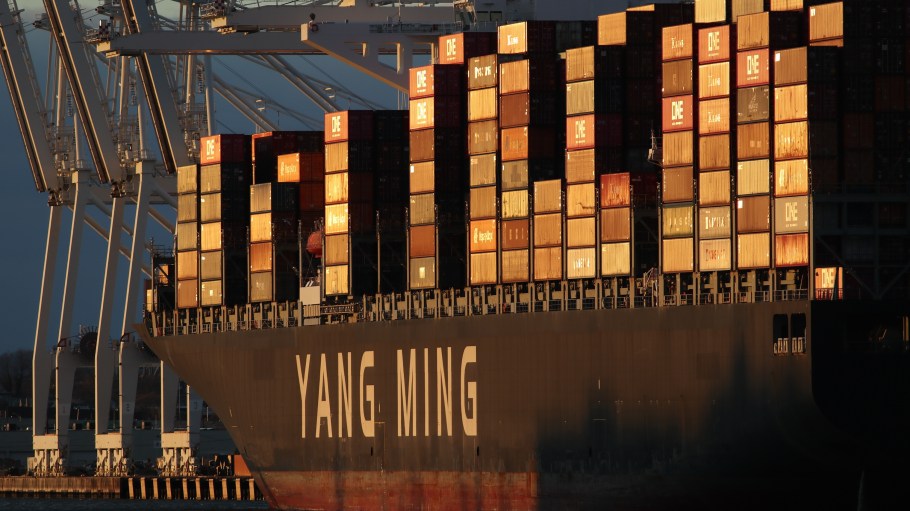
On the Asia-to-Northern Europe route, the Premier Alliance of Ocean Network Express (ONE), Hyundai Merchant Marine (HMM) and Yang Ming have been the first movers in cutting out sailings.
Related Stories
During week 32 of 2025, or Aug. 4-10, the Premier Alliance cut 12.5 percent of its sailings on the trade lane, ahead of the Ocean Alliance’s 2.8 percent. Both the Gemini Cooperation of Maersk and Hapag-Lloyd, as well as Mediterranean Shipping Company (MSC), had not blanked any sailings yet.
The Premier Alliance continued to lead the way in blank sailings over the next three weeks, cutting out 31.8 percent of services by week 35 (Aug. 25-31). By then, the Ocean Alliance of CMA CGM, Cosco Shipping, OOCL and Evergreen had still only blanked 7 percent, while Gemini and MSC had still not committed to any capacity withdrawals.

“While Gemini used a ‘one-and-done’ approach i.e., reached current levels of capacity reduction with the initial wave of blank sailings, MSC’s subsequent acceleration in week 36 was the most aggressive of any alliance in the final weeks,” said Alan Murphy, CEO of Sea-Intelligence.
From weeks 36 through 38, MSC has since respectively withdrawn 17.3 percent, 23.3 percent and 24.6 percent of its capacity on the Asia-to-Europe route, Sea-Intelligence indicated.
Yang Ming “pessimistic” amid blank sailings expected through March
As for the trans-Pacific route, the Premier Alliance expects to reduce 20 percent of its overall capacity until March at least, according to Yang Ming president Cliff Pai.
Notably, the Premier Alliance already suspended its express China-to-U.S. West Coast Pacific South Loop 5 (PS5) service just four months after debuting the offering. The companies have revised four other service lines to add several ports initially included in the PS5 route.
The vessel-sharing alliance said the suspension is temporary “until further notice.”
During a third quarter investor conference held Thursday, Pai noted that the August-to-October peak shipping season started and ended early, echoing the narrative that many U.S. importers had front-loaded goods to get out in front of the tariff negotiation deadlines set by the Trump administration in early August.
“The fourth quarter is traditionally off-peak season for trans-Pacific and European trade,” Yang Ming wrote in its presentation. “With the U.S.-China tariff issue still unresolved, market sentiment remains cautious, and demand is expected to remain weak.”
At the event, Pai said the upcoming holiday quarter is “under great pressure” and that Yang Ming is “pessimistic.”
“Shipment momentum is expected to be weak,” said Pai.
Yang Ming, like its ocean carrier contemporaries, has felt the heat of the softer cargo numbers and declining freight rates since the tariffs first went into effect in April.
In the second quarter, Yang Ming saw consolidated revenues decline 26.5 percent to $38.7 billion New Taiwan dollars ($1.21 billion) on net income after tax of $1 billion New Taiwan dollars ($30.9 million). After-tax profit the year prior was $14 billion New Taiwan dollars ($458 million).
MSC says no to Arctic sailings
MSC also unveiled Monday that it was avoiding any sailings through the Northern Sea Route, which connects the Asia Pacific to Europe via the Arctic Ocean.
“An increase in Arctic transit traffic may also impact the fragile ecosystem of the region and the ice caps,” the world’s largest ocean carrier said in a customer advisory. “More ships transiting the Northern Sea Route could also affect remote Arctic communities by congesting existing shipping lanes and slowing down necessary traffic, which is an essential lifeline for their survival and prosperity.”
MSC indicated that there is no operational reason for its fleet of more than 900 vessels and standalone network to transit the Arctic, noting that it has the capacity and means to safely and reliably transport customer cargo globally without using the Northern Sea Route.
Freight rate collapse continues
All the carriers’ operational shifts come as freight rates keep descending. As of Thursday, Drewry’s World Container Index (WCI) plummeted another 8 percent to $1,761 per 40-foot container, marking the 15th straight week of container price declines.
Unlike the summer months, trans-Pacific and Asia-to-Europe spot rates both saw substantial, consistent declines.
Spot rates from Shanghai to Los Angeles decreased 10 percent to $2,311 per 40-foot container, while those from Shanghai to New York dipped 8 percent to $3,278 on average. And for containers destined for Europe, rates declined 9 percent to $1,735 per 40-foot box on the Shanghai-to-Rotterdam route and fell 7 percent to $1,990 for cargo traveling from Shanghai to Genoa.