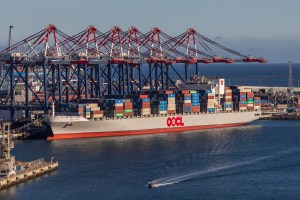
The Federal Maritime Commission (FMC) has hit Mediterranean Shipping Company (MSC) with a $22.7 million fine over three violations of the U.S. Shipping Act.
The enforcement action centers on three main issues: who MSC billed for late fees, how it handled the disclosure of rates for certain containers and repeated overcharges tied to those containers.
After concluding a two-year investigation that started in August 2023, the commission upheld and expanded on a prior ruling by an administrative law judge.
Related Stories
Sourcing Journal reached out to MSC.
First, the FMC flagged MSC for wrongly invoicing certain customs brokers and forwarders listed for demurrage and detention (D&D) fees from 2018 to 2020.
According to the FMC’s 15-page order of investigation, the world’s largest container shipping company used a broad “merchant clause” in its bill of lading to levy the fines. The clause defined a “merchant” to include not just the shipper and consignee, but also other parties listed on the document, including the “notify party.”
These notify parties included freight forwarders Alexander & Co. and John S. Connor, as well as customs clearance services provider Welke Customs Brokers USA, all of which were asked to pay D&D fees.
However, the agency found that those companies had no beneficial cargo interest and often had no role in physically moving the containers.
The commission determined that this practice violated the Shipping Act’s requirement that carriers maintain “just and reasonable” practices related to cargo handling.
Demurrage and detention are meant to act as financial incentives to move containers and “promote freight fluidity,” the 65-page decision read. Billing parties that have no control over container pickup or return, the FMC concluded, does not serve that purpose.
The agency upheld findings of 13 violations tied to this billing approach, assessed $65,000 in penalties and issued a cease-and-desist order barring MSC from charging such fees to parties that are not shippers, consignees or cargo owners.
Another portion of the penalties stems from MSC’s failure to clearly state the applicable rates or rules for non-operating reefers (NORs) when publishing its tariffs. In this case, “tariffs” refer to documents the FMC requires ocean carriers to publish that list rates, rules and extra charges for shippers.
Under the Shipping Act, carriers must publish tariffs that clearly show all rates, charges and related rules for public inspection.
The FMC found that from the start of 2021 until March 2023, MSC failed to properly publish separate rates for NORs, which are refrigerated containers used like standard dry boxes, with the refrigeration unit turned off.
During that period, the tariff only listed demurrage and detention rates for reefers and dry containers, but not NORs.
The commission determined MSC was “knowingly and willfully” noncompliant during at least part of this period, particularly after the shipping giant indicated it would update the tariff but did not promptly do so. That action resulted in a $9.5 million penalty.
The largest portion of these penalties, amounting to $13.1 million, stemmed from the carrier’s overcharging of billed NOR shipments.
In 2021, MSC imported more than 20,000 NOR containers into the U.S. and charged demurrage or detention on over 11,000 of them. On 2,629 occasions, NORs were billed at the higher operating reefer rate rather than at dry-container rates.
Customers disputed at least 925 of those charges, leading to more than $1.2 million in refunds, while many other overcharges initially went undisputed. MSC attributed the issue to an internal billing system error that was later corrected.
Even if unintentional, the FMC found the repeated overbilling was frequent enough to constitute an unreasonable practice under the Shipping Act. The agency did not find this conduct to be knowing and willful, but still imposed $5,000 per violation.
The Commission’s Bureau of Enforcement, Investigations and Compliance (BEIC), through its Offices of Investigation and Enforcement, investigated and prosecuted the matter.
The penalty comes as the agency has taken on more of an expanded role since 2022, when Congress passed the Ocean Shipping Reform Act (OSRA22).
That legislation gave the agency more oversight over ocean carrier practices and allowed it to carry out enforcement actions. The act was aimed at ensuring U.S. shippers were not unfairly bypassed for service by carriers, promoting competition in the ocean shipping market and lowering shipping costs.
Retailers and brands had filed a batch of complaints alleging ocean carriers of conducting unfair business practices during the Covid-19 pandemic, which was a period of record profits for the container shipping industry.
The FMC levied the penalty a day ahead of President Donald Trump’s selection of a new head of the government agency.
Laura DiBella, who once served as the commerce secretary of Florida, was appointed to chair the FMC on Thursday.
Chairman DiBella was sworn in as an FMC commissioner on Jan. 6 to fill the remaining spot term of Louis Sola, a two-term commissioner who left the agency in June.
DiBella was nominated for the commissioner position by President Trump in September before her Senate confirmation three months later. Her term will last until June 30, 2028.
“I look forward to leading the incredible and hardworking FMC team in its integral function in carrying out President Trump’s mandate of ‘Restoring America’s Maritime Dominance’,” DiBella said in a statement.
Another Trump nominee, Robert Harvey, awaits his confirmation to fill the remaining vacant seet in the bipartisan, five-member commission.